What This Document Is
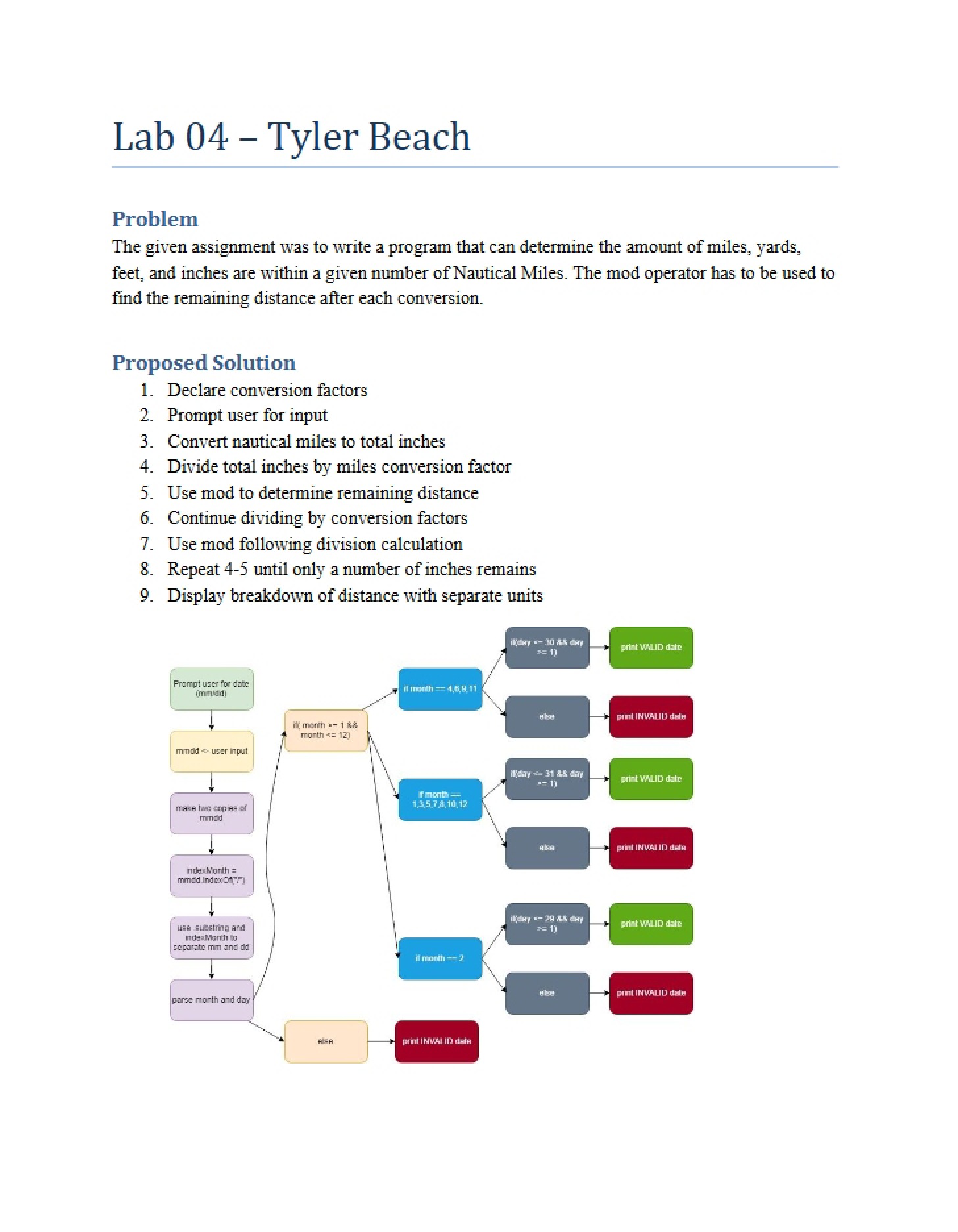
This document represents a completed lab assignment for CSCE 145: Algorithmic Design I at the University of South Carolina, specifically Lab 04 by student Tyler Beach. It details a programming task focused on unit conversions – taking a measurement in nautical miles and breaking it down into its constituent parts of miles, yards, feet, and inches. The assignment centers around applying the modulo operator (%) within a program to accurately calculate remainders after each conversion step. It showcases a student’s approach to problem-solving and implementation within the course’s algorithmic framework.
Why This Document Matters
This assignment is valuable for students currently enrolled in CSCE 145 or similar introductory programming courses. It serves as a practical example of how to translate a real-world problem (unit conversion) into a computational solution. Reviewing a completed assignment can help you understand expectations for lab work, observe a potential approach to utilizing the modulo operator, and identify common elements of a well-documented program. It’s particularly useful when you’re working on similar conversion problems or need to reinforce your understanding of operator application and code structure.
Common Limitations or Challenges
Please note that this document presents *one* student’s solution to the assigned problem. It does not provide a comprehensive set of alternative approaches, nor does it offer detailed explanations of fundamental programming concepts. It assumes a baseline understanding of Java syntax and basic algorithmic principles. This assignment focuses on the application of a specific operator; it won’t cover broader programming topics or advanced algorithmic techniques. Accessing the full assignment will reveal the specific implementation details, but this preview is designed to help you determine if it aligns with your learning needs.
What This Document Provides
* A description of the original programming problem.
* An overview of the proposed solution strategy.
* A record of the code used to address the problem (available with purchase).
* A section detailing tests performed and the results obtained.
* A student’s reflection on challenges encountered and lessons learned.
* Additional review questions related to the concepts explored in the assignment.