What This Document Is
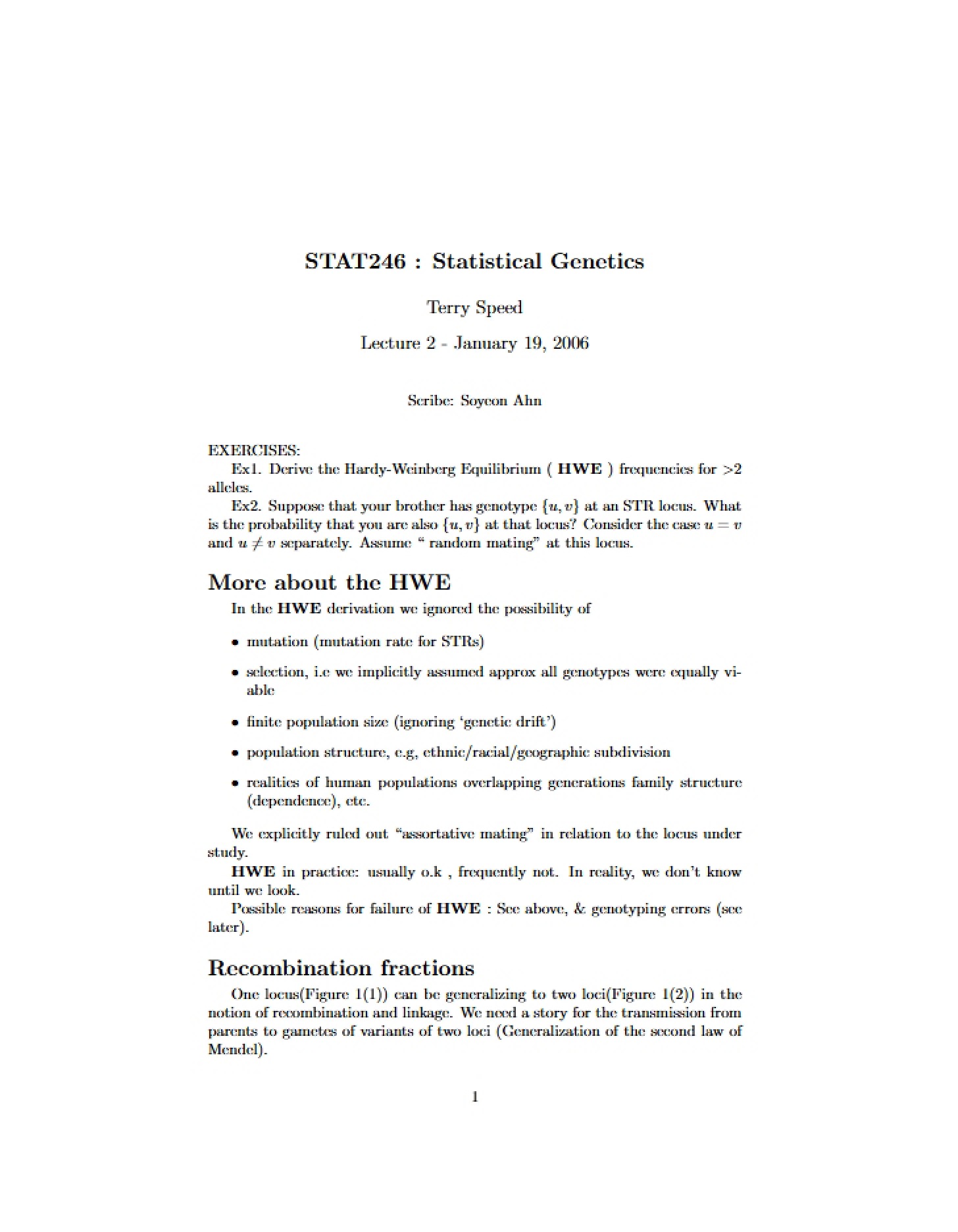
This document presents lecture materials from Statistics 246, a Statistical Genetics course at the University of California, Berkeley. It focuses on a specific approach to identifying genetic contributions to complex diseases, utilizing a novel statistical method for analyzing haplotype sharing. The material details the development and application of this method, contrasting it with existing techniques in the field. It appears to be a detailed exploration of a research-level topic, likely presented during an advanced undergraduate or graduate-level course.
Why This Document Matters
Students and researchers in statistical genetics, bioinformatics, and related fields will find this resource valuable. It’s particularly relevant for those interested in genome-wide association studies, the genetic basis of disease, and the development of new statistical methodologies. Individuals seeking a deeper understanding of haplotype-based analyses and the challenges of detecting genetic signals in complex datasets will benefit from exploring the concepts presented. This material would be most useful when studying population genetics, disease mapping, or advanced statistical modeling.
Topics Covered
* Haplotype sharing statistics
* Nonparametric methods in genetic analysis
* Genome-wide association study (GWAS) strategies
* Permutation testing for statistical significance
* Computational considerations in genetic analysis
* Allelic heterogeneity and ancestral haplotype clusters
* Comparison of different statistical approaches for disease mapping
What This Document Provides
* A detailed explanation of a specific statistical method for assessing haplotype sharing.
* A discussion of the advantages and disadvantages of this method compared to existing likelihood-based approaches.
* An exploration of the computational challenges associated with genome-wide scans.
* Considerations for determining appropriate sample sizes for permutation testing.
* A framework for evaluating the significance of observed genetic associations.
* Conceptual foundations for understanding the role of ancestral haplotypes in disease susceptibility.