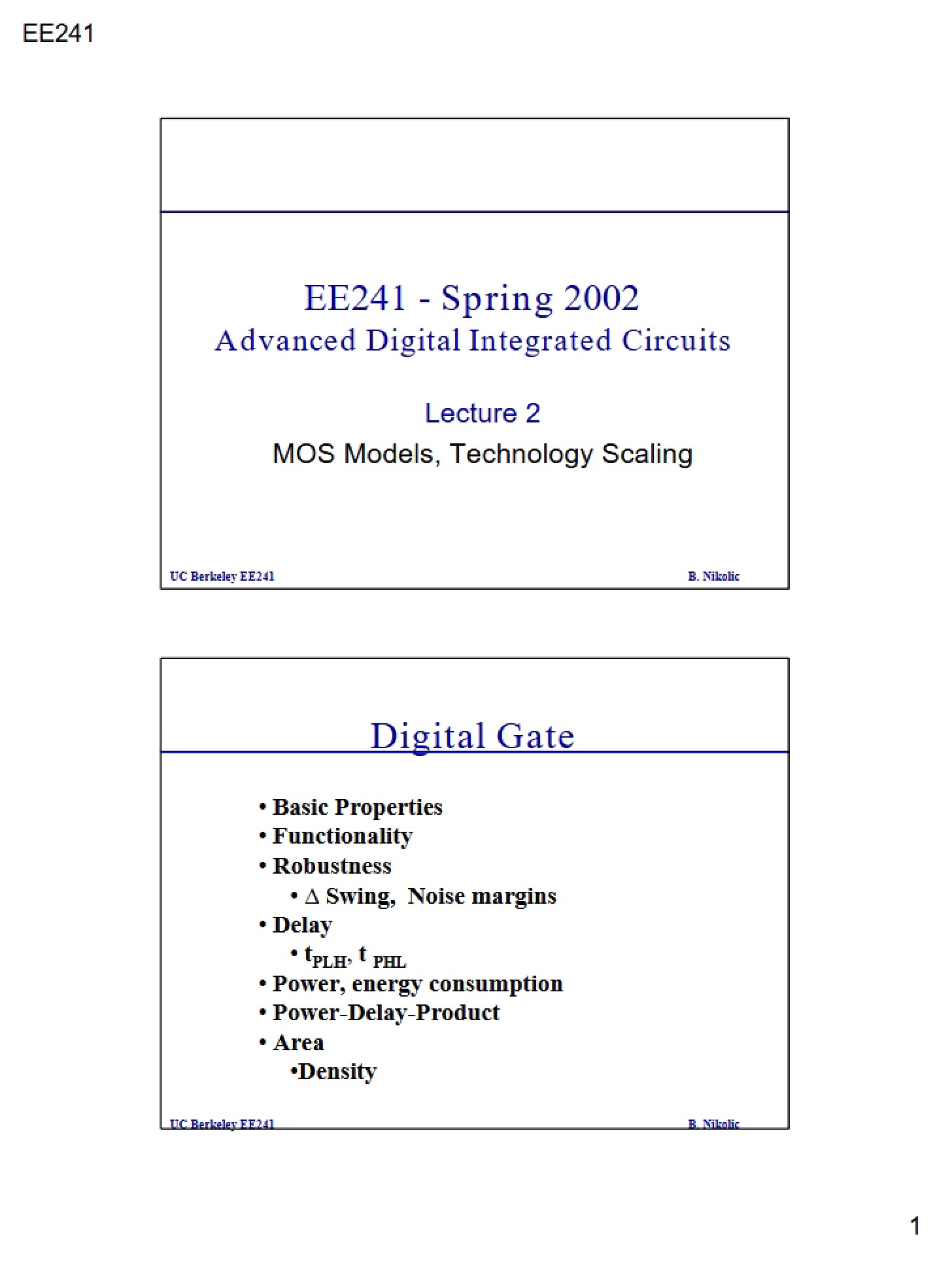
What This Document Is
This document represents Lecture 3 from UC Berkeley’s Advanced Digital Integrated Circuits (ELENG 241B) course, focusing on the critical concepts of technology scaling and MOS transistor models. It delves into the fundamental relationships between device characteristics and the ongoing miniaturization of integrated circuits. This lecture provides a foundational understanding of how scaling impacts performance, power consumption, and reliability in modern digital systems.
Why This Document Matters
This material is essential for advanced undergraduate and graduate students in electrical engineering and computer science specializing in VLSI design, digital systems, or integrated circuit fabrication. It’s particularly valuable when studying CMOS logic, circuit analysis, and the challenges associated with pushing the limits of semiconductor technology. Professionals involved in IC design, process development, or reliability engineering will also find this a useful resource for refreshing core principles. Accessing the full lecture content will provide a deeper understanding needed for successful coursework and professional application.
Topics Covered
* Fundamental properties of CMOS gates and their performance characteristics.
* The behavior of MOS transistors as switches and related circuit analysis techniques.
* Detailed examination of MOS transistor capacitances and their impact on circuit behavior.
* Power dissipation mechanisms in integrated circuits and the power-delay trade-off.
* Various technology scaling models, including constant field scaling and fixed voltage scaling.
* The effects of short-channel phenomena on device characteristics.
* Relationships between scaling and key performance metrics like current, delay, and power.
* Threshold voltage considerations and their impact on sub-threshold conduction.
What This Document Provides
* A comprehensive overview of the factors influencing circuit delay, including resistance and capacitance.
* Graphical representations and illustrations to aid in visualizing complex concepts.
* Discussions on the trade-offs involved in scaling, including reliability and cost considerations.
* Relationships and equations relating to propagation delay and power dissipation.
* Comparative analysis of different scaling scenarios and their implications for circuit design.
* Insights into the challenges and emerging trends in technology scaling.