What This Document Is
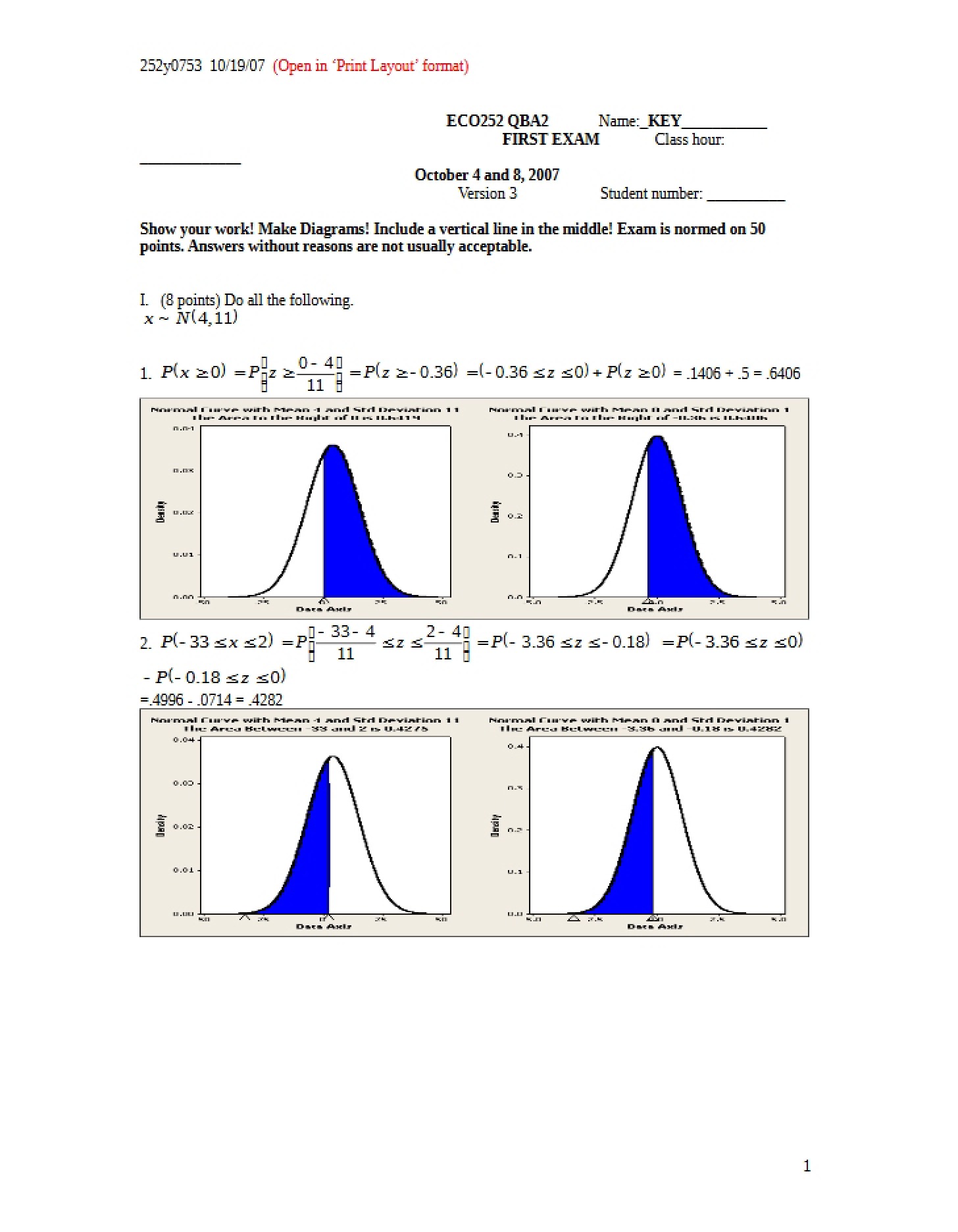
This is an hourly exam for ECO 252: Quantitative Business Analysis II, administered at West Chester University of Pennsylvania. It assesses students’ understanding of core concepts covered in the course, focusing on statistical applications within a business context. The exam emphasizes both computational skills and the ability to interpret results, likely requiring students to demonstrate proficiency in applying quantitative methods to real-world business scenarios. It appears to cover topics related to probability distributions and statistical inference.
Why This Document Matters
This exam is invaluable for students currently enrolled in ECO 252 at West Chester University. It serves as a critical self-assessment tool to gauge preparedness for graded assessments. Working through practice problems similar in style and difficulty to this exam can significantly improve understanding of key concepts and enhance problem-solving abilities. It’s particularly useful for students seeking to identify areas where they need further review or clarification before a formal exam setting. Students preparing for similar quantitative business analysis courses at other institutions may also find the structure and topic coverage helpful as a benchmark.
Common Limitations or Challenges
This document represents a single assessment point in time and does not encompass the entirety of the ECO 252 course material. It will not provide detailed explanations of concepts, step-by-step solutions, or comprehensive lecture notes. It is designed to *test* knowledge, not to *teach* it. Furthermore, the specific focus and weighting of topics may vary in subsequent exams. Accessing this exam does not guarantee success on future assessments, but rather provides a valuable practice opportunity.
What This Document Provides
* A series of problems relating to probability and statistical distributions.
* Questions involving calculations of probabilities based on normally distributed data.
* Application of statistical concepts to a business scenario involving debt-to-equity ratios.
* Practice with constructing confidence intervals.
* Opportunities to apply hypothesis testing procedures.
* Problems requiring the interpretation of statistical results in a business context.