What This Document Is
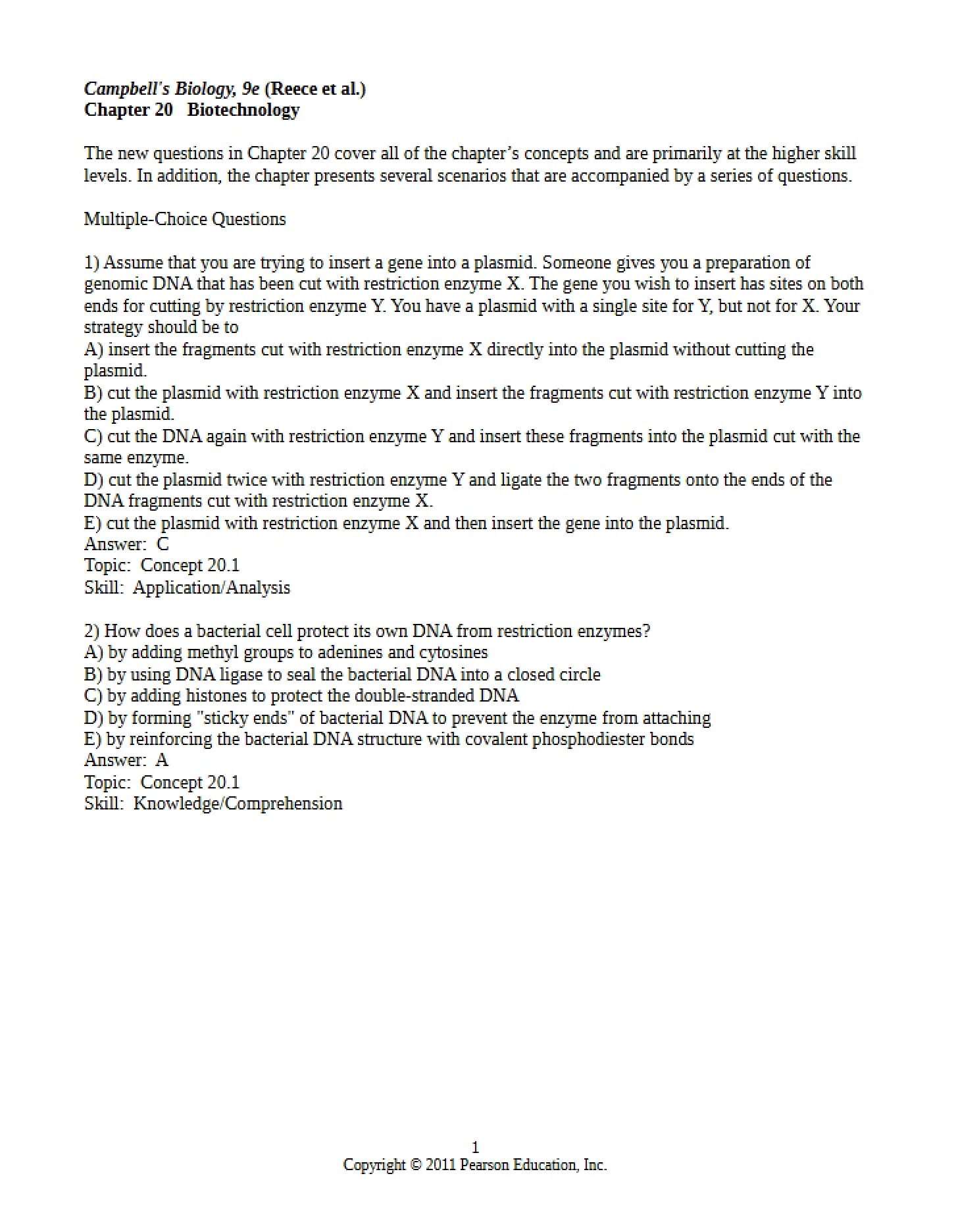
This document is a comprehensive test bank designed to assess your understanding of Chapter 5 from Campbell’s Biology, 9th Edition, focusing on the structure and function of large biological molecules. It’s built around the core concepts presented in the textbook chapter and is formatted as a series of multiple-choice questions. The material covered builds upon foundational chemistry principles to explore the world of biological polymers and lipid membranes.
Why This Document Matters
This test bank is an invaluable resource for students enrolled in an introductory biology course, like BIOL 101 at the University of South Carolina. It’s perfect for self-assessment, allowing you to identify areas where your comprehension needs strengthening *before* high-stakes exams. Use it to practice recalling key definitions, applying concepts to new scenarios, and analyzing the relationships between molecular structure and biological function. It’s particularly helpful when preparing for quizzes and exams that emphasize foundational biological principles.
Common Limitations or Challenges
This test bank is designed to *test* your knowledge, not to *teach* it. It assumes you have already engaged with the corresponding chapter in the textbook and lectures. It does not include detailed explanations of the correct answers, nor does it offer comprehensive re-teaching of the material. It focuses specifically on the content within Chapter 5 and doesn’t cover broader biological concepts outside of its scope.
What This Document Provides
* A large number of multiple-choice questions covering the key concepts of Chapter 5.
* Questions categorized by relevant textbook “Concept” numbers for focused review.
* Indication of the “Skill” level each question assesses (Knowledge/Comprehension, Application/Analysis).
* Questions designed to test your understanding of polymer formation and breakdown.
* Practice applying your knowledge of biological molecule structure and function.
* Opportunities to evaluate your grasp of the relationship between monomers and polymers.