What This Document Is
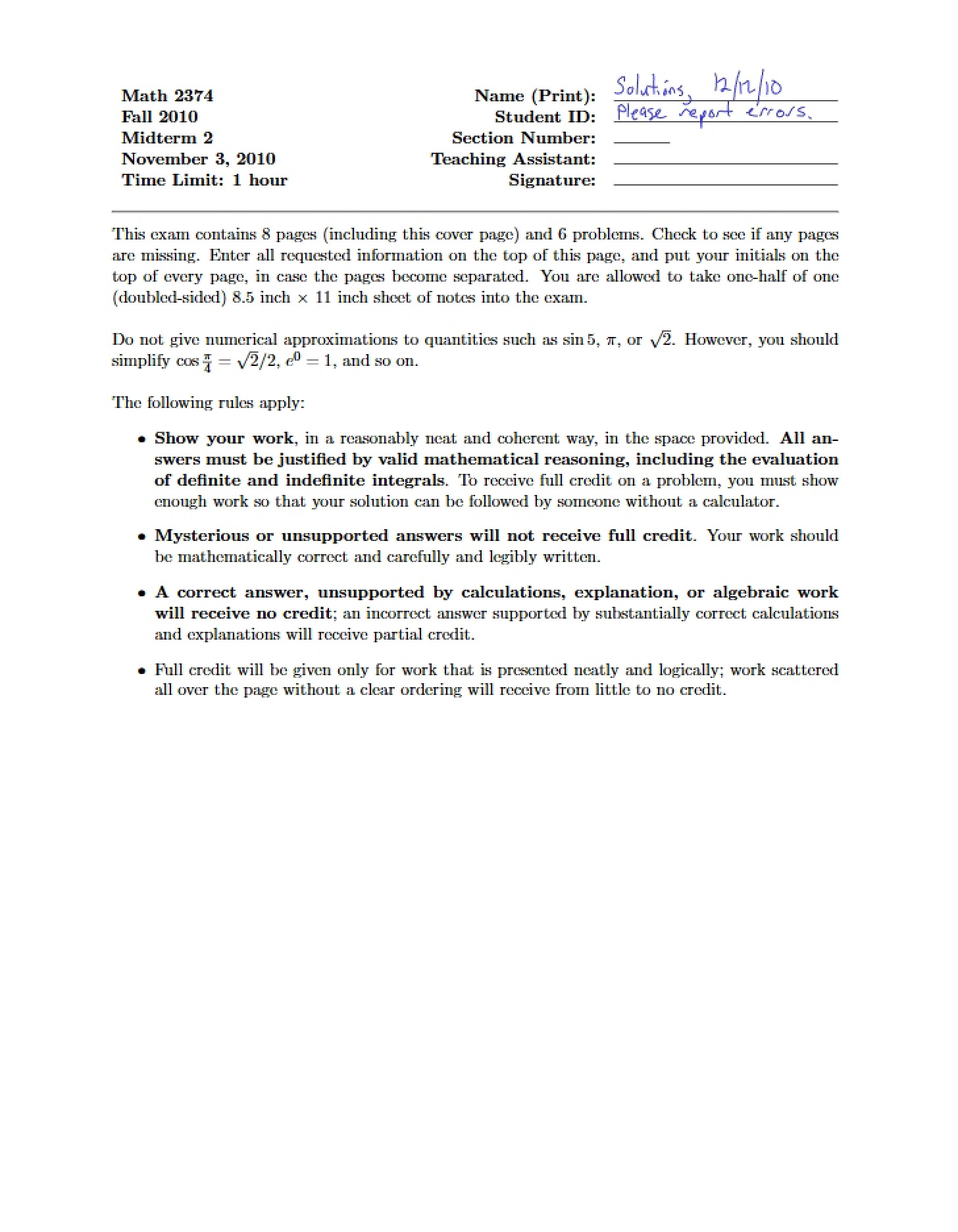
This document is a past exam paper for MATH 2374: Multivariable Calculus and Vector Analysis, offered at the University of Minnesota Twin Cities. Specifically, it’s an Exam 1 from Spring 2008, designed to assess student understanding of foundational concepts in multivariable calculus. The exam covers a range of topics typically addressed early in a multivariable calculus sequence, focusing on both conceptual understanding and problem-solving skills. It’s a time-limited assessment, originally designed to be completed within one hour.
Why This Document Matters
This resource is invaluable for students currently enrolled in or preparing for a similar multivariable calculus course. It provides a realistic assessment of the types of questions and the level of difficulty expected on exams. Studying past exams is a proven method for identifying knowledge gaps, practicing problem-solving techniques, and becoming familiar with the exam format. It’s particularly useful for students seeking to refine their test-taking strategies and build confidence before an upcoming evaluation. Students who benefit most are those looking for authentic practice beyond textbook examples and homework assignments.
Common Limitations or Challenges
While this exam provides excellent practice, it’s important to remember that it represents a specific assessment from a particular semester. The exact topics covered and the emphasis placed on each may vary in subsequent offerings of the course. This document does *not* include solutions, detailed explanations, or worked examples. It is a raw assessment tool, requiring the user to independently apply their knowledge to solve the presented problems. It also doesn’t cover all possible topics within multivariable calculus.
What This Document Provides
* A set of problems designed to test understanding of vector operations and properties.
* Questions assessing the ability to work with functions of multiple variables.
* Problems requiring the application of linear approximation techniques.
* Exercises focused on finding gradients and understanding level surfaces.
* Tasks involving tangent planes and their relationship to function graphs.
* Problems evaluating directional derivatives and understanding rates of change.
* A clear indication of the expected format and time constraints of an exam in this course.