What This Document Is
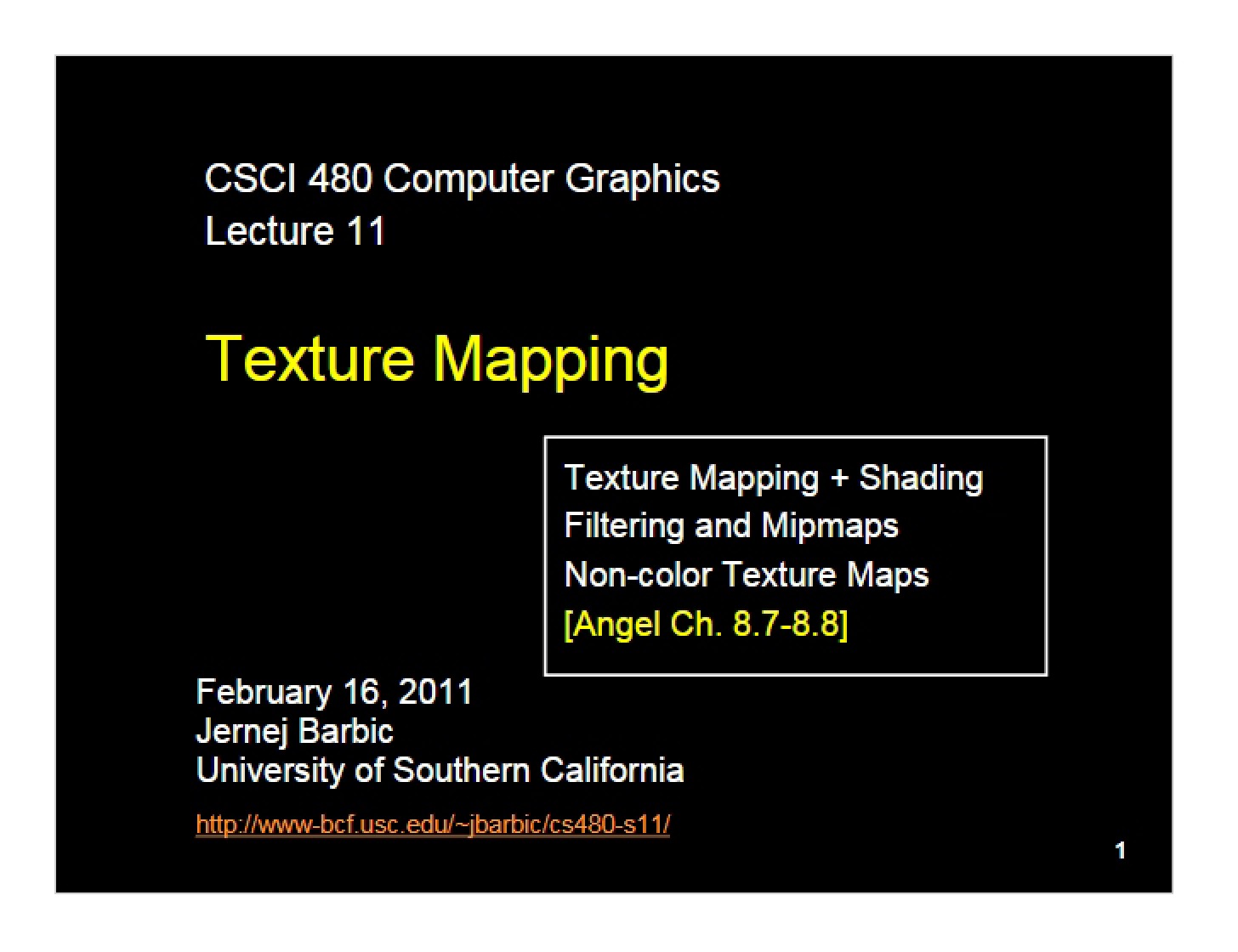
This handout provides a focused exploration of texture mapping within the realm of 3D computer graphics. It delves into the techniques used to add detail and realism to digital scenes without increasing the complexity of the underlying geometric models. The material originates from a Computer Graphics course (CSCI 480) at the University of Southern California and represents lecture notes on the subject. It’s a core concept for anyone seeking to understand how visually rich 3D environments are created efficiently.
Why This Document Matters
This resource is invaluable for students learning computer graphics, game development, or visual effects. It’s particularly helpful when you’re grappling with the trade-offs between geometric detail and rendering performance. Understanding texture mapping is crucial for optimizing scenes, creating believable surfaces, and achieving realistic visual outcomes. It’s best used as a companion to lectures and practical exercises, providing a solid theoretical foundation before implementation. Professionals seeking a refresher on fundamental techniques will also find it useful.
Common Limitations or Challenges
This handout concentrates specifically on the principles and implementation of texture mapping. It does *not* cover advanced shading techniques beyond how they interact with textures, nor does it provide a comprehensive guide to 3D modeling itself. It assumes a basic understanding of 3D graphics concepts like coordinate systems and rendering pipelines. It also focuses on the application of texture mapping within the OpenGL framework, so direct translation to other APIs may require additional knowledge. It doesn’t include code examples or step-by-step tutorials.
What This Document Provides
* An overview of the core concept of texture mapping and its historical roots in artistic techniques.
* Explanations of how textures are represented and stored digitally.
* Discussions on how texture coordinates are used to map images onto 3D surfaces.
* Insights into managing texture behavior when coordinates fall outside the expected range.
* An exploration of how texture mapping interacts with shading models to create final pixel colors.
* Guidance on initializing and enabling texture mapping within an OpenGL environment.