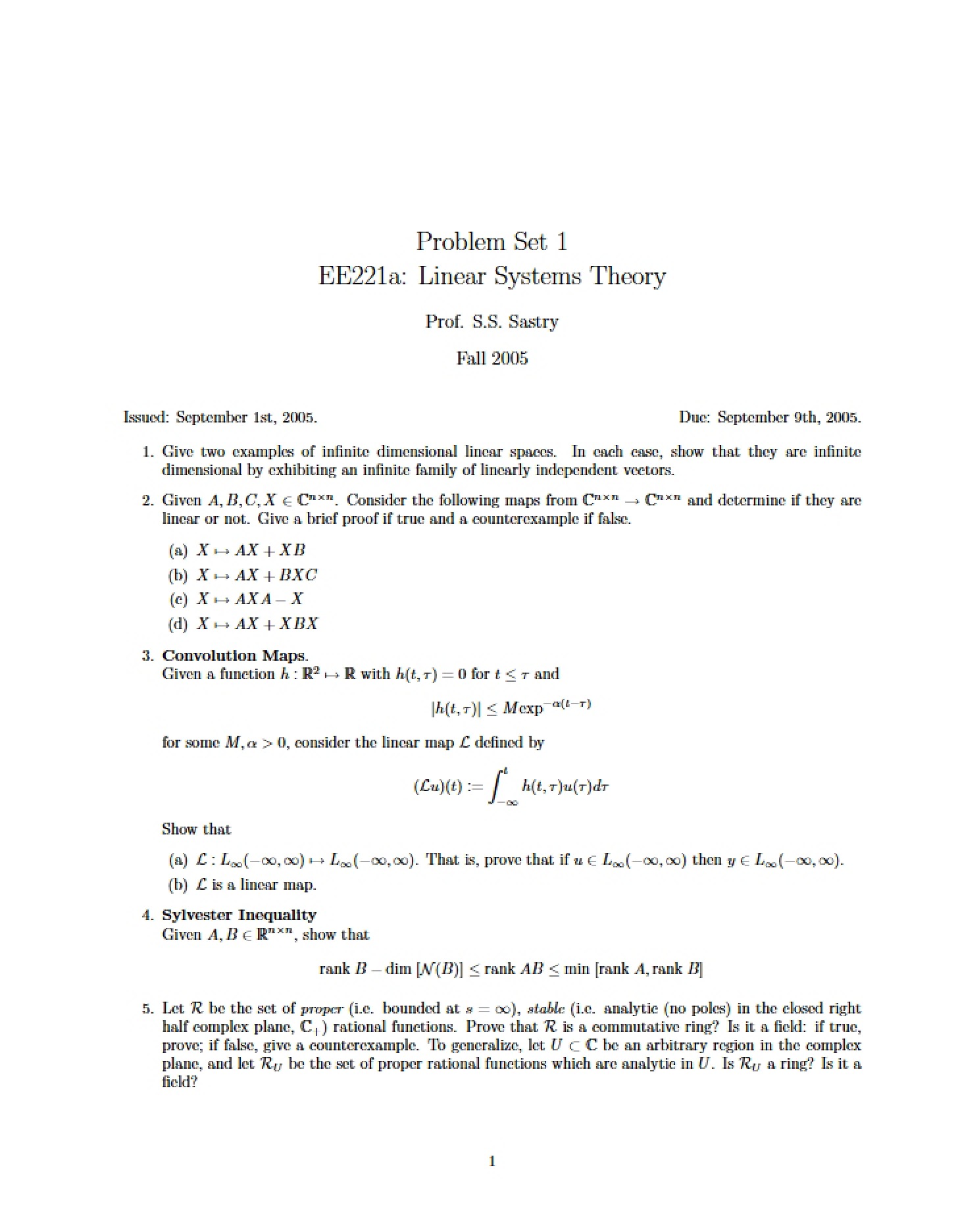
What This Document Is
This document is a comprehensive course outline and syllabus for EECS 221A: Linear Systems Theory, offered at the University of California, Berkeley. It details the structure and content of an advanced undergraduate/graduate level course focused on the mathematical foundations and practical applications of linear systems. It serves as a foundational resource for students delving into control systems, signal processing, and related engineering disciplines.
Why This Document Matters
This resource is invaluable for students enrolled in or considering enrollment in a rigorous linear systems course. It’s particularly helpful for those seeking to understand the course expectations, required materials, and the breadth of topics that will be explored. Prospective students can use this to gauge the course’s suitability for their background and interests. Current students will find it essential for planning their study schedule and understanding the weighting of different assessment components.
Topics Covered
* Foundational concepts in Linear Algebra relevant to system analysis.
* Analysis of Linear Differential Equations, both time-varying and time-invariant.
* Matrix properties, eigenspaces, and decomposition techniques.
* Numerical considerations for robust system modeling.
* System properties of Controllability and Observability.
* State Feedback and State Estimation methodologies.
* Optimal Control techniques, including Linear Quadratic Regulation.
* Introduction to Automata, Finite State Systems, and Hybrid Systems.
What This Document Provides
* A detailed course syllabus outlining grading breakdown (problem sets, midterm, final).
* A list of recommended textbooks and supplementary reading materials.
* Instructor and Teaching Assistant contact information and office hours.
* A structured outline of the course’s key theoretical areas.
* An overview of the mathematical tools and concepts that will be utilized throughout the course.