What This Document Is
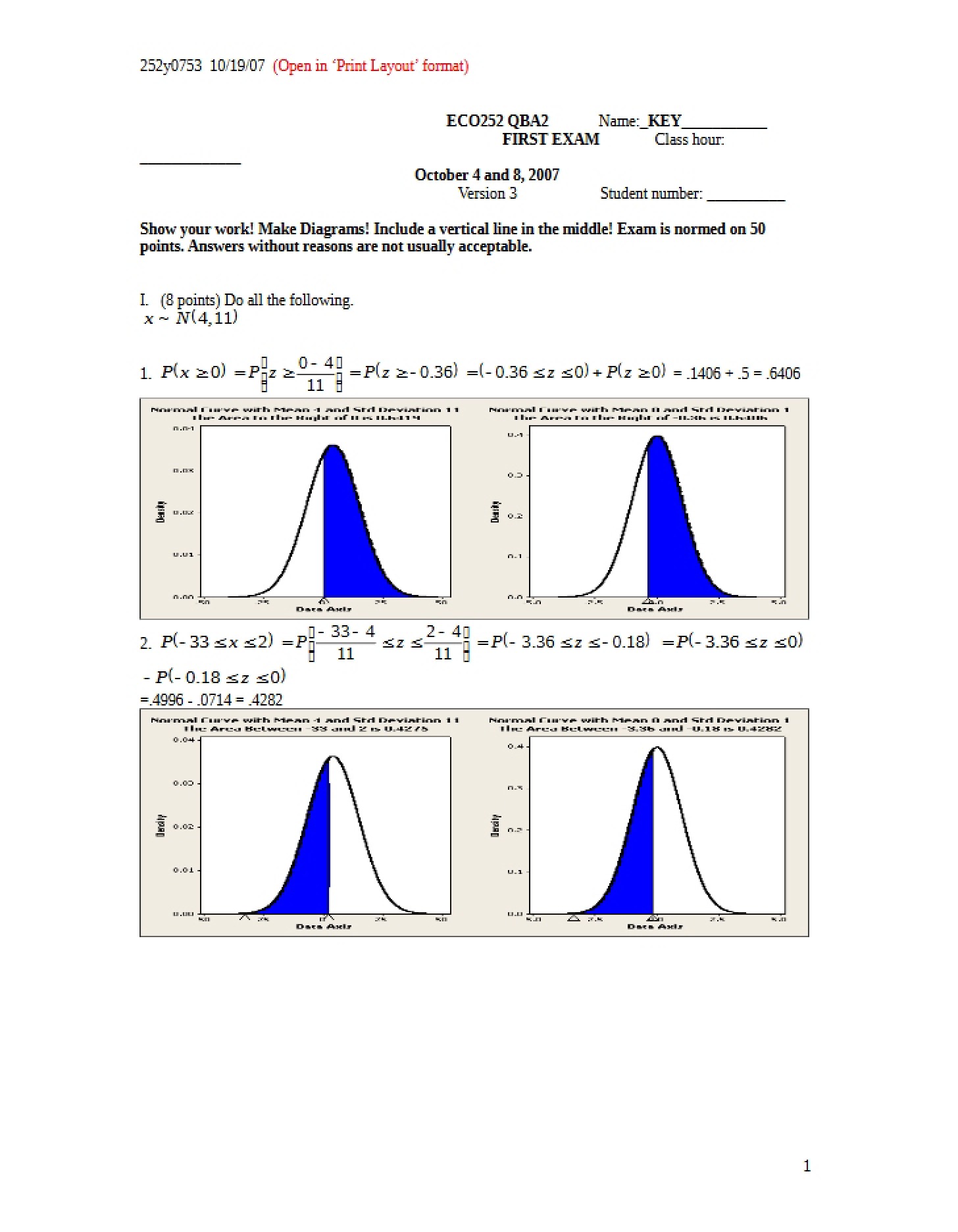
This document is a past hourly assessment for ECO 252: Quantitative Business Analysis II, offered at West Chester University of Pennsylvania. It represents a comprehensive evaluation of student understanding of key concepts covered during a specific period of the course. The assessment focuses on applying statistical methods to business-related scenarios, requiring both computational skills and interpretative abilities. It’s designed to test a student’s ability to analyze data and draw meaningful conclusions.
Why This Document Matters
This resource is invaluable for students currently enrolled in ECO 252 or those preparing to take the course. It serves as an excellent study aid, allowing you to gauge the typical difficulty and scope of exams. Reviewing the structure and types of questions asked can help you focus your study efforts and identify areas where you may need further clarification. It’s particularly useful for understanding the professor’s expectations regarding problem-solving approaches and the presentation of results. Utilizing past assessments is a proven strategy for exam success.
Common Limitations or Challenges
Please be aware that this is a previous iteration of the hourly assessment and may not perfectly reflect the content or emphasis of the current course offering. While the core concepts likely remain consistent, specific data sets, scenarios, or weighting of topics could differ. This document does *not* include detailed solutions or step-by-step explanations; it is intended for self-assessment and practice, not as a substitute for understanding the underlying principles.
What This Document Provides
* A full copy of a previously administered hourly exam.
* Questions covering topics such as two-way ANOVA analysis, including assessing interaction effects.
* Problems requiring interpretation of statistical output (e.g., from Minitab).
* Regression analysis questions, focusing on coefficient significance and predictive modeling.
* Guidance on constructing confidence intervals for comparing means.
* An indication of the point value associated with each question.