What This Document Is
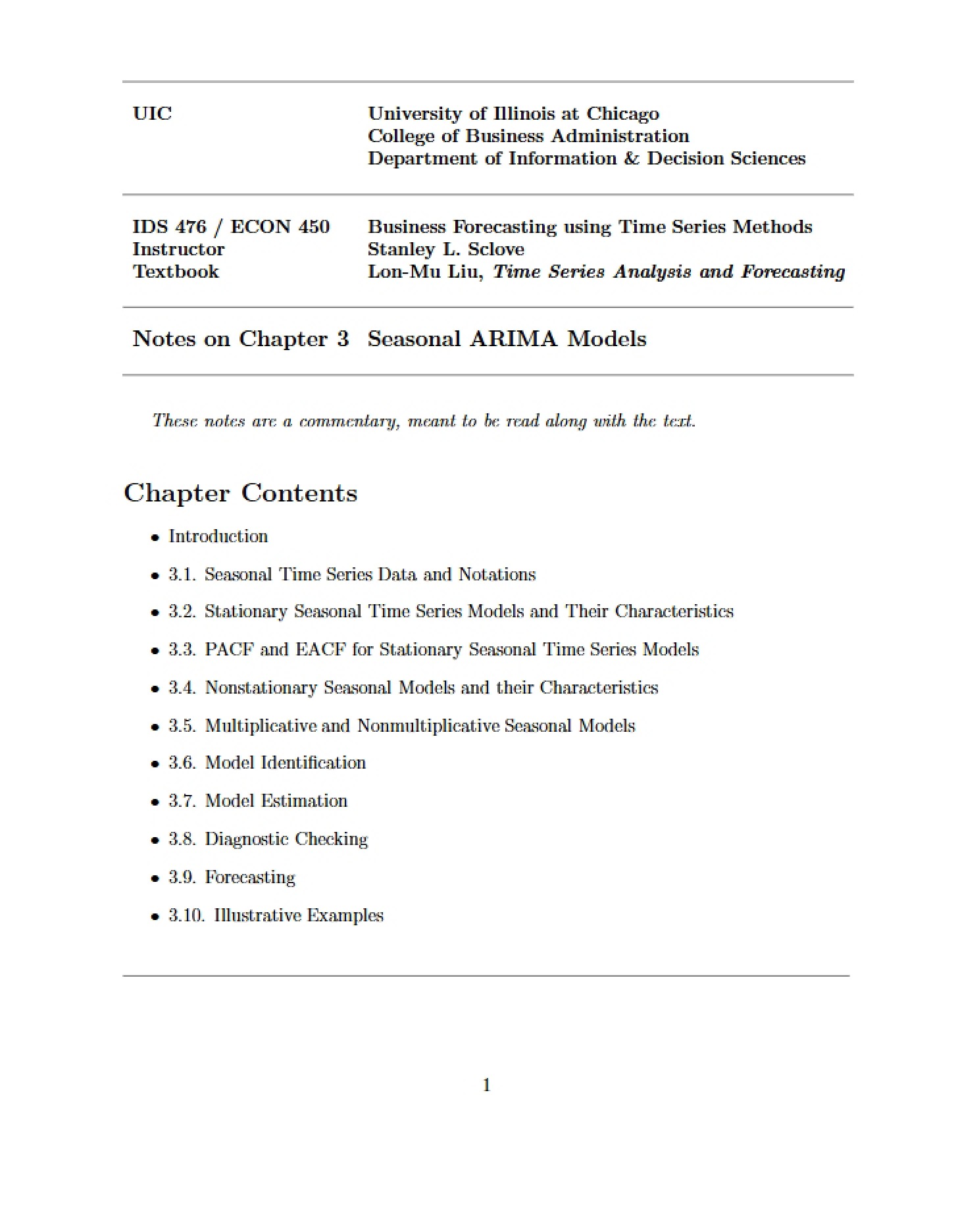
This document provides foundational notes for a university-level course on Business Forecasting using Time Series Methods. It serves as a companion resource to a core textbook, offering a structured overview of the key symbols, terminology, and mathematical foundations used in the field of time series analysis. It’s designed to enhance understanding of forecasting techniques applicable to business data.
Why This Document Matters
Students enrolled in forecasting, statistics, or data science courses – particularly those with a focus on business applications – will find this resource valuable. It’s especially helpful for those seeking a consolidated reference for the notation and core concepts underpinning time series modeling. Professionals looking to refresh their understanding of time series methods for practical forecasting tasks may also benefit. This material is most useful when studying the mathematical and statistical underpinnings of forecasting models.
Topics Covered
* Fundamental Time Series Notation and Definitions
* Data Transformations for Time Series Analysis
* Understanding White Noise Processes
* Lag Operators and Autocorrelation Functions
* Autoregressive (AR) Models
* Moving Average (MA) Models
* Combined ARMA and ARIMA Models
* Concepts of Stationarity and Differencing
* Forecasting Terminology and Conditional Expectations
* Mathematical Foundations and Exercises
What This Document Provides
* A comprehensive glossary of symbols commonly used in time series analysis.
* Definitions of key concepts like autocovariance, autocorrelation, and partial autocorrelation.
* An introduction to various time series models, including AR, MA, ARMA, and ARIMA.
* A set of exercises designed to reinforce understanding of the core concepts.
* A bibliography of relevant textbooks and resources for further study.
* Mathematical formulations relating to differencing and lag operators.