What This Document Is
This is a focused exploration of wind patterns, specifically contrasting conditions found at the Earth’s surface with those occurring at upper atmospheric levels. It delves into the forces that govern wind behavior, examining how these forces interact to create different types of flow. This material is part of an introductory meteorology course and provides a foundational understanding of atmospheric dynamics.
Why This Document Matters
This resource is ideal for students seeking to build a strong conceptual grasp of why winds behave as they do. It’s particularly helpful for those studying atmospheric science, geography, or related fields. Use this to solidify your understanding of the fundamental principles behind weather systems and forecasting, and to prepare for more advanced topics in atmospheric motion. It’s best reviewed when first encountering concepts of pressure gradients, the Coriolis effect, and atmospheric circulation.
Topics Covered
* The Geostrophic Wind and its underlying principles
* Force balances influencing wind direction and speed
* The impact of curvature on wind flow around high and low-pressure systems
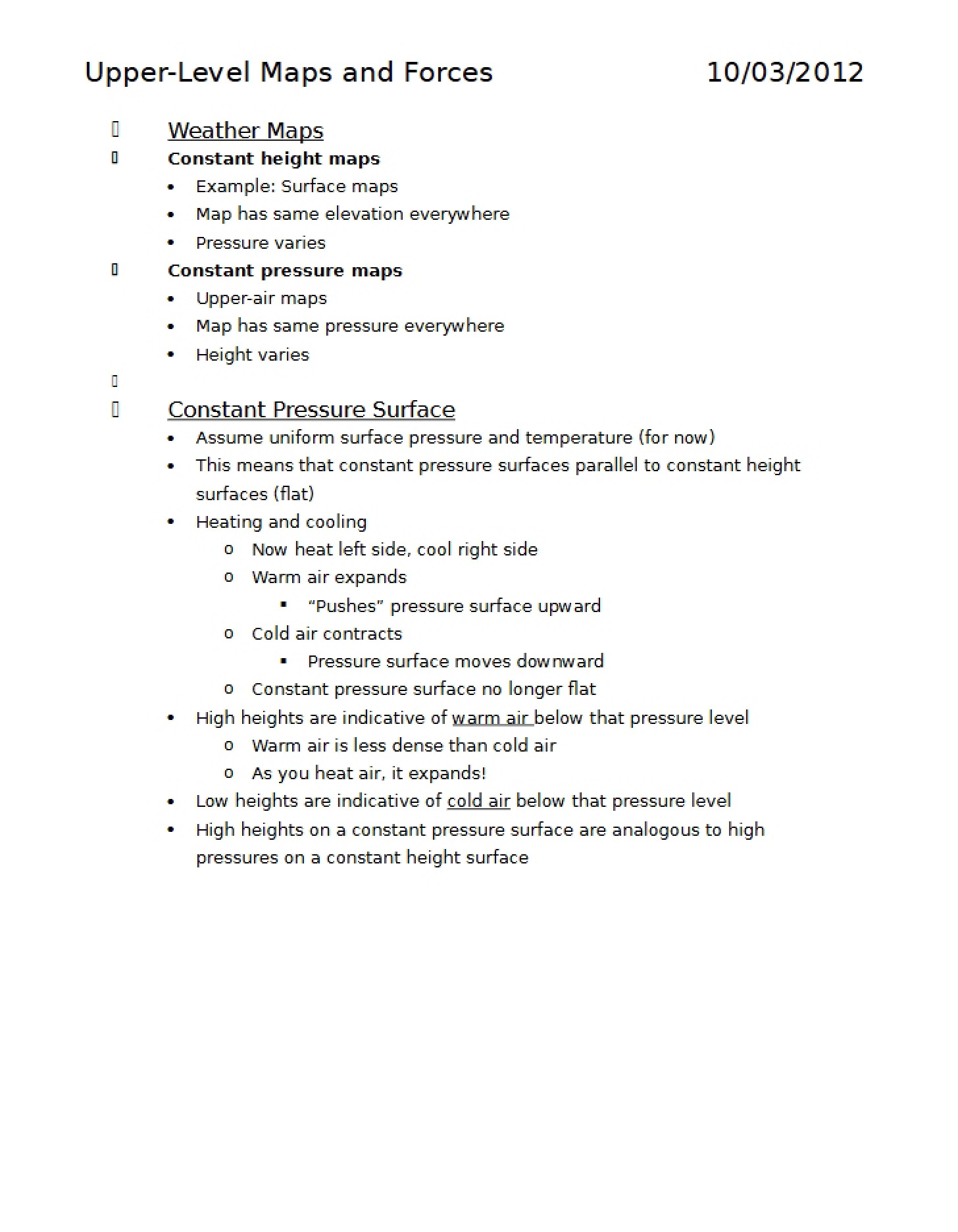
* Characteristics of upper-level wind patterns (zonal and meridional flow)
* Identifying cyclones and anticyclones and their associated wind directions in both hemispheres
* Differences between upper-level and surface wind behavior
* The relationship between height contours, pressure gradients, and wind velocity
What This Document Provides
* A detailed examination of the forces at play in atmospheric motion.
* Explanations of how these forces combine to create different wind regimes.
* Conceptual frameworks for understanding wind flow around pressure systems.
* A foundation for interpreting upper-level weather maps and predicting atmospheric behavior.
* A comparative analysis of wind characteristics at different altitudes.