What This Document Is
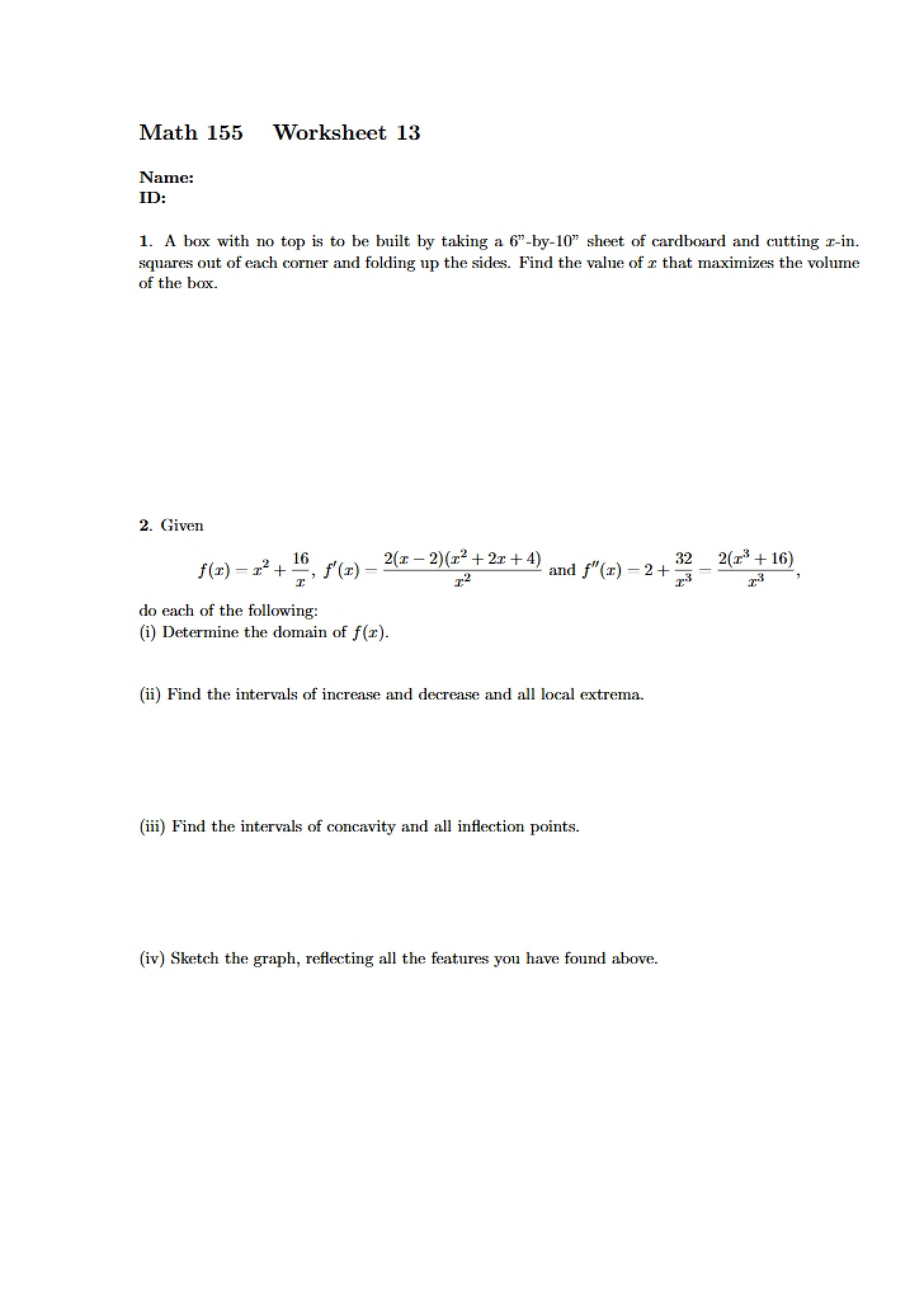
This is a practice worksheet designed to reinforce your understanding of related rates and linear approximation concepts within Calculus I. Specifically, it focuses on applying differentiation techniques to solve problems involving changing quantities and estimating function values using tangent line approximations. It’s formatted as a problem set for individual practice, mirroring the types of questions you’ll encounter on assessments. The worksheet draws from textbook exercises, indicating a connection to core course materials.
Why This Document Matters
This worksheet is ideal for students in a first-semester calculus course who are looking to solidify their grasp of related rates and linear approximation. It’s best used *after* you’ve attended lectures and read the textbook sections covering these topics. Working through these types of problems will build your problem-solving skills and prepare you for quizzes and exams. It’s particularly helpful if you struggle with translating word problems into mathematical equations and applying the chain rule in dynamic scenarios. Consistent practice with these concepts is crucial for success in subsequent calculus topics.
Common Limitations or Challenges
This worksheet does *not* provide step-by-step solutions or detailed explanations. It’s designed to be a self-assessment tool, requiring you to actively apply the concepts you’ve learned. It also assumes you have a foundational understanding of differentiation rules and techniques. It won’t cover the initial theoretical derivations of related rates or linear approximation – it focuses solely on application. Access to the textbook referenced within the problems is recommended for context.
What This Document Provides
* A series of problems centered around calculating rates of change in various geometric and real-world scenarios.
* Exercises requiring the application of related rates to problems involving distances, volumes, and angles.
* Problems focused on utilizing linear approximations to estimate function values.
* Practice with finding differentials and approximating changes in functions.
* Problems involving trigonometric functions and their rates of change.
* Opportunities to practice setting up and solving equations involving derivatives.