What This Document Is
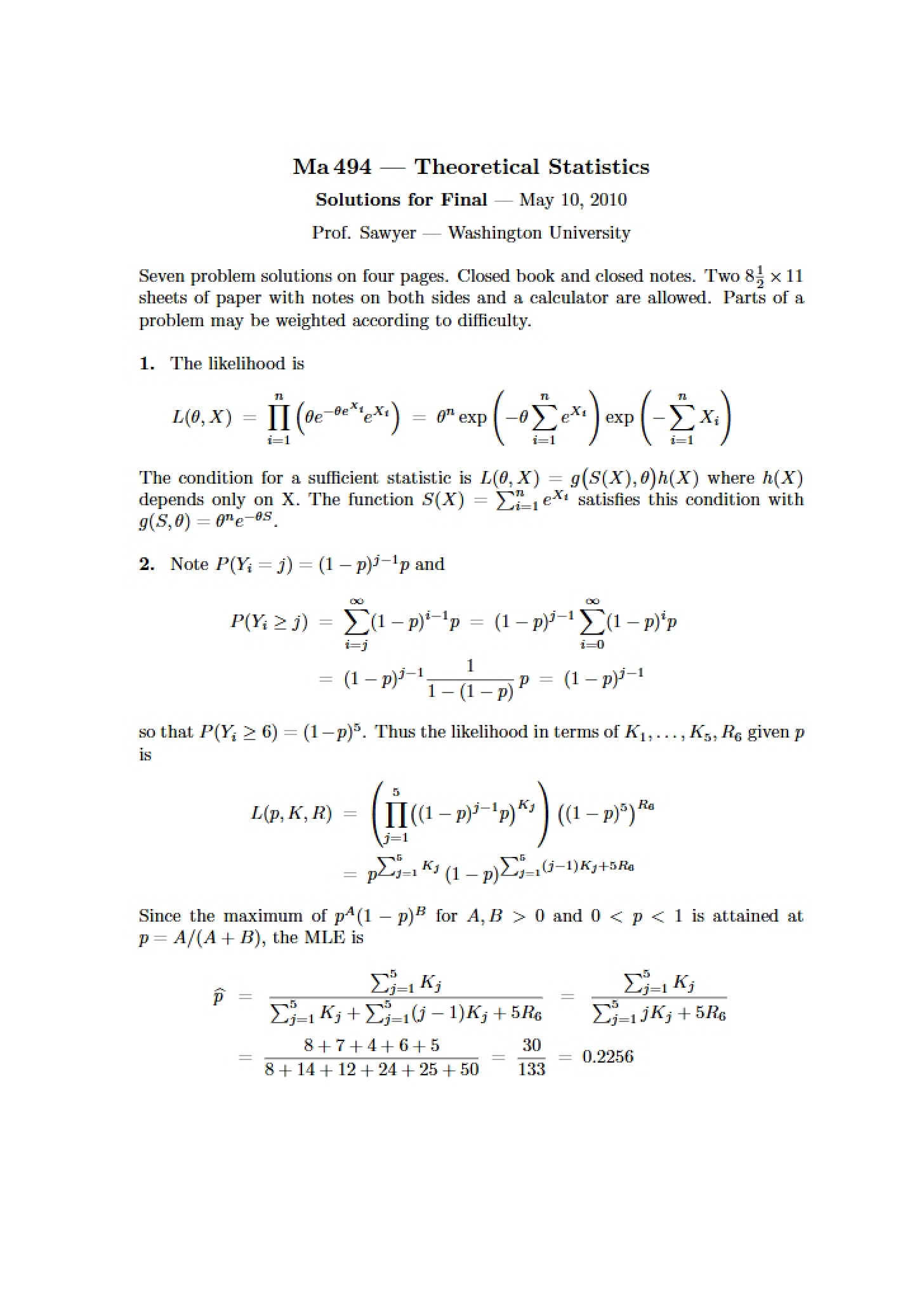
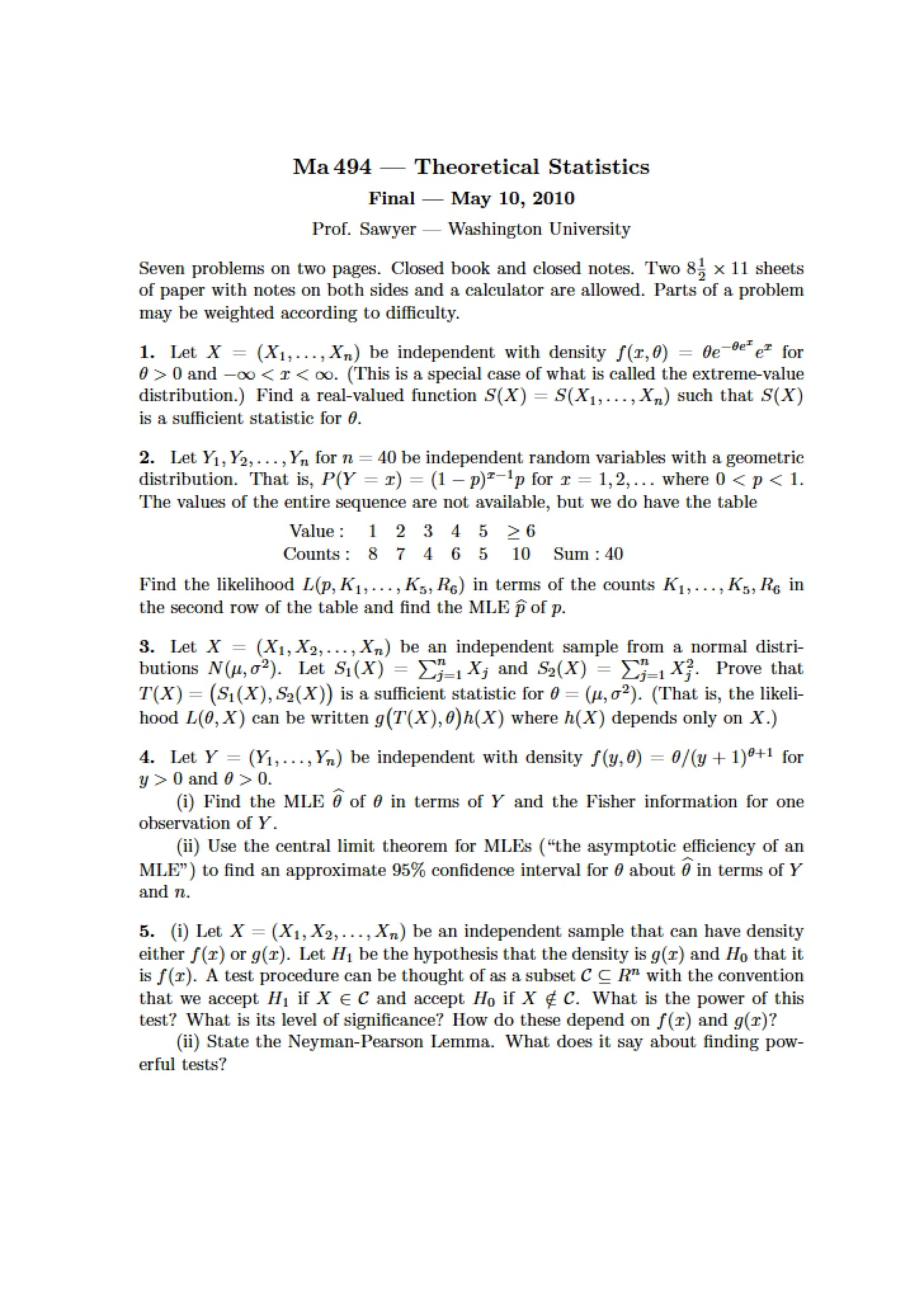
This document contains a detailed, worked-through solution set for a problem set in a graduate-level Mathematical Statistics course (MATH 494) at Washington University in St. Louis. It focuses on theoretical statistical concepts and their application to specific problems. The material centers around hypothesis testing and statistical inference, covering topics like variance comparisons and chi-square tests. It’s designed to accompany course lectures and reinforce understanding of complex statistical methodologies.
Why This Document Matters
This resource is invaluable for students enrolled in similar advanced statistics courses. It’s particularly helpful when you’re looking to solidify your grasp of challenging concepts and check your approach to problem-solving. If you've attempted the problem set and are seeking to understand the underlying logic and methodology behind arriving at correct conclusions, this solution key can be a powerful learning tool. It’s best used *after* independent effort has been made to solve the problems, serving as a guide to identify areas where your understanding might need strengthening.
Common Limitations or Challenges
This document does *not* provide a substitute for attending lectures, reading the textbook, or actively participating in the learning process. It assumes a foundational understanding of statistical theory and mathematical notation. The solutions presented are specific to the problems outlined in the original problem set and won’t directly address different or unrelated statistical questions. It also doesn’t offer detailed explanations of *why* certain methods are chosen, focusing instead on the execution of those methods.
What This Document Provides
* Detailed breakdowns of solutions to a set of statistical problems.
* Applications of statistical tests to practical scenarios.
* Illustrations of how to interpret statistical results.
* Examples involving variance comparisons using F-distributions.
* Worked examples utilizing Pearson chi-square tests for goodness-of-fit.
* Discussion of potential limitations of statistical approximations.
* Analysis of likelihood estimation techniques.