What This Document Is
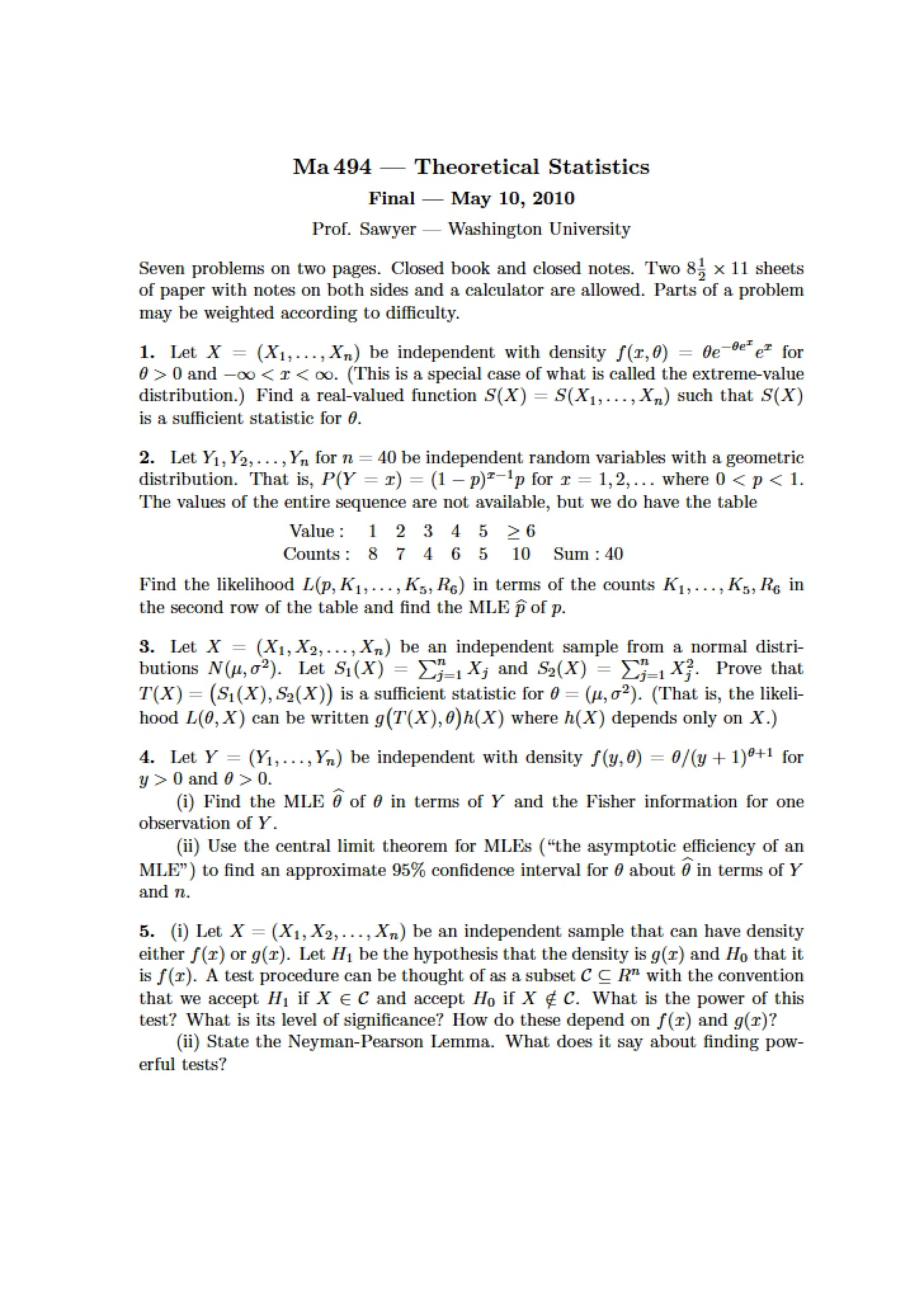
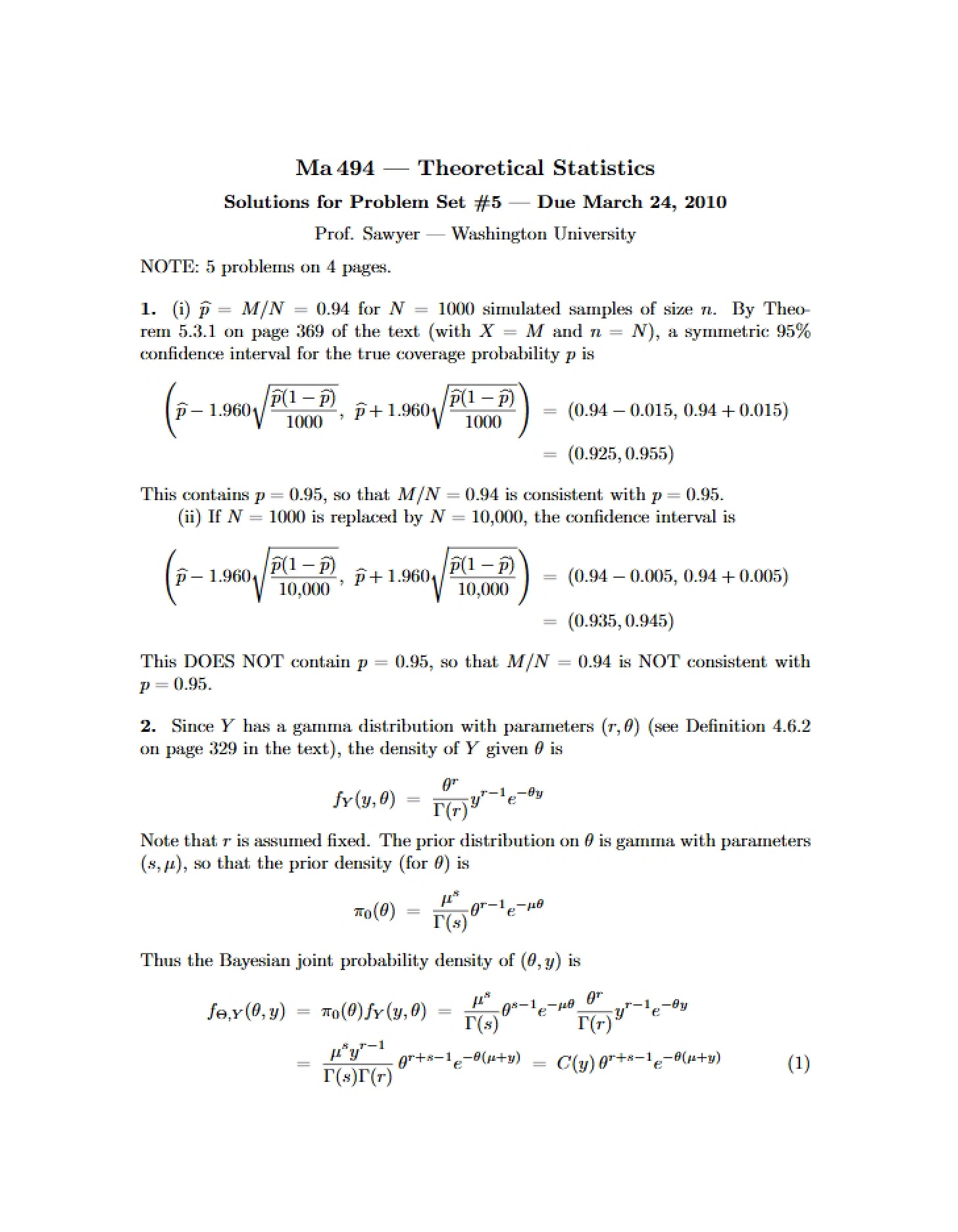
This document is an answer key for a final exam in Mathematical Statistics (MATH 494) at Washington University in St. Louis. It details the solutions to a closed-book, closed-notes examination covering advanced theoretical statistical concepts. The exam permitted the use of reference sheets and calculators. This resource is intended for students who have completed the course and are seeking to review their performance or understand the expected approach to complex statistical problems.
Why This Document Matters
This answer key is invaluable for students preparing for advanced coursework or professional applications in statistics, data science, or related fields. It’s particularly useful after completing the course to identify areas of strength and weakness, and to solidify understanding of core principles. Students can use this to check their work, analyze solution methodologies, and gain deeper insight into the professor’s expectations. It’s also a helpful resource for self-assessment and targeted review before tackling more advanced statistical topics.
Common Limitations or Challenges
This document provides *solutions* but does not offer detailed explanations of the underlying reasoning or alternative approaches. It assumes a strong foundation in the course material. It will not be helpful for students who are attempting to learn the material for the first time without prior coursework or a textbook. The answer key focuses on the specific problems presented on *this* particular exam and may not cover the full breadth of topics within the Mathematical Statistics course.
What This Document Provides
* Detailed responses to seven distinct problems from the final exam.
* Solutions covering topics in statistical theory, including likelihood functions and sufficient statistics.
* Applications of statistical principles to problems involving probability distributions and hypothesis testing.
* Insights into the expected level of rigor and mathematical formulation for exam solutions.
* Illustrations of how to apply theoretical concepts to practical statistical scenarios.
* Solutions related to concepts like maximum likelihood estimation and Fisher information.
* Discussion of Neyman-Pearson Lemma and its application to statistical testing.