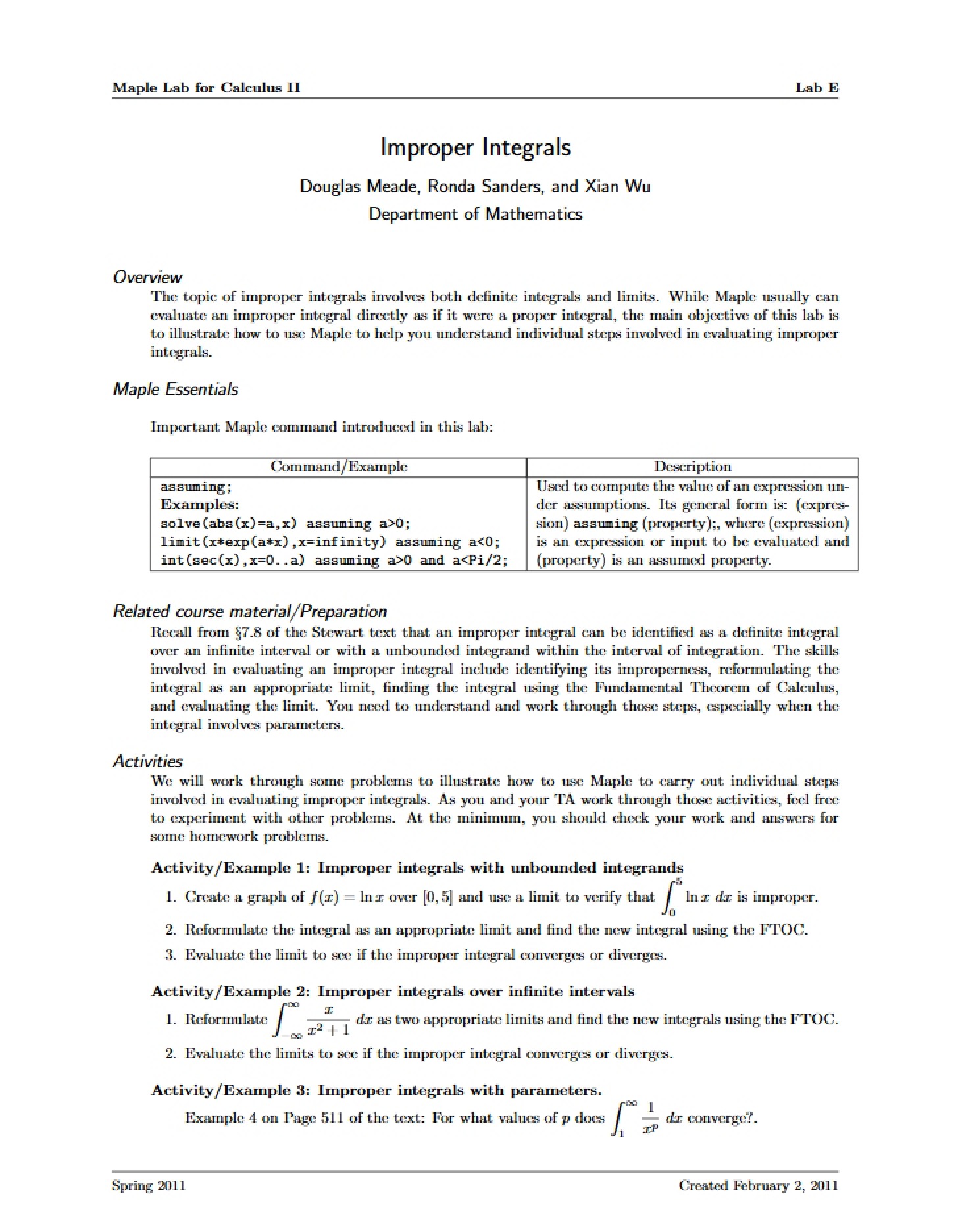
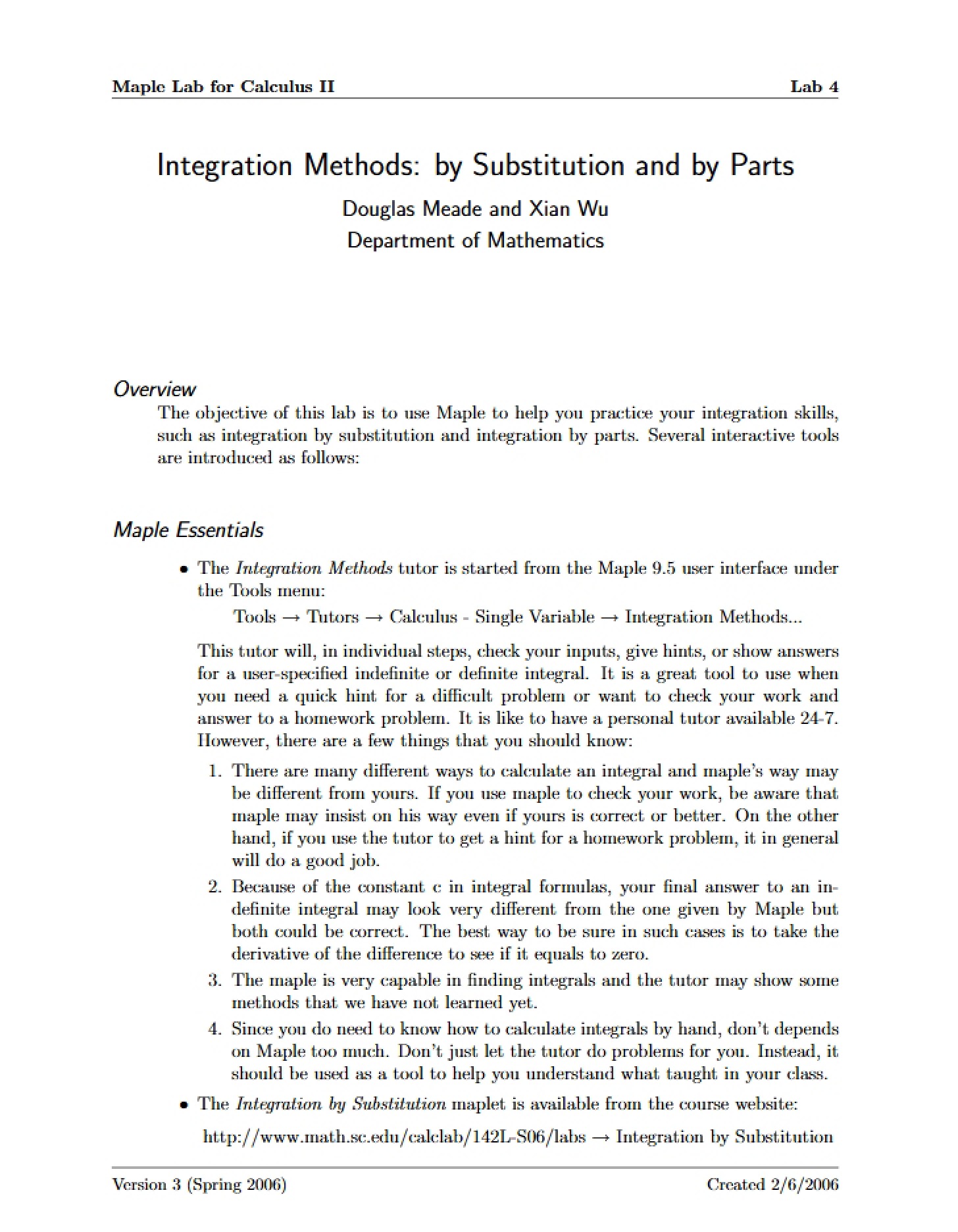
What This Document Is
This is a Maple Lab designed to reinforce your understanding of applying definite integrals to calculate areas between curves – a core concept in Calculus II. Developed for students at the University of South Carolina (MATH 142), this resource focuses on utilizing the Maple software to visualize, analyze, and solve problems related to finding areas bounded by various functions. It’s a hands-on guide intended to bridge theoretical knowledge with practical application.
Why This Document Matters
This lab is ideal for Calculus II students who are looking to solidify their grasp of integration techniques and learn how to leverage computational tools like Maple. It’s particularly helpful when you’re tackling problems involving finding the area of complex regions where simple geometric formulas aren’t sufficient. If you’re struggling to visualize the areas defined by intersecting curves or need assistance setting up the correct integrals, this lab will provide a structured approach. It’s best used *alongside* your textbook and lecture notes, as a way to actively practice and confirm your understanding.
Common Limitations or Challenges
This resource is a guided lab exercise and does not serve as a comprehensive review of all integration techniques. It assumes a foundational understanding of definite integrals and curve sketching. While it introduces key Maple commands, it doesn’t offer a full Maple tutorial – familiarity with the software’s basic interface is expected. The lab focuses on specific problem types and may not cover all possible scenarios encountered when calculating areas between curves. It will not provide step-by-step solutions to problems.
What This Document Provides
* An overview of the concept of area calculation using definite integrals.
* Introduction to specific Maple commands useful for solving area problems, including `fsolve` and `int`.
* Guidance on identifying appropriate integration limits and determining which function represents the “top” or “bottom” curve.
* Exploration of scenarios where integrating with respect to *y* is more efficient than integrating with respect to *x*.
* Worked examples demonstrating the application of Maple to find areas enclosed by curves, including cases with multiple intersection points.
* References to relevant sections in standard Calculus II textbooks (Stewart) and CaleLabs materials.