What This Document Is
This study guide focuses on foundational concepts within Calculus I, specifically exploring the rigorous definition and application of limits. It delves into understanding how functions behave as their inputs approach certain values, and how to quantify this behavior with precision. The material centers around translating graphical and functional relationships into formal mathematical statements about limits. It appears to emphasize a problem-solving approach to solidify understanding.
Why This Document Matters
This resource is ideal for students enrolled in a first-semester calculus course, particularly those at the University of Minnesota Twin Cities (MATH 1271). It’s most beneficial when you’re grappling with the abstract concept of a limit and need to build a strong foundation for future topics like derivatives and integrals. Use this guide to reinforce lecture material, prepare for quizzes and exams, and develop a deeper intuitive grasp of limit calculations and proofs. Students who struggle with the epsilon-delta definition of a limit will find this particularly helpful.
Common Limitations or Challenges
This guide does *not* provide a substitute for attending lectures or completing assigned homework. It’s designed to *supplement* your coursework, not replace it. It won’t walk you through every possible type of limit problem, nor does it cover all the nuances of calculus. It focuses specifically on the core ideas surrounding limits and their formal definition, and assumes a basic understanding of algebraic manipulation and function notation. It does not offer comprehensive coverage of all Calculus I topics.
What This Document Provides
* Exploration of limit concepts through graphical representations of functions.
* Practice applying limit definitions to specific functions.
* Exercises designed to build intuition around the relationship between input changes and function output changes.
* A framework for constructing formal proofs related to limits.
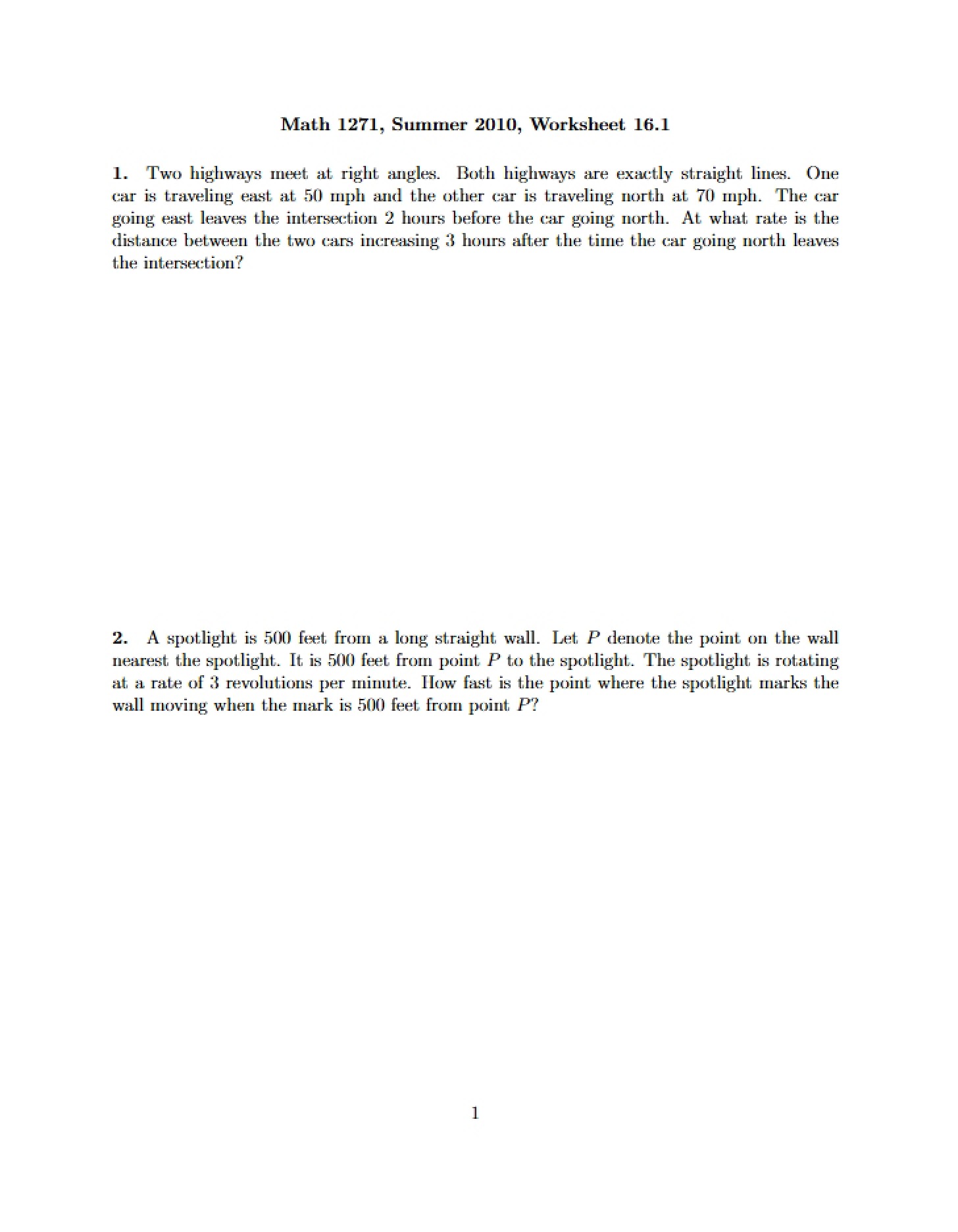
* Real-world application problems demonstrating the practical relevance of limits (e.g., manufacturing tolerances).
* Opportunities to refine skills in precise mathematical reasoning and expression.