What This Document Is
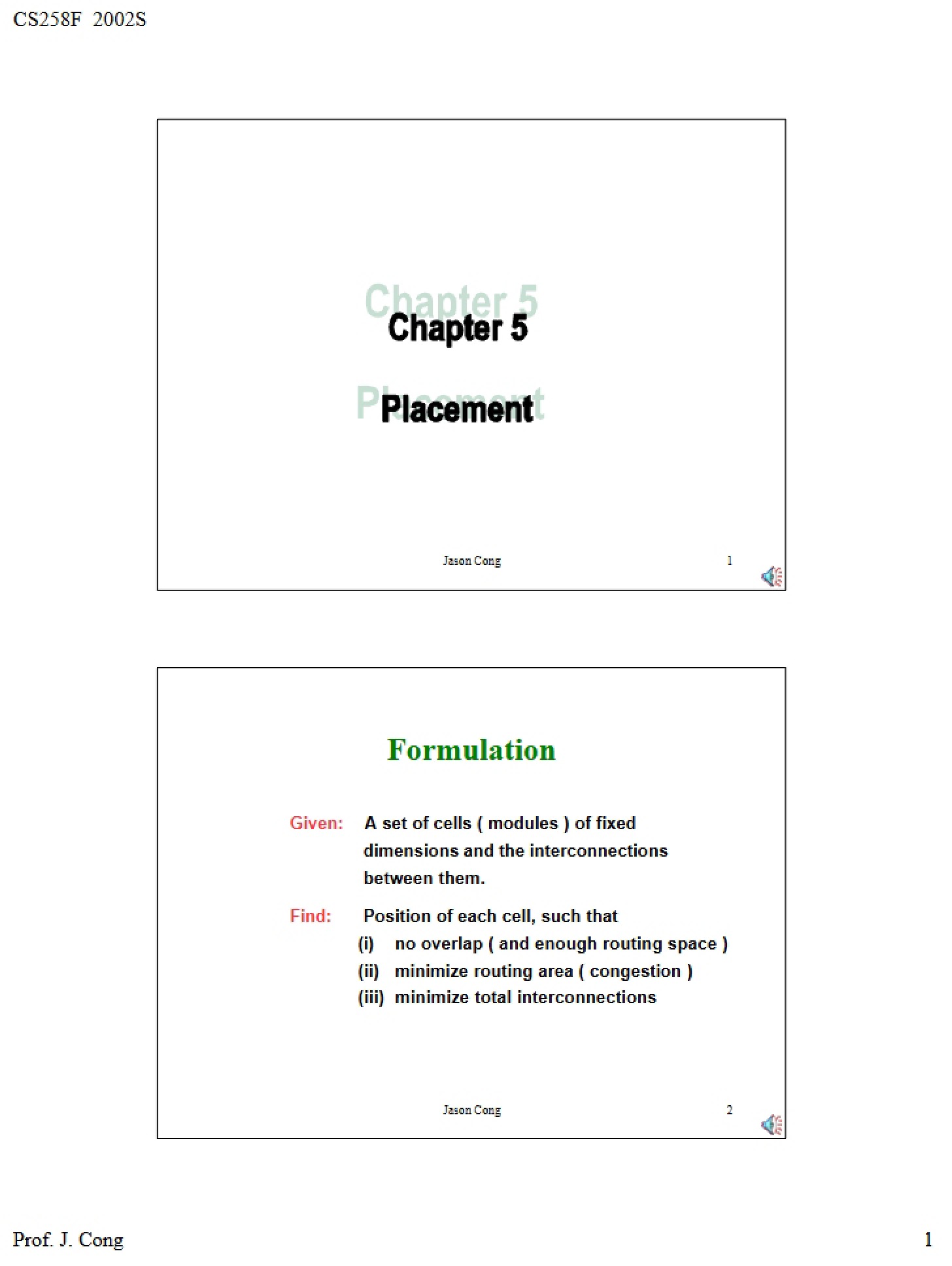
This document represents Chapter 05 (03) from the course Physical Design Automation of VLSI Systems (COMSCI 258F) at UCLA. It’s a focused exploration of the ‘Placement’ stage within the broader VLSI design flow – a critical step in transforming a circuit’s description into a physical layout. This chapter delves into the methodologies and theoretical underpinnings required to strategically position circuit components on a chip. It’s designed for students seeking a deep understanding of the algorithms and considerations involved in optimizing chip area and performance.
Why This Document Matters
This material is essential for students specializing in VLSI design, integrated circuit engineering, or related fields. It’s particularly valuable when you’re tackling projects involving chip layout, seeking to improve circuit performance through optimized component arrangement, or preparing for advanced coursework in physical design. Understanding placement techniques is foundational for anyone aiming to contribute to the development of modern microelectronic devices. Accessing the full chapter unlocks a detailed examination of these concepts, allowing for a comprehensive grasp of the subject.
Topics Covered
* Formulation of the placement problem, defining key objectives and constraints.
* Various placement methodologies, categorized into constructive, iterative improvement, and analytical approaches.
* Detailed examination of specific algorithms like Cluster Growth, Force-Directed Placement, and Goto’s Algorithm.
* Cost function analysis for evaluating placement quality.
* Concepts related to neighborhood analysis and iterative improvement strategies.
* Approaches to estimating interconnection costs and routing congestion.
What This Document Provides
* A structured overview of different placement techniques, outlining their strengths and weaknesses.
* A theoretical framework for understanding the underlying principles of placement algorithms.
* Discussions on how to quantify placement quality through cost functions and congestion metrics.
* Insights into the trade-offs between various placement objectives, such as minimizing wire length and reducing routing congestion.
* A foundation for further exploration of advanced placement algorithms and tools.