What This Document Is
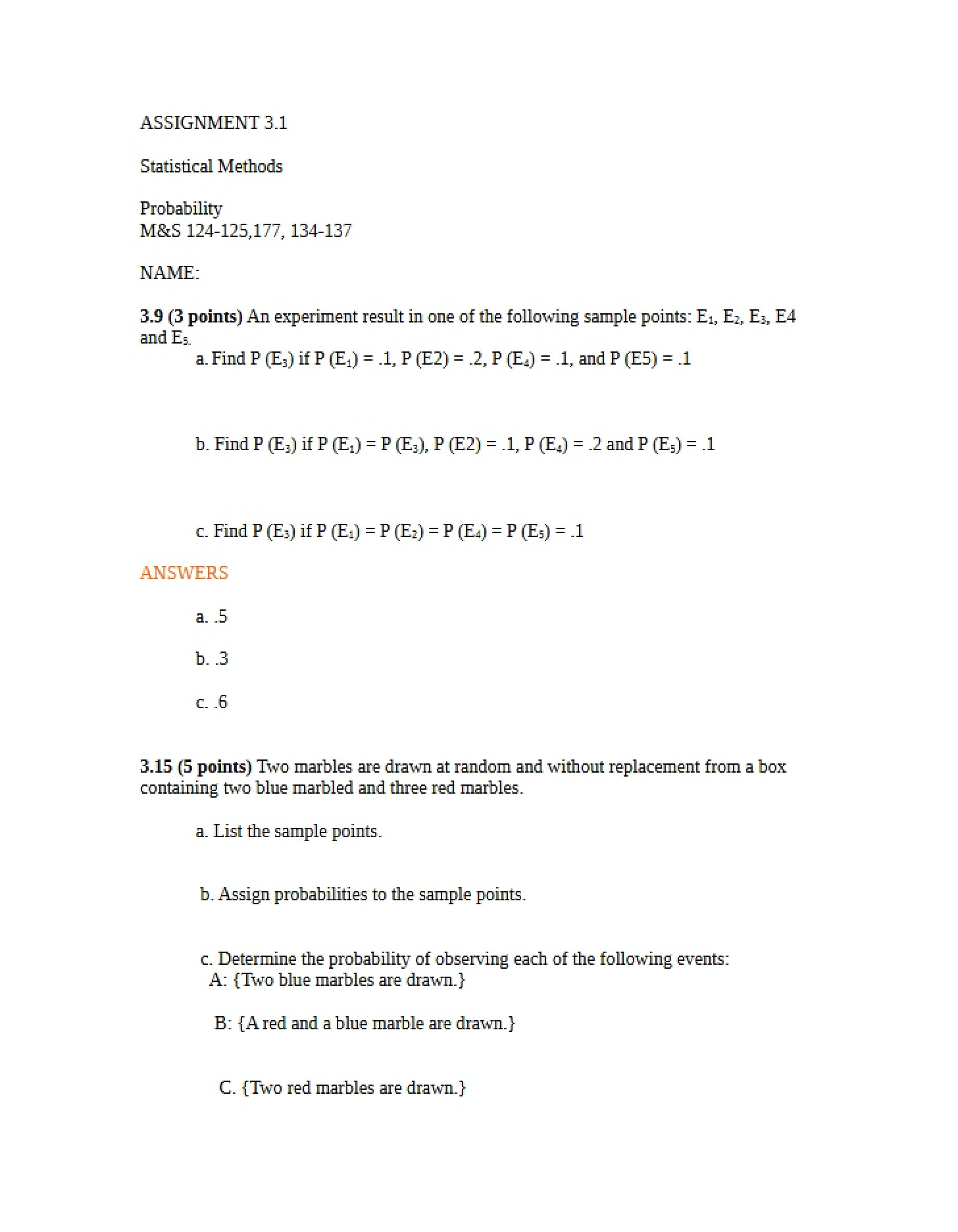
This is a practice assignment for STAT 2601: Statistical Methods, offered at the University of Minnesota Twin Cities. Specifically, it focuses on concepts covered in Chapter 6 of the course materials. The assignment is designed to test your understanding of sampling distributions, probability, and statistical inference. It builds upon foundational knowledge of probability distributions and introduces applications related to sample means and variances. The problems presented require applying theoretical concepts to practical scenarios.
Why This Document Matters
This assignment is crucial for students enrolled in STAT 2601. Successfully completing it demonstrates a firm grasp of key principles related to statistical sampling and estimation. Working through these types of problems will prepare you for more complex statistical analyses and interpretations encountered later in the course and in subsequent statistics coursework. It’s particularly helpful to use this assignment as a self-assessment tool after reviewing lecture notes and the textbook chapter, identifying areas where further study is needed. It’s ideal for reinforcing learning *before* an exam or quiz covering these topics.
Common Limitations or Challenges
This assignment does not provide step-by-step solutions or fully worked-out examples. It presents problems for you to solve independently, applying the methods and formulas discussed in class and in the textbook. It assumes you have a solid understanding of basic probability concepts and statistical notation. While the assignment covers a range of problem types, it is not an exhaustive review of *all* material in Chapter 6. It also doesn’t offer detailed explanations of *why* certain methods are chosen over others – that understanding is expected from course instruction.
What This Document Provides
* A series of problems relating to probability distributions and sampling.
* Exercises focused on calculating and interpreting sampling distributions of the sample mean.
* Opportunities to apply concepts of unbiased estimators.
* Problems involving calculations of means and standard deviations of sampling distributions.
* Scenarios requiring the application of statistical principles to real-world contexts (e.g., evaluating research studies).
* Practice with determining probabilities related to sample statistics.