What This Document Is
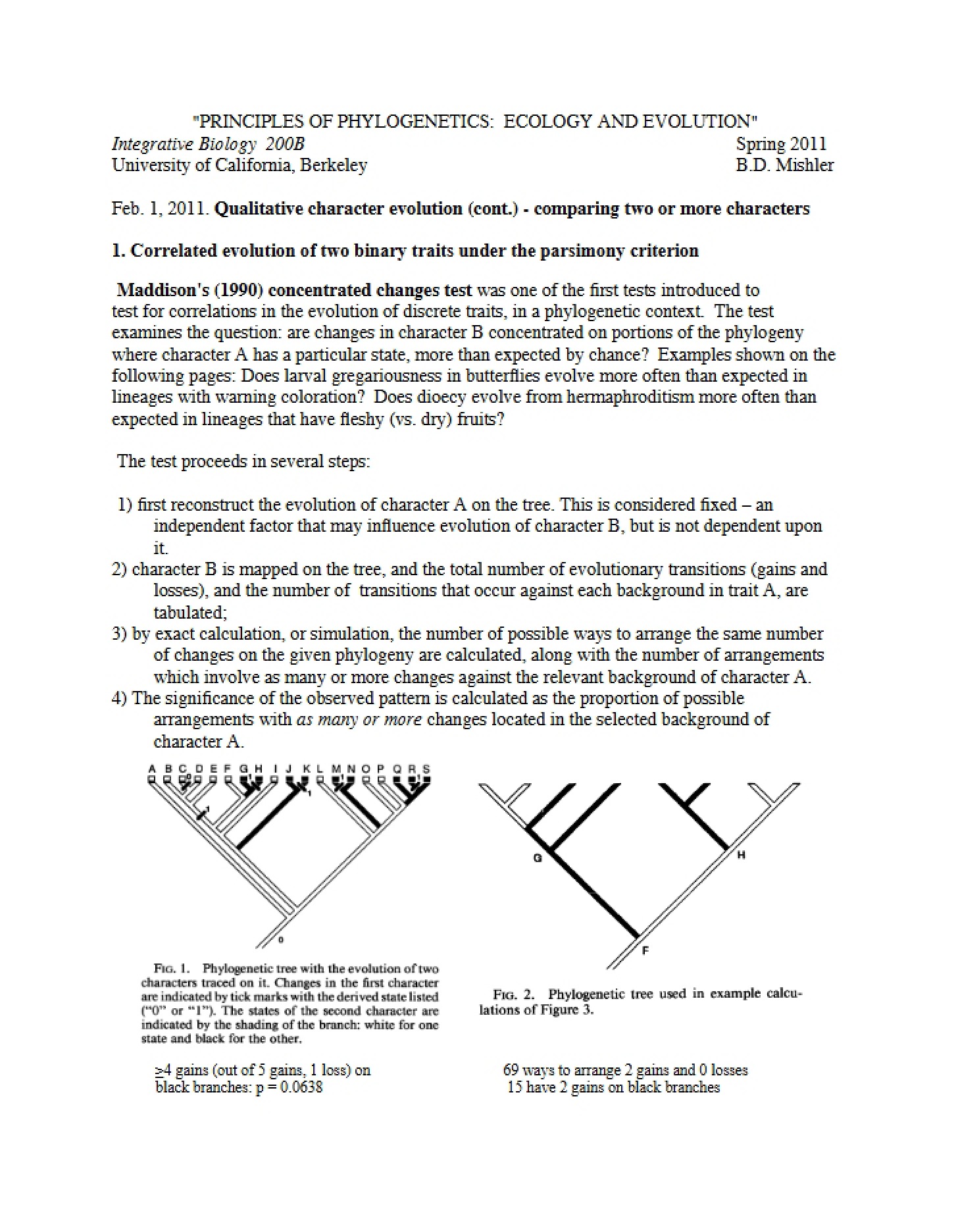
This material provides a focused exploration of character evolution within the framework of phylogenetic analysis. It delves into methods for understanding how traits change over evolutionary time, specifically utilizing cladograms – branching diagrams representing evolutionary relationships. The content centers on interpreting patterns of character states on these diagrams to infer the history of traits in ancestral lineages. It’s part of a larger course examining the intersection of ecology and evolution, building upon foundational concepts in phylogenetics.
Why This Document Matters
This resource is invaluable for students in evolutionary biology, ecology, or related fields who are seeking a deeper understanding of comparative methods. It’s particularly helpful when you’re ready to move beyond simply constructing phylogenetic trees and begin using them to investigate evolutionary processes. If you’re grappling with how to test hypotheses about adaptation, convergence, or correlated evolution, this material will provide a crucial foundation. It’s best used after gaining familiarity with basic phylogenetic principles and terminology.
Topics Covered
* Inferring ancestral character states
* The application of parsimony principles to character evolution
* Different models for character state transitions (unordered, ordered, Dollo)
* The relationship between character evolution and adaptive hypotheses
* Using cladograms for comparative analyses
* Homology and its role in reconstructing evolutionary history
What This Document Provides
* A detailed discussion of the theoretical underpinnings of mapping character states onto phylogenies.
* An overview of different approaches to reconstructing ancestral states.
* Considerations for evaluating the assumptions inherent in different evolutionary models.
* A framework for formulating and testing hypotheses about the evolutionary history of traits.
* A foundation for understanding how phylogenetic information can be used to address questions in ecology and evolution.