What This Document Is
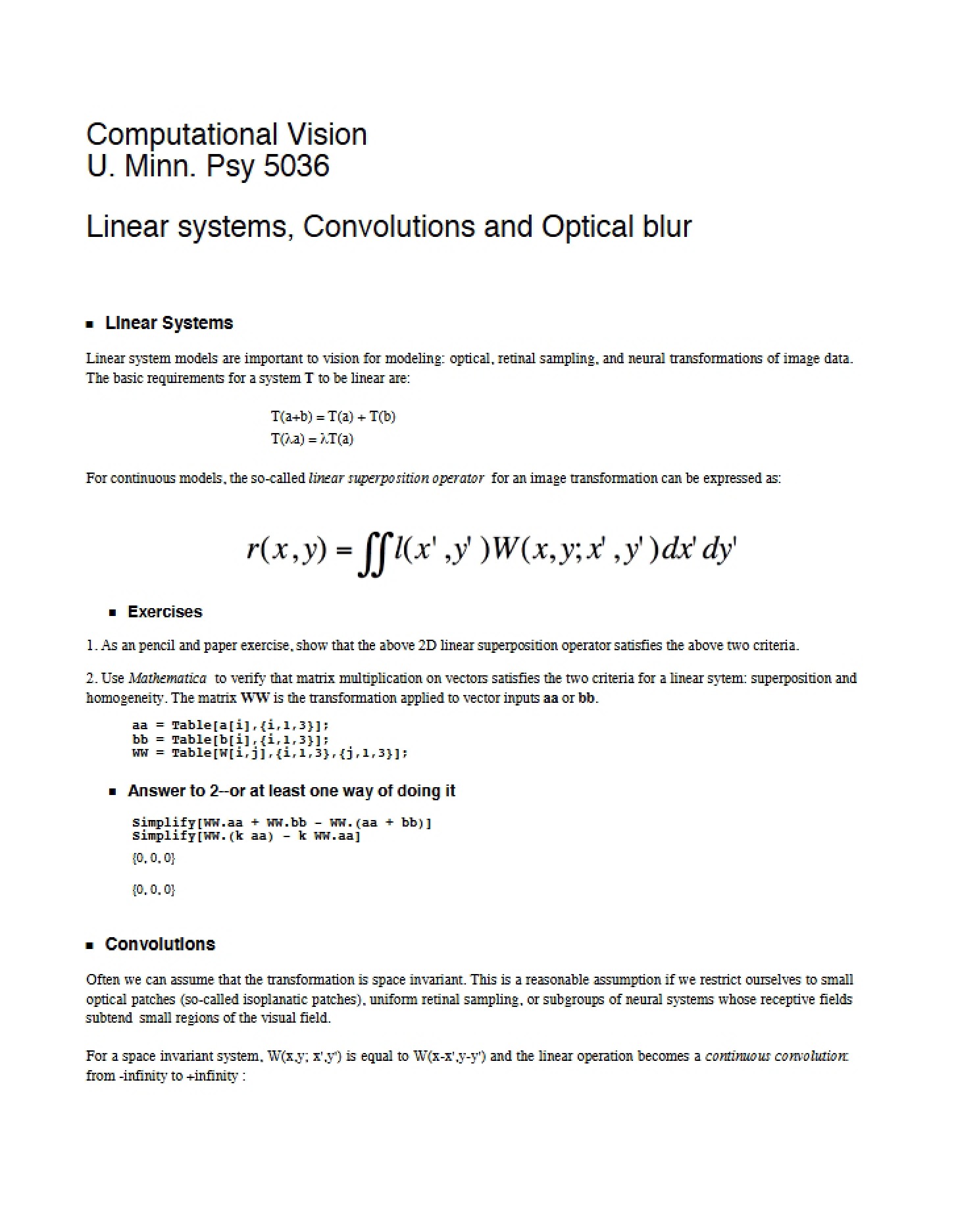
This document represents lecture notes from Computational Vision (PSY 5036W) at the University of Minnesota Twin Cities, specifically focusing on the topic of Image Coding. It delves into the principles behind how visual information is efficiently represented, drawing connections between neural processing and image processing techniques. The material builds upon foundational concepts in Fourier transforms and image operations, extending into more advanced topics within computational vision.
Why This Document Matters
Students enrolled in Computational Vision, or related fields like Neuroscience, Psychology, or Computer Science with an interest in visual processing, will find this material highly valuable. It’s particularly useful for those seeking a deeper understanding of how natural image statistics influence coding strategies, and how these strategies might be implemented in biological systems. This resource can be used to supplement classroom learning, prepare for assignments, or review key concepts before exams. It’s ideal for students wanting to explore the theoretical underpinnings of visual information processing.
Common Limitations or Challenges
This document presents a focused exploration of image coding principles. It does *not* provide a comprehensive overview of all computational vision techniques. It assumes a foundational understanding of Fourier analysis and basic image manipulation concepts. While it references biological examples, it doesn’t offer an exhaustive treatment of neurophysiological data or experimental methods. Furthermore, it focuses on specific theoretical models and may not cover all current research directions in the field.
What This Document Provides
* An exploration of efficient coding principles in relation to natural image statistics.
* Discussion of the functional rationale behind certain neural response characteristics.
* Connections between image processing techniques (like histogram equalization) and biological visual systems.
* Considerations regarding the impact of image compression on statistical properties.
* Illustrative examples utilizing image data for analysis.