What This Document Is
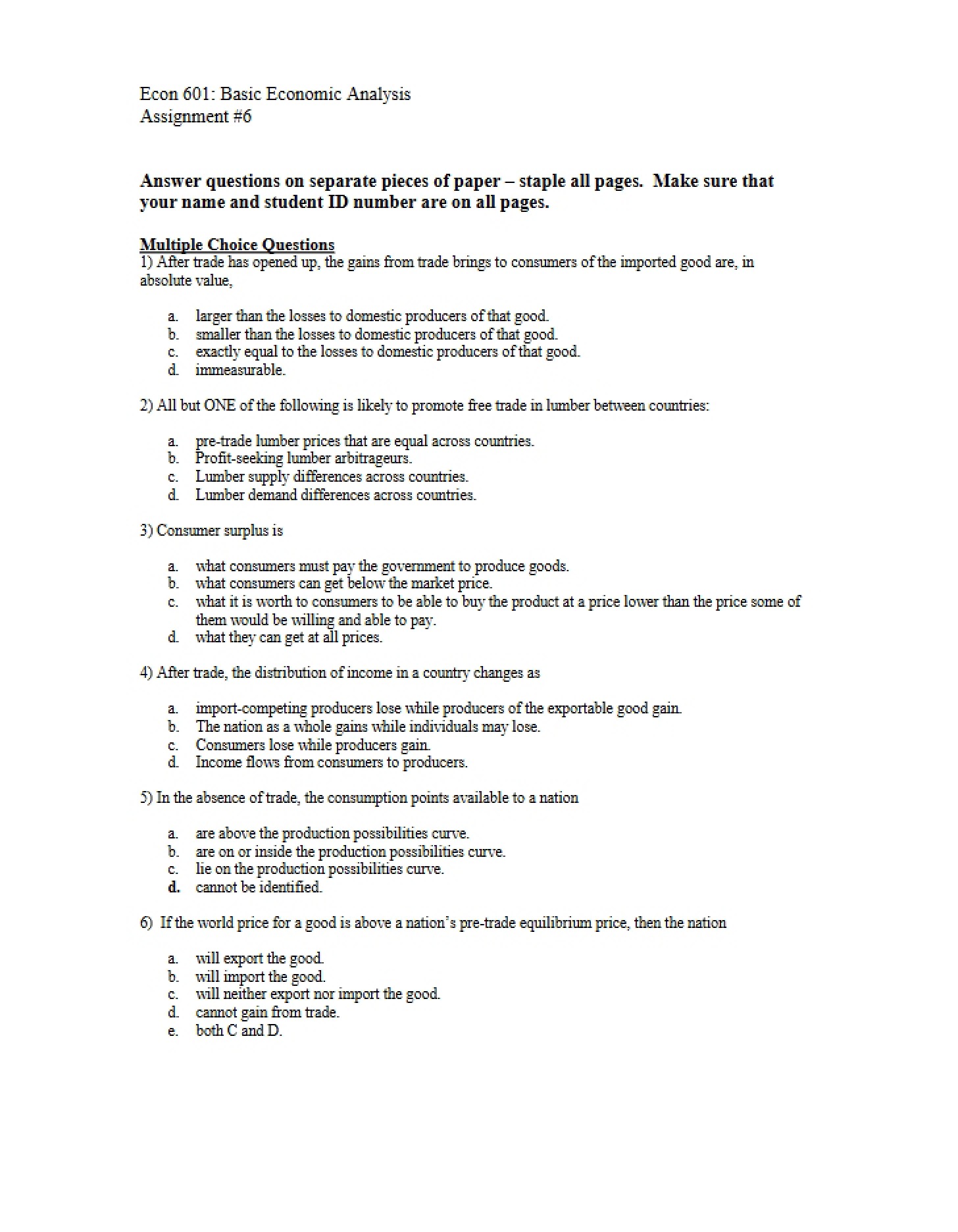
This is a graded assignment for ECON 6010: Basic Economic Analysis at Western Michigan University. It focuses on the intersection of government policies and labor market dynamics. The assignment challenges students to apply core economic principles to real-world scenarios involving labor supply, demand, and the impact of regulations. It’s designed to test your understanding of how various factors influence employment decisions and wage determination.
Why This Document Matters
This assignment is crucial for students enrolled in introductory economics courses, particularly those concentrating in labor economics, public policy, or related fields. Successfully completing this work will demonstrate your ability to analyze complex economic situations, interpret data, and formulate reasoned conclusions. It’s particularly helpful when preparing for assessments that require applying theoretical knowledge to practical problems. Students will benefit from working through these questions as they build a foundation for more advanced economic study.
Common Limitations or Challenges
This assignment requires a solid grasp of foundational economic concepts related to market structures, labor theory, and government intervention. It does *not* provide a comprehensive review of these underlying principles; students are expected to have already acquired that knowledge through coursework and readings. The assignment also doesn’t offer step-by-step solutions or detailed explanations – it’s designed to be a test of your independent analytical skills. It assumes familiarity with basic economic modeling techniques.
What This Document Provides
* A series of text-based questions exploring concepts like natural monopolies and the effects of key labor laws (National Labor Relations Act and the Taft-Hartley Act).
* A data set requiring calculations of Total Revenue and Marginal Revenue Product, followed by the construction of a labor demand schedule.
* An analytical problem involving a shift in market demand and its impact on a firm’s hiring decisions, considering both price and wage changes.
* A selection of multiple-choice questions designed to assess understanding of labor supply, labor demand, and productivity concepts.
* Scenarios prompting application of economic principles to understand firm behavior and market outcomes.