What This Document Is
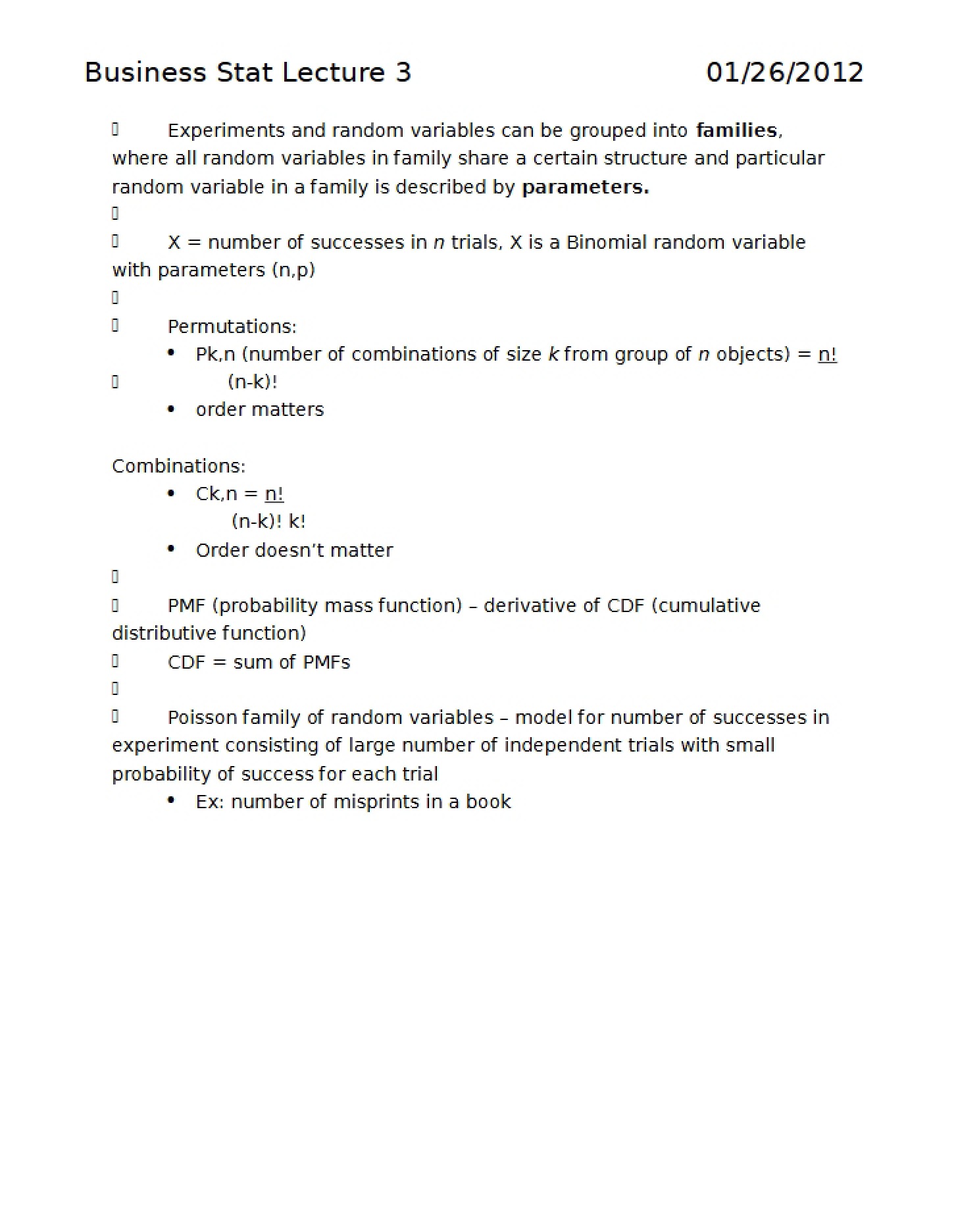
This document represents lecture notes from BUAD 310, Applied Business Statistics at the University of Southern California, specifically focusing on descriptive statistics. Lecture 3 delves into key concepts for understanding data spread and relationships between variables – Variance, Standard Deviation, Covariance, and Correlation. It’s designed to build a foundational understanding of these statistical measures and their practical applications in a business context. The material presented is geared towards students seeking a robust grasp of statistical principles.
Why This Document Matters
Students enrolled in introductory business statistics courses, or those needing a refresher on these core concepts, will find this resource particularly valuable. It’s ideal for use during exam preparation, when working through homework assignments, or as a supplementary aid to classroom learning. Professionals seeking to interpret statistical reports and make data-driven decisions in fields like finance, marketing, or operations management will also benefit from a solid understanding of these principles. Understanding these concepts is crucial for interpreting data and drawing meaningful conclusions.
Common Limitations or Challenges
This material focuses on the *concepts* and *principles* behind variance, standard deviation, covariance, and correlation. It does not provide a comprehensive guide to statistical software packages or detailed walkthroughs of complex calculations. While sample data is referenced to illustrate the ideas, the document does not offer step-by-step solutions to specific problems. It assumes a basic understanding of mathematical notation and statistical terminology. It is intended to supplement, not replace, textbook readings and in-class instruction.
What This Document Provides
* An explanation of how variance and standard deviation quantify data dispersion.
* An overview of the importance of understanding the spread of data in statistical analysis.
* An introduction to the concept of covariance as a measure of the relationship between two variables.
* A discussion of correlation and its interpretation as a measure of linear association.
* Illustrative examples referencing stock price data to demonstrate the application of these concepts.
* An exploration of degrees of freedom in the context of statistical calculations.