What This Document Is
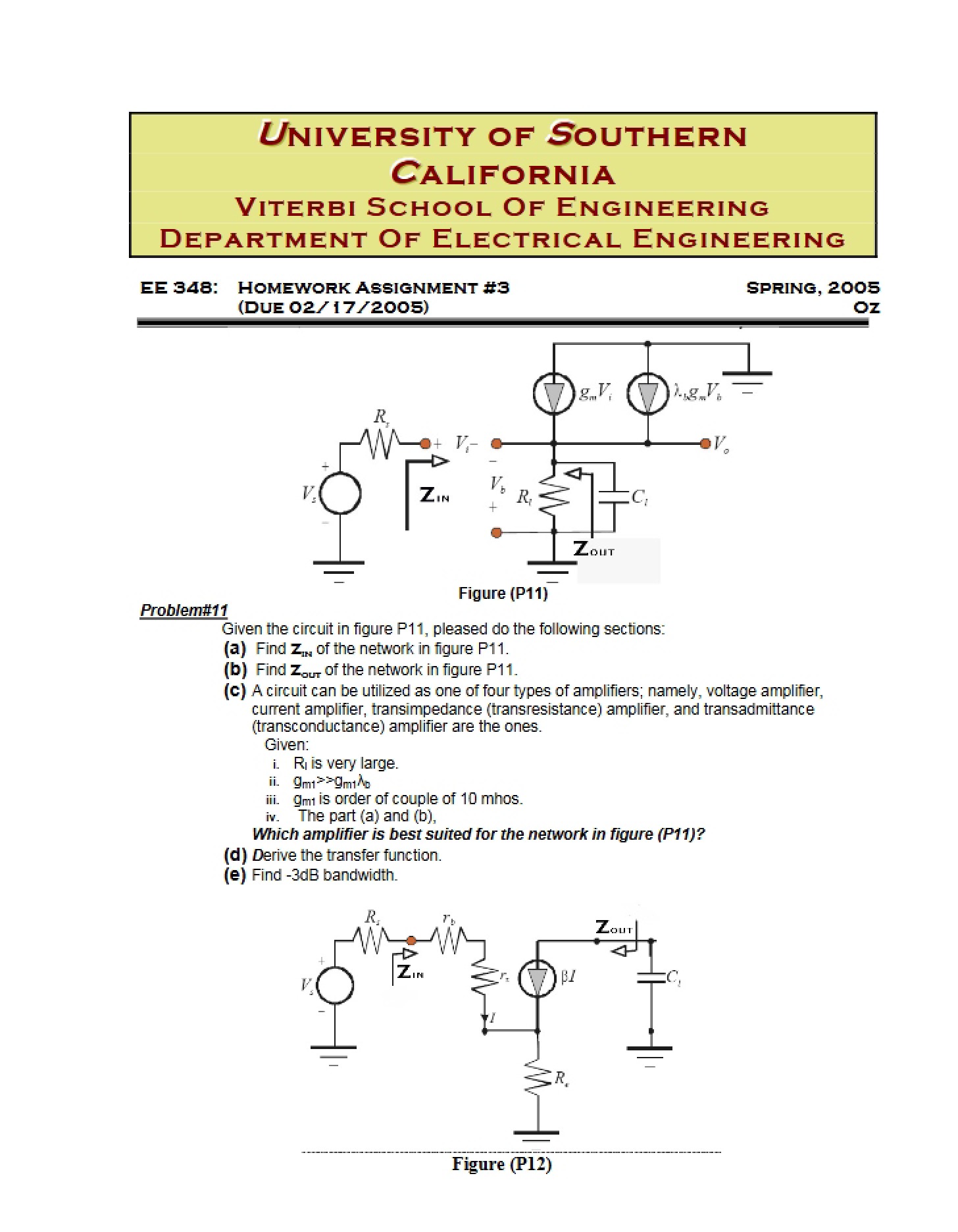
This is a detailed, worked solution set for a homework assignment in an advanced Electronic Circuits course (EE 348L) at the University of Southern California. It focuses on the analysis of multi-stage feedback amplifier circuits, a core topic in analog circuit design. The assignment delves into the theoretical underpinnings of current gain calculations within these amplifiers, exploring both open-loop and closed-loop configurations. It utilizes circuit diagrams and mathematical derivations to illustrate key concepts.
Why This Document Matters
This resource is invaluable for students currently enrolled in a similar electronic circuits course, particularly those struggling with the complexities of feedback amplifier analysis. It’s most beneficial when used *after* attempting the original homework problems independently. Reviewing a detailed solution can clarify misunderstandings, highlight common pitfalls, and reinforce the application of fundamental circuit analysis techniques. It’s also helpful for students preparing for exams covering amplifier design and analysis.
Common Limitations or Challenges
This document provides a complete solution to a *specific* homework assignment. It does not offer a comprehensive overview of all feedback amplifier topologies or a step-by-step tutorial on solving circuit problems from scratch. It assumes a foundational understanding of transistor characteristics, small-signal analysis, and basic circuit laws. It will not substitute for attending lectures, reading the textbook, or actively participating in problem-solving sessions.
What This Document Provides
* Detailed analysis of a two-stage feedback amplifier circuit.
* Derivation of current gain expressions for both open-loop and closed-loop configurations.
* Examination of the impact of feedback resistance on amplifier gain.
* Circuit diagrams illustrating key concepts and configurations.
* Mathematical relationships describing voltage and current behavior within the amplifier.
* Discussion of the relationship between transistor parameters and overall circuit performance.