What This Document Is
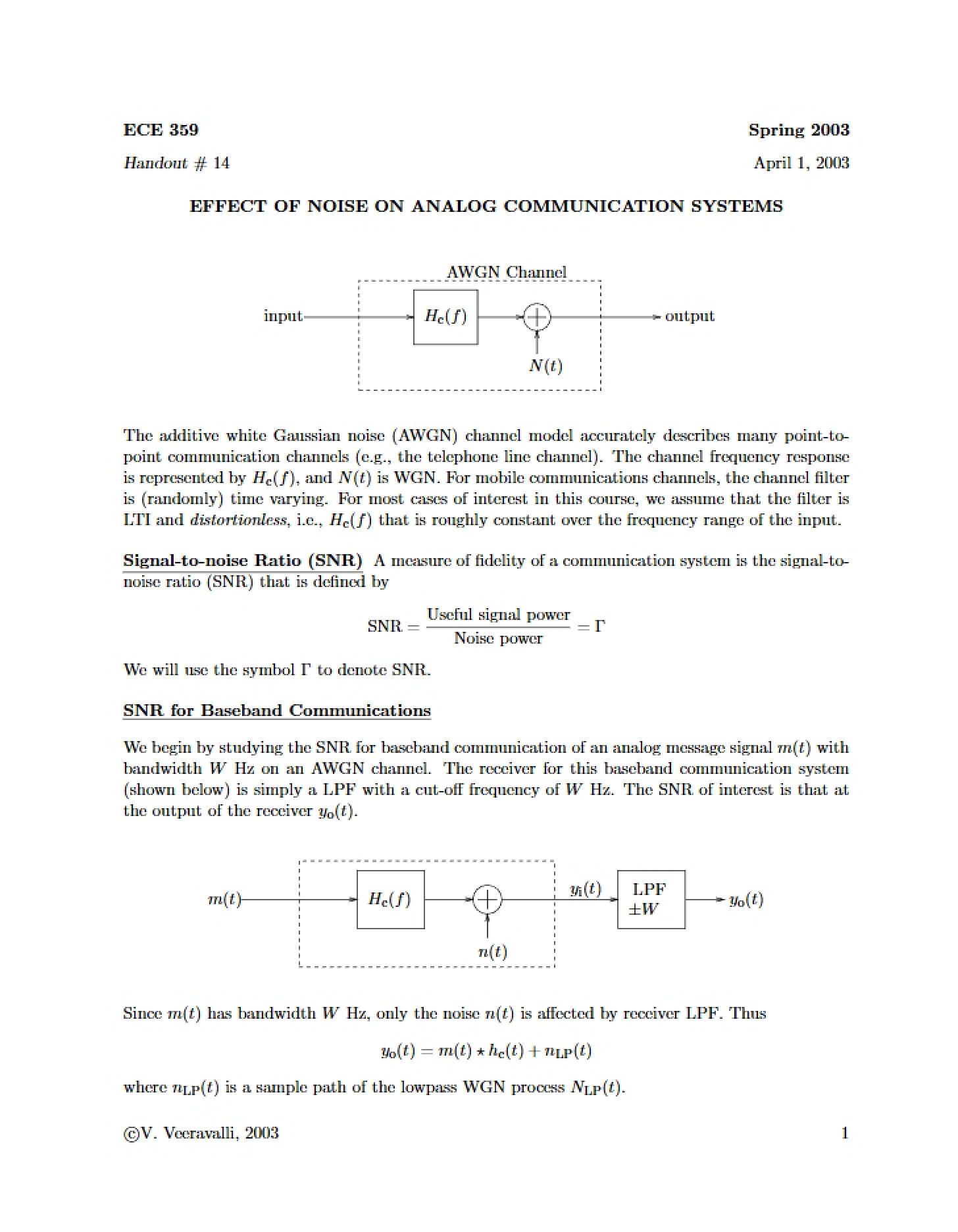
This is a focused handout exploring signal-to-noise ratio (SNR) analysis within the context of Double-Sideband Suppressed-Carrier (DSB-SC) communication systems. Developed for an advanced undergraduate course in communication systems, it delves into the performance characteristics of these systems when operating in an Additive White Gaussian Noise (AWGN) environment. The material builds upon foundational concepts in modulation and receiver design, offering a deeper understanding of system limitations and optimization.
Why This Document Matters
This resource is ideal for Electrical and Computer Engineering students enrolled in communication systems courses. It’s particularly beneficial when studying analog modulation techniques and preparing to analyze the performance of real-world communication links. Students grappling with the impact of noise on signal quality, or seeking to compare different modulation schemes, will find this a valuable study aid. It’s best used alongside lecture notes and textbooks to reinforce core principles.
Topics Covered
* DSB-SC Modulation and Demodulation
* SNR Calculation in AWGN Channels
* Coherent Detection Techniques
* Performance Comparison with Baseband Systems
* Conventional AM Modulation with Coherent Demodulation
* Envelope Detection Considerations (qualitative overview)
* Impact of Noise on System Performance
* Normalized Message Signal and Modulation Index effects
What This Document Provides
* A detailed examination of SNR calculations for DSB-SC systems.
* Mathematical frameworks for evaluating system performance in noisy environments.
* Comparative analysis of DSB-SC and conventional AM modulation schemes.
* Discussion of the trade-offs associated with different detection methods.
* Insights into the relationship between modulation parameters and SNR.
* A foundation for understanding more complex modulation techniques.