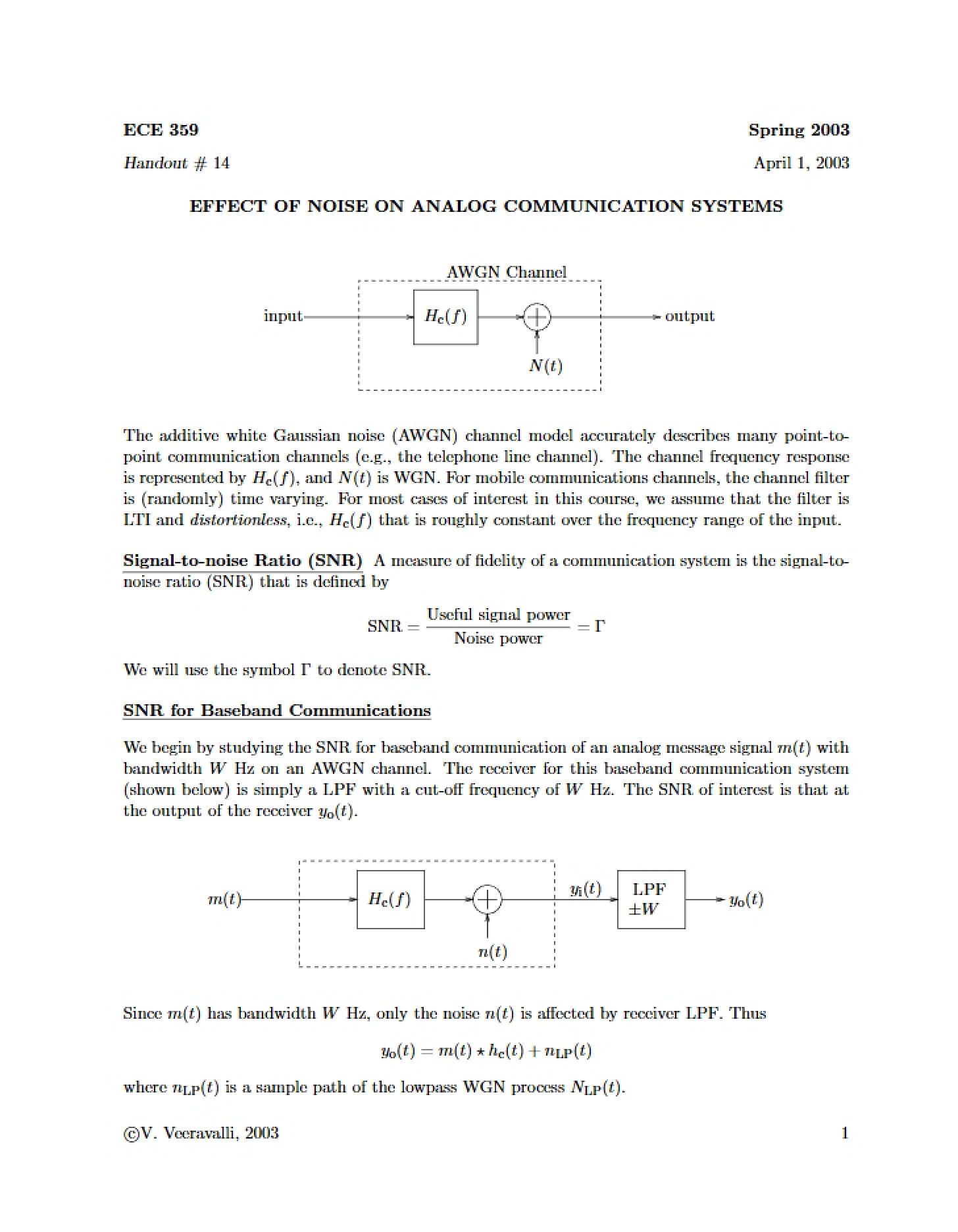
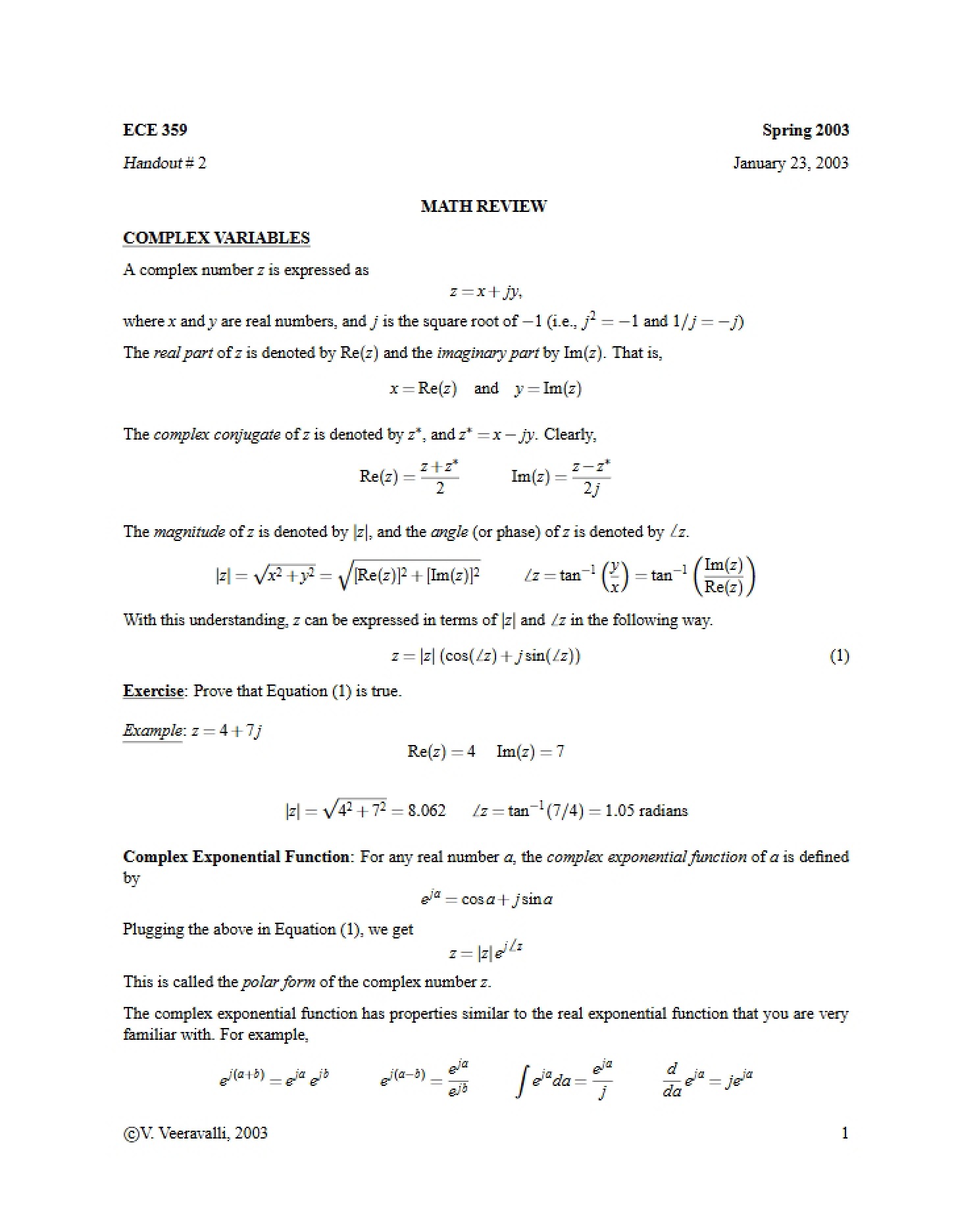
What This Document Is
This handout from ECE 359 at the University of Illinois at Urbana-Champaign delves into the mathematical foundations of Gaussian Random Processes – a core concept in communication systems. It’s a focused exploration designed to build a strong theoretical understanding of random processes exhibiting Gaussian distributions. This material is intended to supplement lectures and provide a detailed reference for students tackling advanced problems in the field.
Why This Document Matters
This resource is invaluable for students in communication systems, signal processing, and related electrical engineering courses. It’s particularly helpful when you need a deeper dive into the properties and behaviors of Gaussian processes than can be covered in a standard lecture. Use this handout when working on assignments involving noise analysis, system modeling, or performance evaluation where probabilistic descriptions are essential. It’s also a strong foundation for more advanced coursework.
Topics Covered
* Characterization of Gaussian Random Processes
* White Gaussian Noise and its properties
* The relationship between Power Spectral Density (PSD) and Autocorrelation
* The impact of Linear Time-Invariant (LTI) systems on Gaussian processes
* Filtering of White Gaussian Noise through various filter types (Low-Pass, Band-Pass)
* Mathematical representation of Band-Pass filtered signals
* Statistical independence of components within filtered signals
What This Document Provides
* A rigorous definition of Gaussian Random Processes and their key characteristics.
* Detailed explanations of idealizations used in modeling real-world noise.
* Formulations for analyzing the output of Gaussian processes passed through LTI systems.
* Mathematical descriptions of the spectral and autocorrelation properties of filtered White Gaussian Noise.
* A proposition relating Band-Pass filtered signals to low-pass processes, with supporting rationale.
* Key equations and relationships for further study and application.