What This Document Is
This document represents the eighth lesson within the Dynamics of Mechanical Systems (ME 340) course at the University of Illinois at Urbana-Champaign. It delves into the critical concepts of resonance, modal frequencies, and mode shapes – fundamental principles in understanding the behavior of dynamic systems. The lesson builds upon prior knowledge of mass-spring-damper systems and frequency response, extending those concepts to more complex scenarios involving coupled systems. It utilizes mathematical representations and system diagrams to illustrate these principles.
Why This Document Matters
This lesson is essential for mechanical engineering students seeking a robust understanding of how systems respond to external forces. It’s particularly valuable for those focused on design, control systems, or vibration analysis. Understanding resonance is crucial for preventing catastrophic failures in engineered structures and machines. This material will be most helpful when you are analyzing systems prone to oscillatory behavior, designing for specific frequency ranges, or troubleshooting unwanted vibrations. It serves as a foundational building block for more advanced topics in dynamics and control.
Common Limitations or Challenges
This lesson focuses on the theoretical underpinnings of resonance and related concepts. It does not provide a comprehensive guide to practical implementation or real-world case studies. While system diagrams are used, the document assumes a working knowledge of block diagram manipulation and transfer function analysis. It also doesn’t offer step-by-step solution manuals or pre-solved problems; the intention is to foster independent problem-solving skills. Access to this lesson alone will not guarantee mastery of the subject – it’s designed to be part of a larger learning experience.
What This Document Provides
* A detailed exploration of the conditions leading to resonance in linear systems.
* Discussion of the impact of damping on resonance behavior.
* Analysis of coupled systems and their influence on resonant frequencies.
* Introduction to the concepts of modal frequencies and mode shapes.
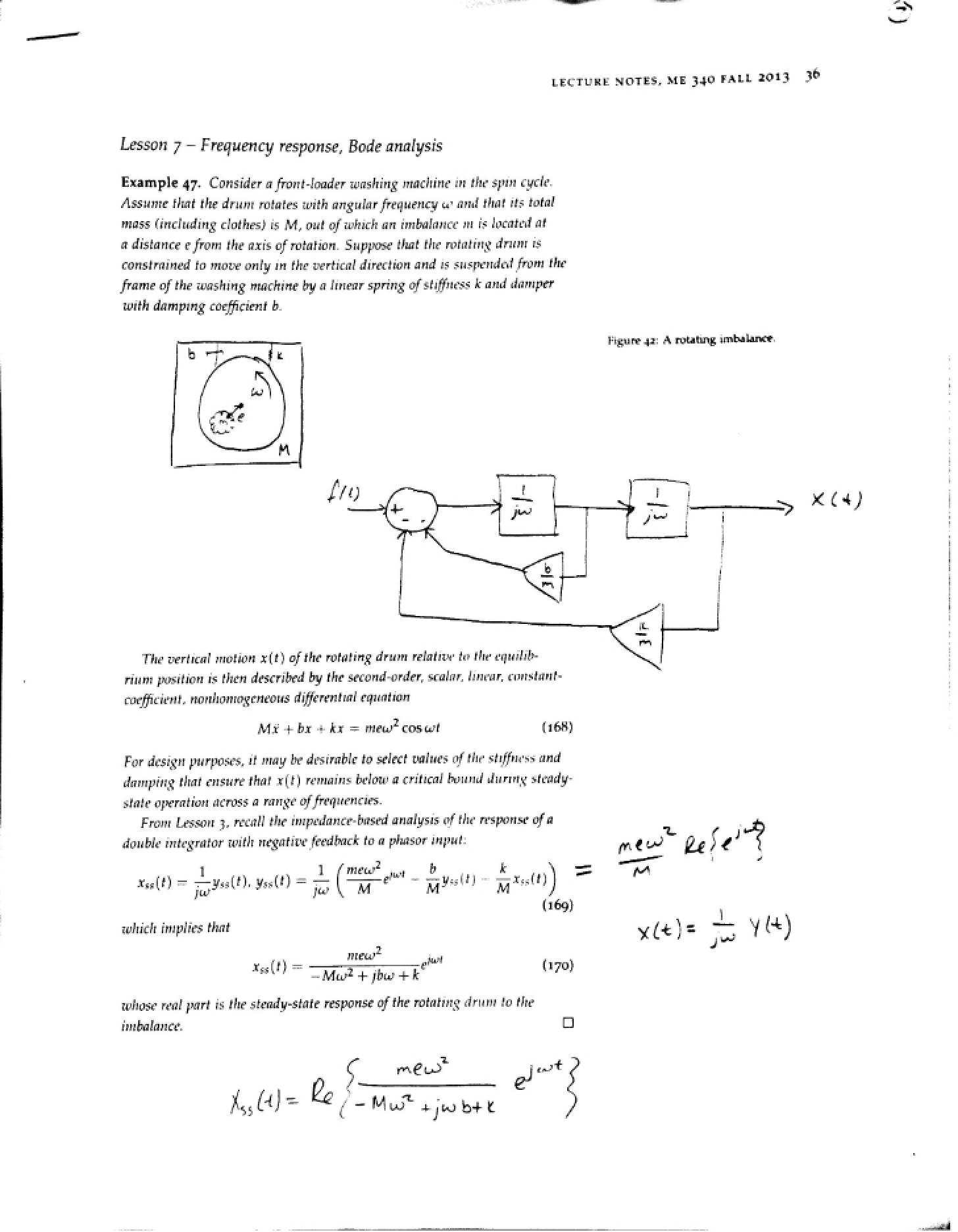
* Illustrative examples involving coupled double integrators to demonstrate key principles.
* Mathematical formulations relating to frequency response and system stability.