What This Document Is
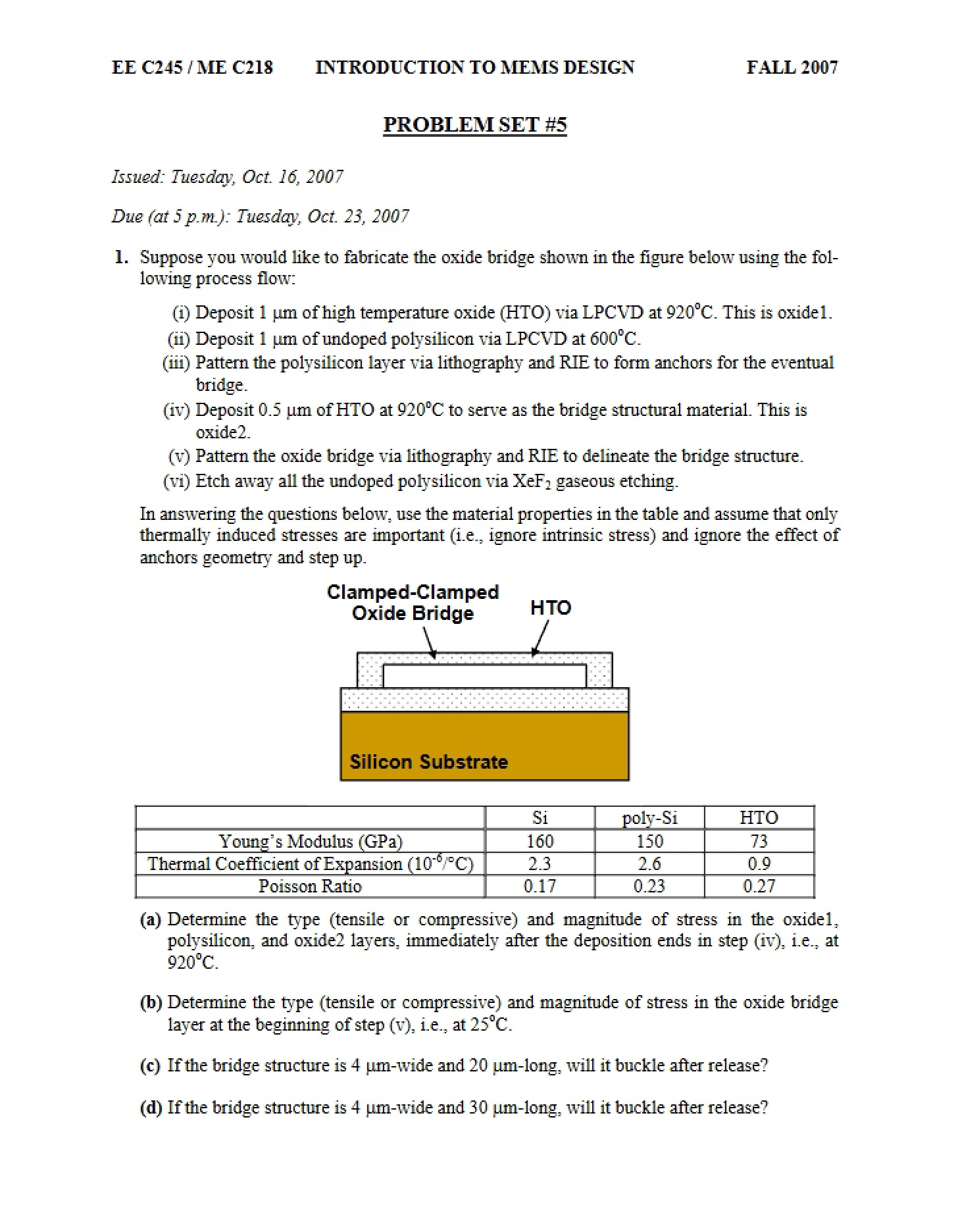
This is a homework assignment for an advanced course in Micro-Electro-Mechanical Systems (MEMS) design, specifically ELENG C247B at UC Berkeley. It challenges students to apply theoretical knowledge to practical design and analysis problems within the field of MEMS. The assignment focuses on utilizing simulation software and analytical calculations to understand the behavior of various MEMS devices. It builds upon foundational concepts explored in prior coursework and prepares students for more complex design challenges.
Why This Document Matters
This assignment is crucial for students pursuing careers in MEMS development, sensor technology, or related engineering fields. Successfully completing it demonstrates a strong grasp of core MEMS principles and the ability to translate those principles into tangible designs. It’s particularly valuable for those intending to work with microfabrication processes like MUMPS and for anyone needing to model and predict the performance of microscale mechanical systems. This assignment will be most helpful when you are actively engaged in applying MEMS design principles to solve engineering problems.
Topics Covered
* Electrostatic actuation and instability in MEMS
* Thermal actuation principles and analysis
* Resonant frequency calculations and design
* Mechanical resonance and quality factor considerations
* Beam deflection and stress analysis
* Use of simulation software (SUGAR) for MEMS design verification
* Comb drive actuator and sensor concepts
* Gap closing actuator design and pull-in voltage analysis
What This Document Provides
* A series of design problems requiring both analytical calculations and simulation using SUGAR software.
* Opportunities to explore the relationship between geometric parameters, material properties, and device performance.
* A framework for understanding the limitations of simplified models and the importance of considering real-world effects.
* Problem statements that encourage critical thinking and application of MEMS design methodologies.
* A practical application of theoretical concepts related to thermal and electrostatic forces in MEMS.