What This Document Is
This document represents Lecture 6 from the Introduction to MEMS Design (ELENG C245) course at UC Berkeley, focusing on the foundational principles of etching – a critical process in Micro-Electro-Mechanical Systems (MEMS) fabrication. It delves into the core concepts necessary for understanding how material is selectively removed during MEMS device creation. This lecture provides a detailed exploration of both wet and dry etching techniques, laying the groundwork for more advanced fabrication methods covered later in the course.
Why This Document Matters
This lecture is essential for students and professionals involved in MEMS design and fabrication. It’s particularly valuable for those seeking a strong understanding of the underlying physics and chemistry governing material removal processes. Anyone preparing to design, simulate, or manufacture MEMS devices will benefit from a thorough grasp of the concepts presented here. It serves as a key building block for understanding process flow and limitations in MEMS manufacturing.
Topics Covered
* Fundamental etching principles and definitions
* Anisotropy in etching – isotropic vs. anisotropic etching behaviors
* The concept of selectivity and its importance in multi-layer structures
* Overetching considerations and their impact on feature dimensions
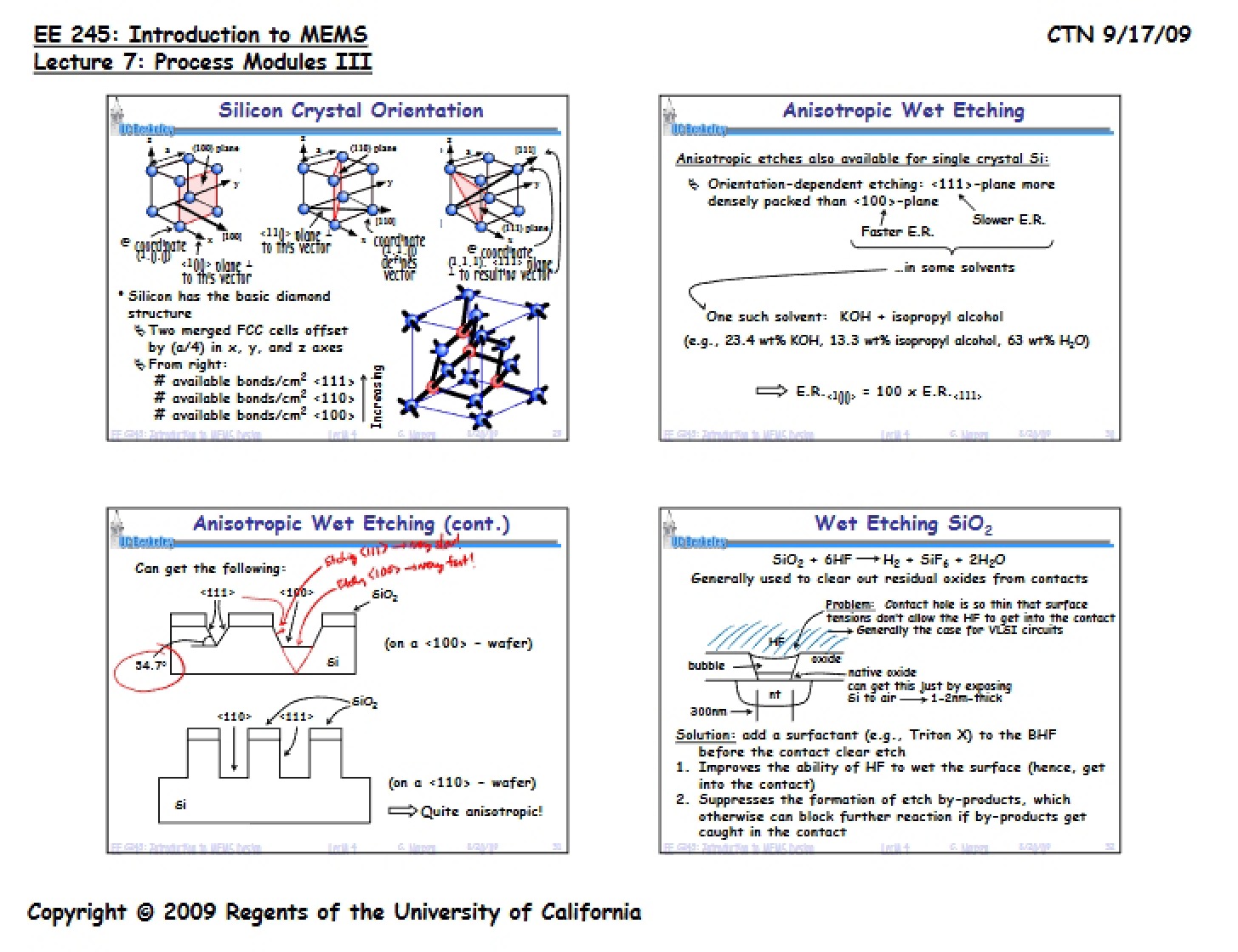
* Wet etching mechanisms and advantages
* Factors influencing wet etching rates and selectivity
* Diffusion processes involved in wet etching
What This Document Provides
* A detailed outline of the lecture’s key discussion points.
* Definitions of crucial etching parameters like anisotropy and selectivity.
* An examination of the trade-offs between different etching approaches.
* Insights into the challenges associated with achieving precise material removal.
* A foundational understanding of the chemical processes involved in wet etching.
* Discussion of practical considerations for optimizing etching processes.