What This Document Is
This material provides a focused exploration of co-adaptation within the framework of evolutionary biology. Specifically, it delves into the intricacies of how different species evolve *in relation* to one another, moving beyond simple interactions to examine long-term reciprocal evolutionary changes. It’s designed for students engaged in advanced study of phylogenetic principles, ecology, and evolutionary processes, building upon concepts related to cladograms and comparative methods. The content originates from an Integrative Biology course at the University of California, Berkeley.
Why This Document Matters
This resource is particularly valuable for students tackling complex questions about species relationships and the historical forces shaping biodiversity. It’s ideal for those preparing to conduct research involving phylogenetic analyses, or seeking a deeper understanding of the methods used to investigate co-evolutionary patterns. If you’re grappling with how to interpret evolutionary relationships beyond individual lineages, and how to test hypotheses about the drivers of those relationships, this will be a helpful resource.
Topics Covered
* Defining co-evolution and distinguishing it from broader evolutionary interactions.
* The role of different ecological interactions (competition, predation, mutualism, etc.) in driving co-evolution.
* The concept of symbiosis and its connection to co-evolutionary processes.
* Cospeciation – a specific pattern resulting from prolonged co-evolution.
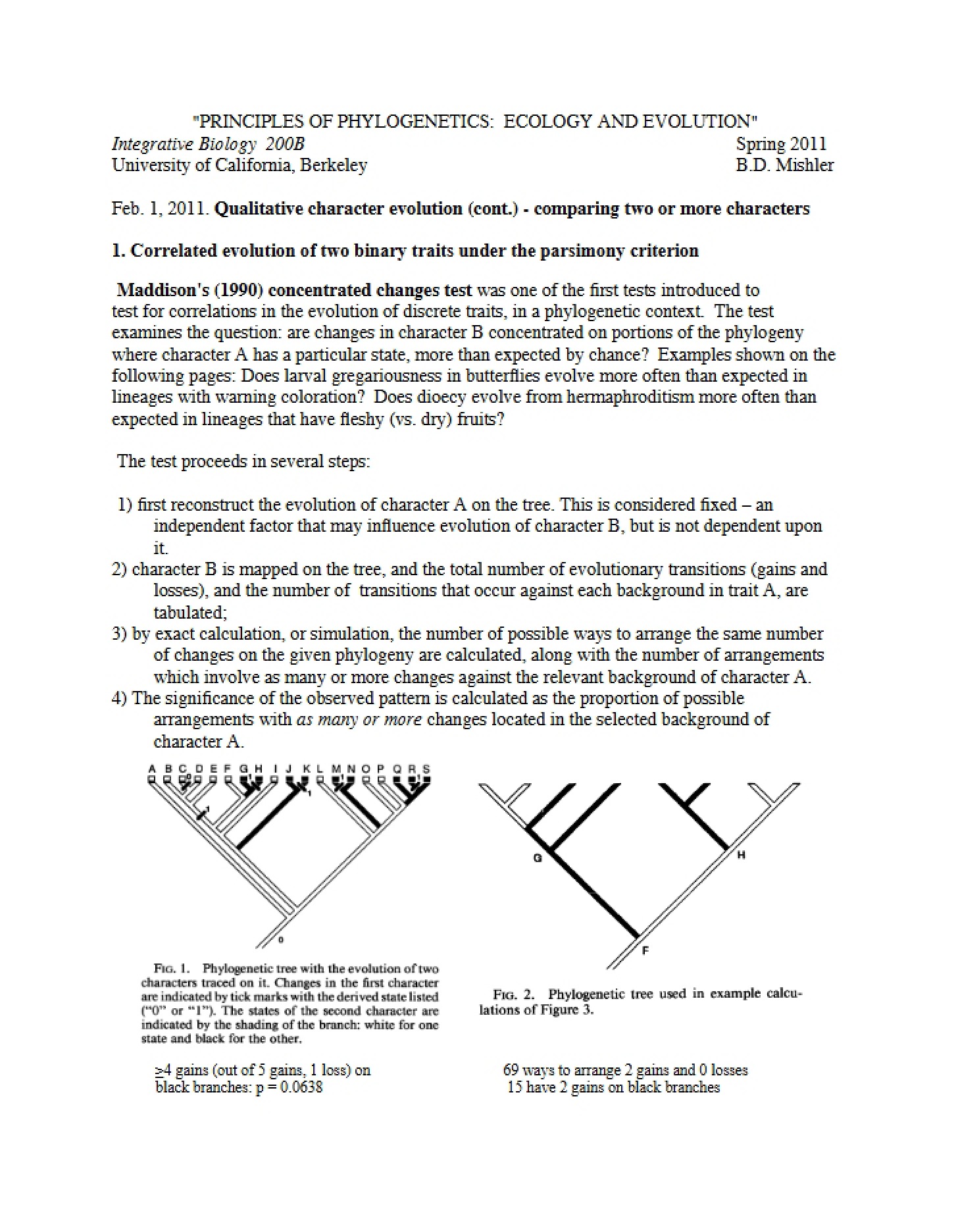
* Methodological approaches for studying co-evolution using phylogenetic comparative methods.
* Formulating and testing hypotheses related to co-evolutionary relationships.
What This Document Provides
* A detailed discussion of the criteria for identifying true co-evolutionary relationships.
* An overview of how phylogenetic congruence can be used to infer co-speciation events.
* A framework for designing comparative studies using cladograms and character data.
* Guidance on establishing null hypotheses and designing tests to evaluate co-evolutionary scenarios.
* A curated list of relevant scientific literature for further exploration of the topic.