What This Document Is
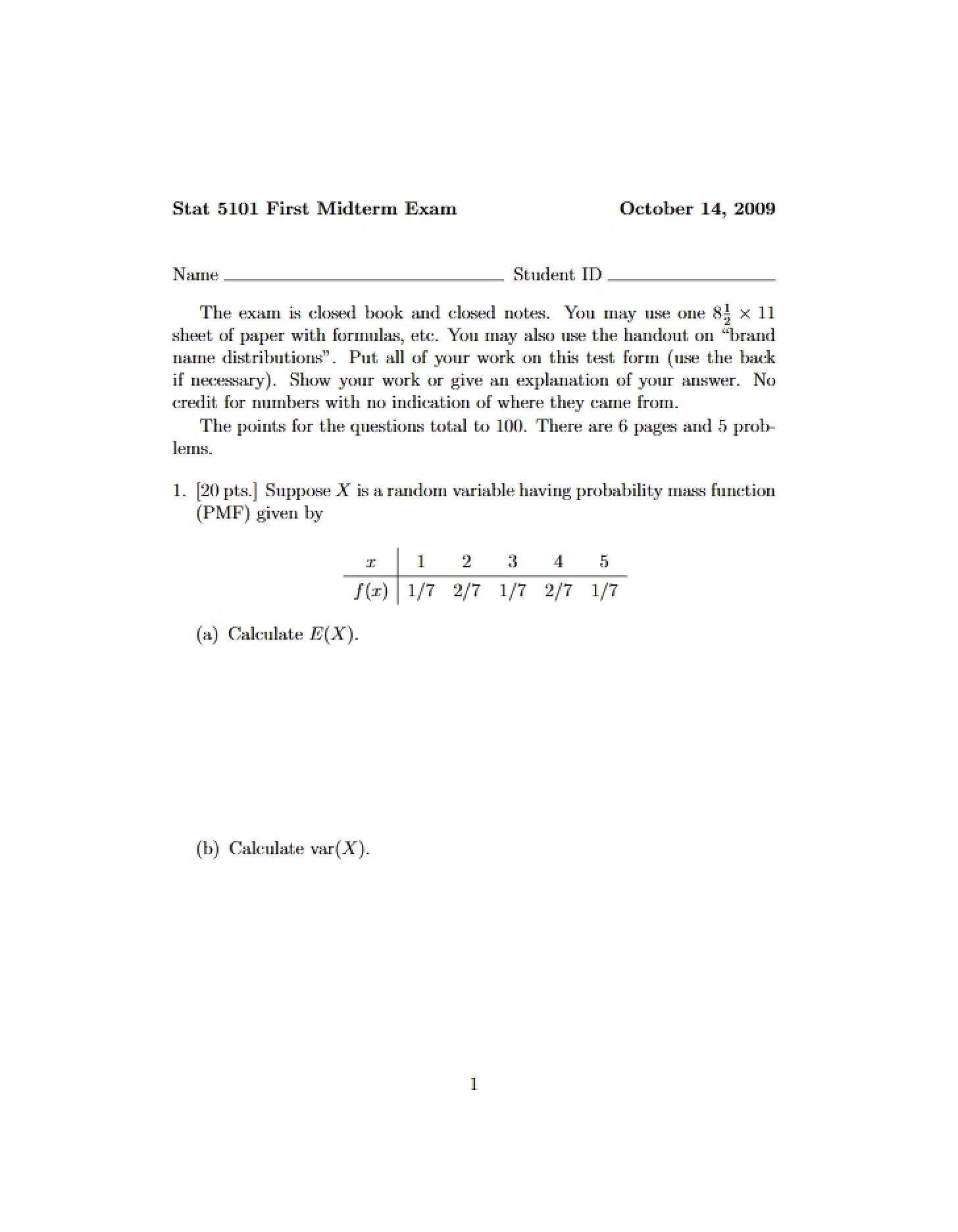
This is a final examination for STATS 5101, Theory of Statistics I, offered at the University of Minnesota Twin Cities. It’s a comprehensive assessment designed to evaluate a student’s understanding of core statistical concepts covered throughout the semester. The exam focuses on theoretical foundations rather than computational exercises, requiring a strong grasp of probability distributions and statistical principles. It’s a closed-book, closed-notes exam, emphasizing recall and application of learned material.
Why This Document Matters
This resource is invaluable for students currently enrolled in, or preparing to take, a rigorous Theory of Statistics I course. It’s particularly helpful for those seeking to gauge the depth and breadth of topics likely to be tested at the upper-division undergraduate or introductory graduate level. Reviewing the structure and scope of this exam can help students identify areas where their understanding needs strengthening and refine their study strategies. It’s best used *after* completing coursework and as part of a final review process.
Common Limitations or Challenges
Please note that this document presents the *exam itself* and does not include solutions, explanations, or worked examples. It will not teach you the material; rather, it assesses your existing knowledge. Accessing this exam does not guarantee success – it requires dedicated study and a solid foundation in statistical theory. The specific problems presented are from a December 2009 offering and may not perfectly reflect the content of future exams.
What This Document Provides
* A full copy of a past final examination for STATS 5101 at the University of Minnesota Twin Cities.
* Eight distinct problems covering a range of theoretical statistical topics.
* Insight into the exam format, including point values assigned to each question.
* Exposure to the types of questions asked regarding exponential distributions, probability density functions, Gamma distributions, and conditional expectations.
* An understanding of the expected level of mathematical rigor and proof-based reasoning.