What This Document Is
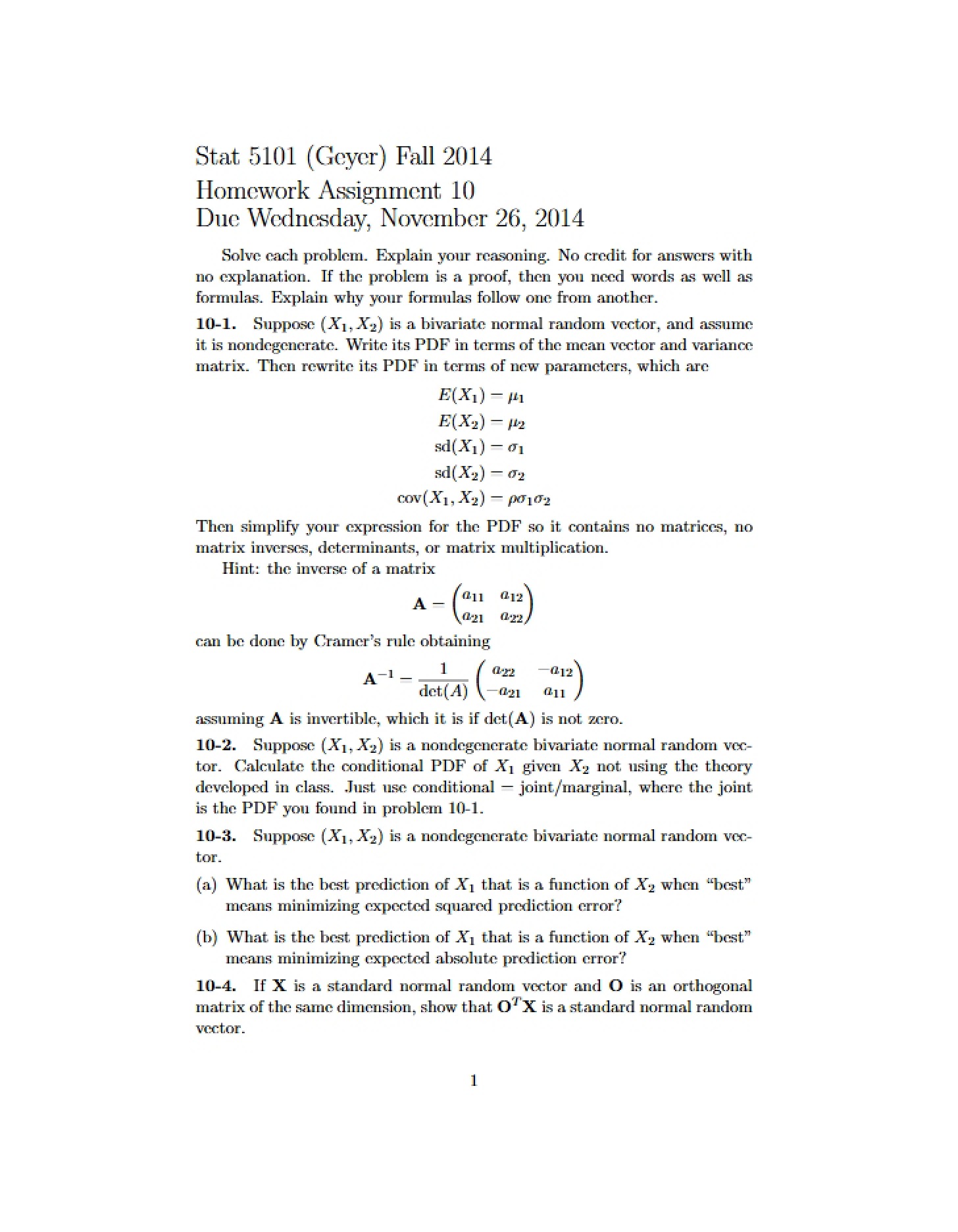
This document is a detailed solution key for Homework Assignment 04 within the STATS 5101: Theory of Statistics I course, offered at the University of Minnesota Twin Cities. It focuses on applying foundational statistical concepts to a variety of problems. The material covered builds upon earlier coursework and delves into areas like expected values, variances, covariances, and probability distributions. It appears to address both discrete and continuous random variables, and explores properties related to symmetry and transformations.
Why This Document Matters
This resource is invaluable for students currently enrolled in STATS 5101 who are seeking to verify their understanding of the homework problems. It’s particularly helpful if you’ve attempted the assignment and are looking to pinpoint areas where your approach differed or where conceptual misunderstandings may exist. Utilizing this key *after* independent effort will maximize its learning benefit. It’s best used as a study aid during exam preparation, allowing you to reinforce core principles and problem-solving techniques. Students who are struggling with the theoretical underpinnings of statistical calculations will find this particularly useful.
Common Limitations or Challenges
This solution key does *not* provide step-by-step explanations of how to arrive at the answers. It presents the final solutions, requiring you to already possess a solid grasp of the underlying statistical theory and methods. It won’t substitute for attending lectures, reading the course textbook, or actively participating in study groups. Furthermore, it focuses specifically on Homework 04 and does not cover broader course concepts outside of those problems. It assumes familiarity with previous homework assignments and related theorems.
What This Document Provides
* Detailed solutions for a series of problems related to probability distributions and their properties.
* Applications of concepts like linearity of expectation.
* Calculations involving variances and covariances of random variables.
* Exploration of relationships between different probability distributions.
* Solutions relating to transformations of random variables and their impact on probability density functions.
* Analysis of symmetric distributions and their characteristics.
* Solutions pertaining to the moments of random variables.