What This Document Is
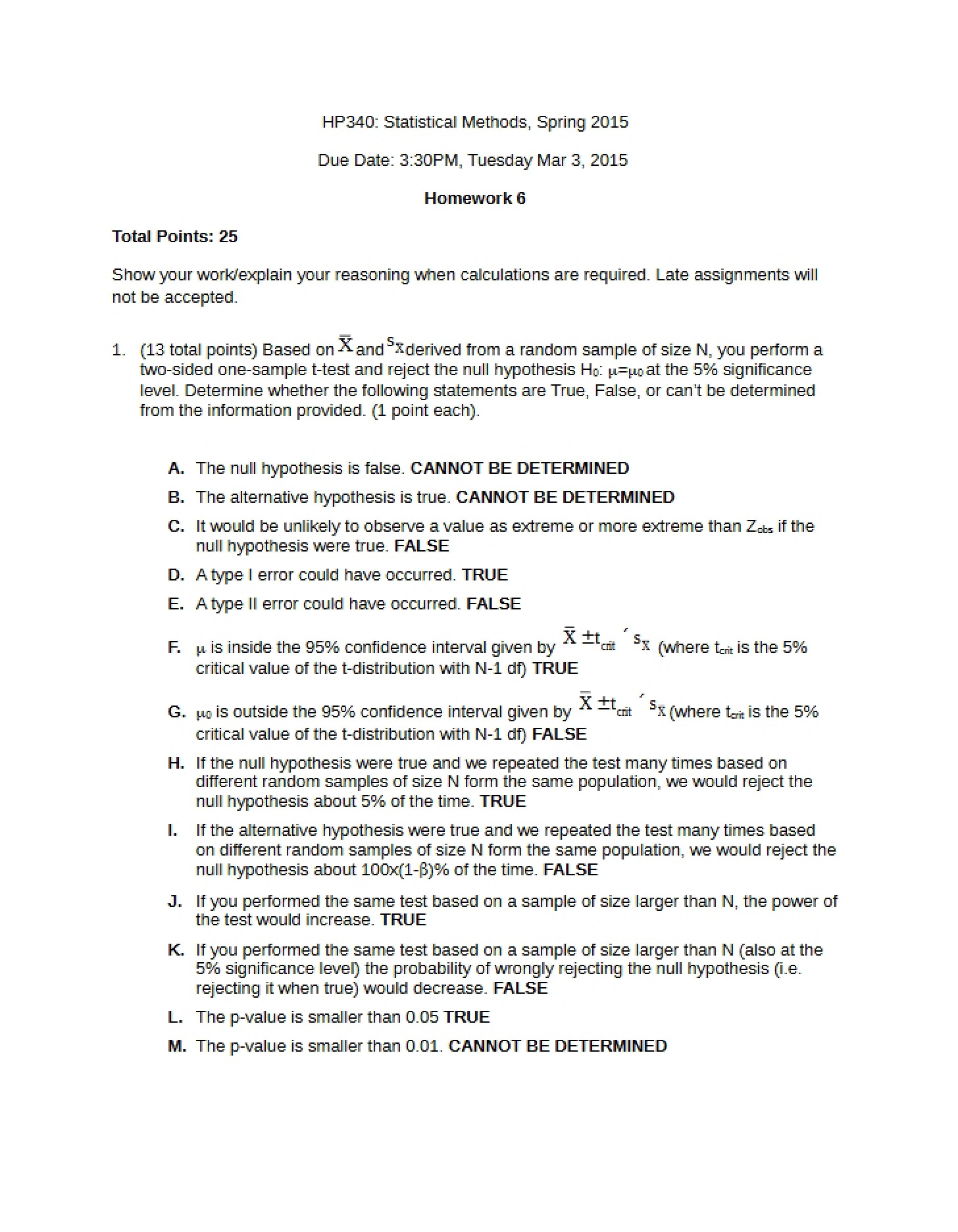
This is an extra credit homework assignment for HP 340, Health Behavior Statistical Methods at the University of Southern California. It centers around applying statistical testing to analyze and interpret research findings, specifically focusing on comparisons between proportions. The assignment requires students to demonstrate an understanding of hypothesis testing and its application to real-world scenarios in health and social science research. It builds upon core concepts taught in the course, challenging students to independently apply learned methods.
Why This Document Matters
This assignment is designed for students enrolled in HP 340 who are seeking to deepen their understanding of statistical methods and improve their overall course grade. It’s particularly beneficial for those who want to solidify their ability to translate theoretical knowledge into practical application. Students preparing for advanced coursework or careers requiring statistical analysis – such as public health research, epidemiology, or health policy – will find the skills reinforced here invaluable. Working through this assignment will help build confidence in interpreting statistical outputs and drawing meaningful conclusions from data.
Common Limitations or Challenges
This assignment focuses on the *application* of statistical tests, assuming a foundational understanding of the underlying principles. It does not provide a comprehensive review of basic statistical concepts. Students should already be familiar with concepts like null and alternative hypotheses, significance levels, and test statistics. Furthermore, the assignment focuses on a specific type of statistical test – the two-sample binomial test – and does not cover the full range of statistical methods used in health behavior research. It also doesn’t offer detailed guidance on data collection or study design.
What This Document Provides
* A scenario based on a well-known psychological study involving obedience to authority.
* Data sets for analysis, presented in a structured format.
* A framework for formulating hypotheses related to population proportions.
* Opportunities to practice calculating test statistics and interpreting p-values.
* References to external resources for further exploration of the statistical methods used.
* A focus on interpreting the results of statistical tests in the context of research findings.