What This Document Is
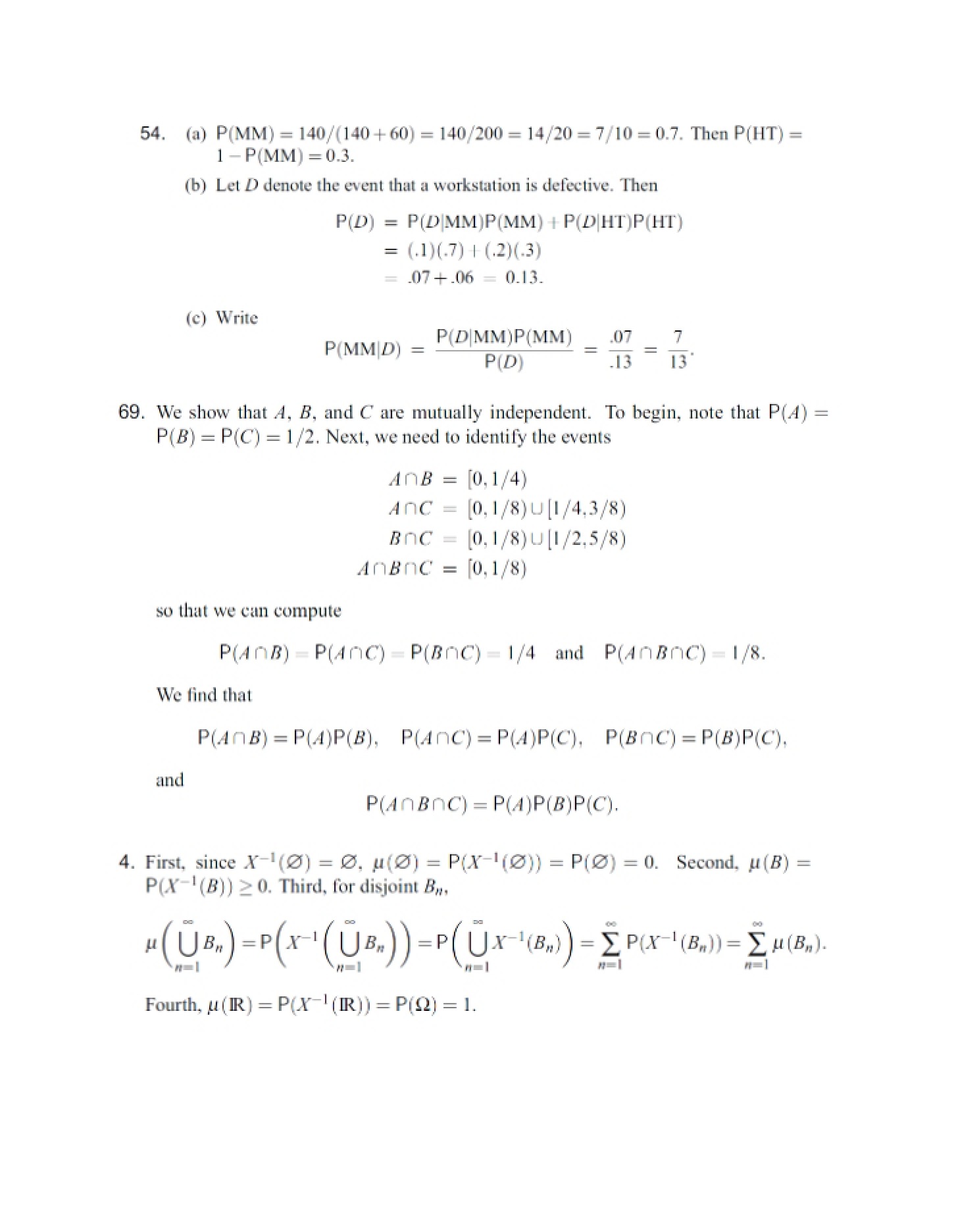
This document consists of a collection of practice problems designed to help students prepare for a final examination in Probability and Stochastic Processes (ESE 520) at Washington University in St. Louis. It’s structured as a problem set, covering a range of topics central to the course’s curriculum. The problems are intended to be challenging and representative of the types of questions students may encounter on the final exam. It focuses on applying theoretical knowledge to problem-solving scenarios.
Why This Document Matters
This resource is invaluable for students seeking to solidify their understanding of probability and stochastic processes before a major assessment. It’s particularly useful for those who learn best by working through examples and testing their knowledge independently. Utilizing these practice problems can help identify areas where further study is needed and build confidence in tackling complex concepts. Students who are aiming for a comprehensive grasp of the material, and those who want to simulate exam conditions, will find this particularly beneficial.
Common Limitations or Challenges
This document does *not* include detailed solutions or step-by-step explanations. It presents the problems themselves, requiring students to draw upon their course notes, textbooks, and understanding of the underlying principles to arrive at answers. It also assumes a foundational knowledge of probability theory, random variables, and stochastic processes as taught within the ESE 520 course. It is not a substitute for attending lectures or completing assigned readings.
What This Document Provides
* Problems assessing understanding of fundamental probability space concepts.
* Questions relating to the properties and transformations of random variables.
* Exercises focused on Gaussian random variables and their statistical characteristics.
* Problems involving characteristic functions and their application to distributions.
* Questions exploring linear estimation techniques in the context of random vectors.
* Practice with covariance functions and their properties for Poisson processes.
* Problems related to stationary Gaussian processes and their analysis.
* Exercises involving Wiener processes and related stochastic processes.
* Questions on spectral density and its relationship to covariance functions.