What This Document Is
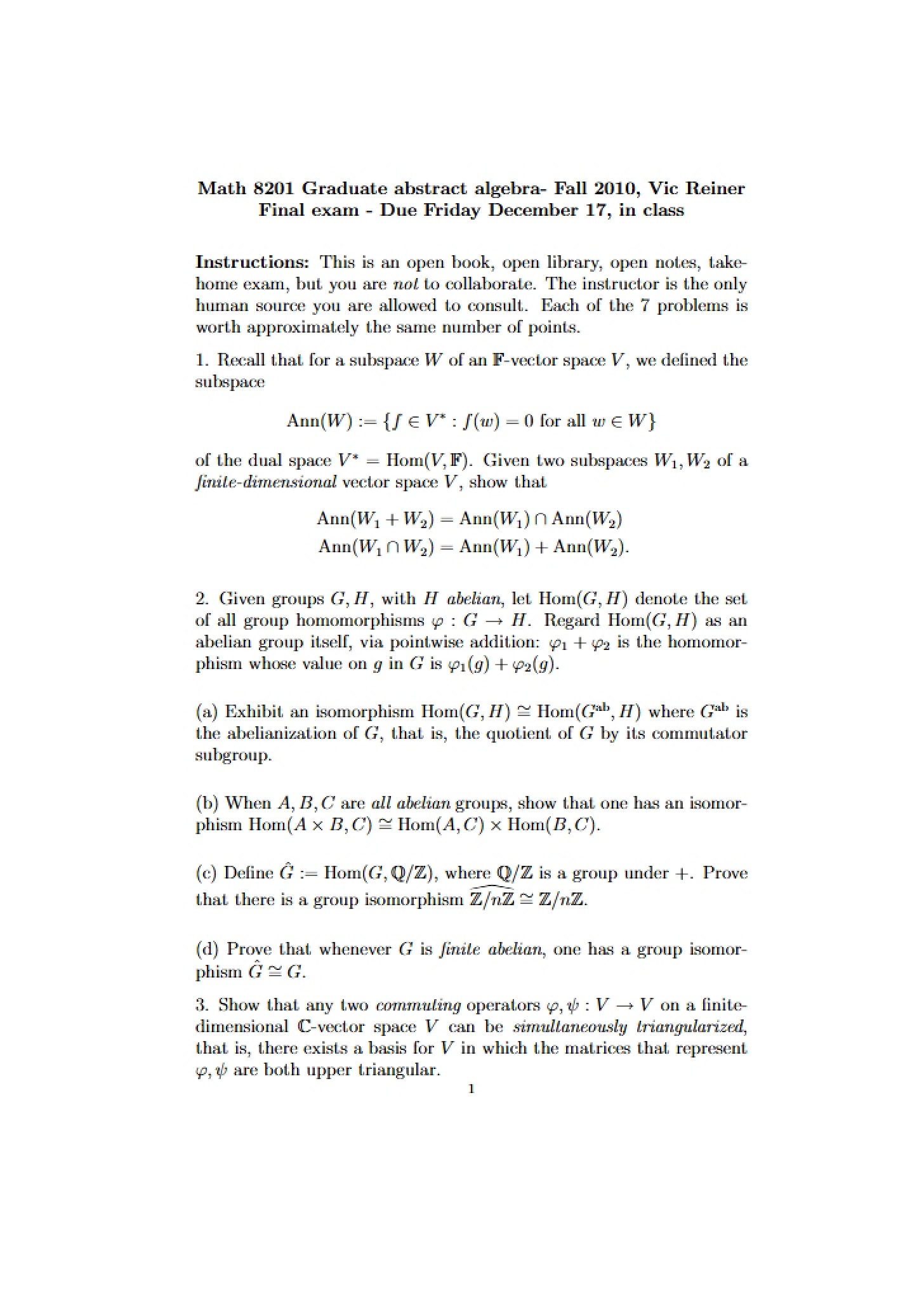
This is a practice midterm examination for MATH 8201, General Algebra, offered at the University of Minnesota Twin Cities. It’s designed to assess your understanding of core concepts covered in the first half of the course, specifically focusing on foundational topics within abstract algebra. The exam is formatted as a take-home assessment, allowing for open-book, open-note review, but emphasizes individual work and prohibits collaboration.
Why This Document Matters
This resource is invaluable for students preparing for their first midterm in a graduate-level abstract algebra course. It provides a realistic simulation of the exam format, question style, and expected depth of knowledge. Working through problems similar to those presented here will help you identify areas where your understanding is strong and pinpoint topics requiring further study. It’s best utilized *after* completing assigned readings and practice problems, as a culminating assessment of your preparedness. This is particularly useful for solidifying your grasp of proofs and theoretical applications.
Common Limitations or Challenges
This document presents a single midterm exam. While representative of the course material, it doesn’t encompass *every* possible topic or question type that could appear on a future exam. It’s crucial to remember that this is a sample assessment and should be used in conjunction with other course materials, such as lecture notes, homework assignments, and textbook examples. It does not include solutions or detailed explanations, requiring you to apply your existing knowledge to attempt the problems.
What This Document Provides
* Six distinct problems covering fundamental algebraic structures.
* Questions relating to subgroup properties, including conditions for subgroups generated by sets.
* Problems exploring group isomorphisms and their existence.
* Exercises involving group actions and their applications to subgroup analysis.
* Tasks focused on the relationship between group order and centralizers.
* Problems concerning ring homomorphisms and the Euler phi function, including its connection to prime factorization.