What This Document Is
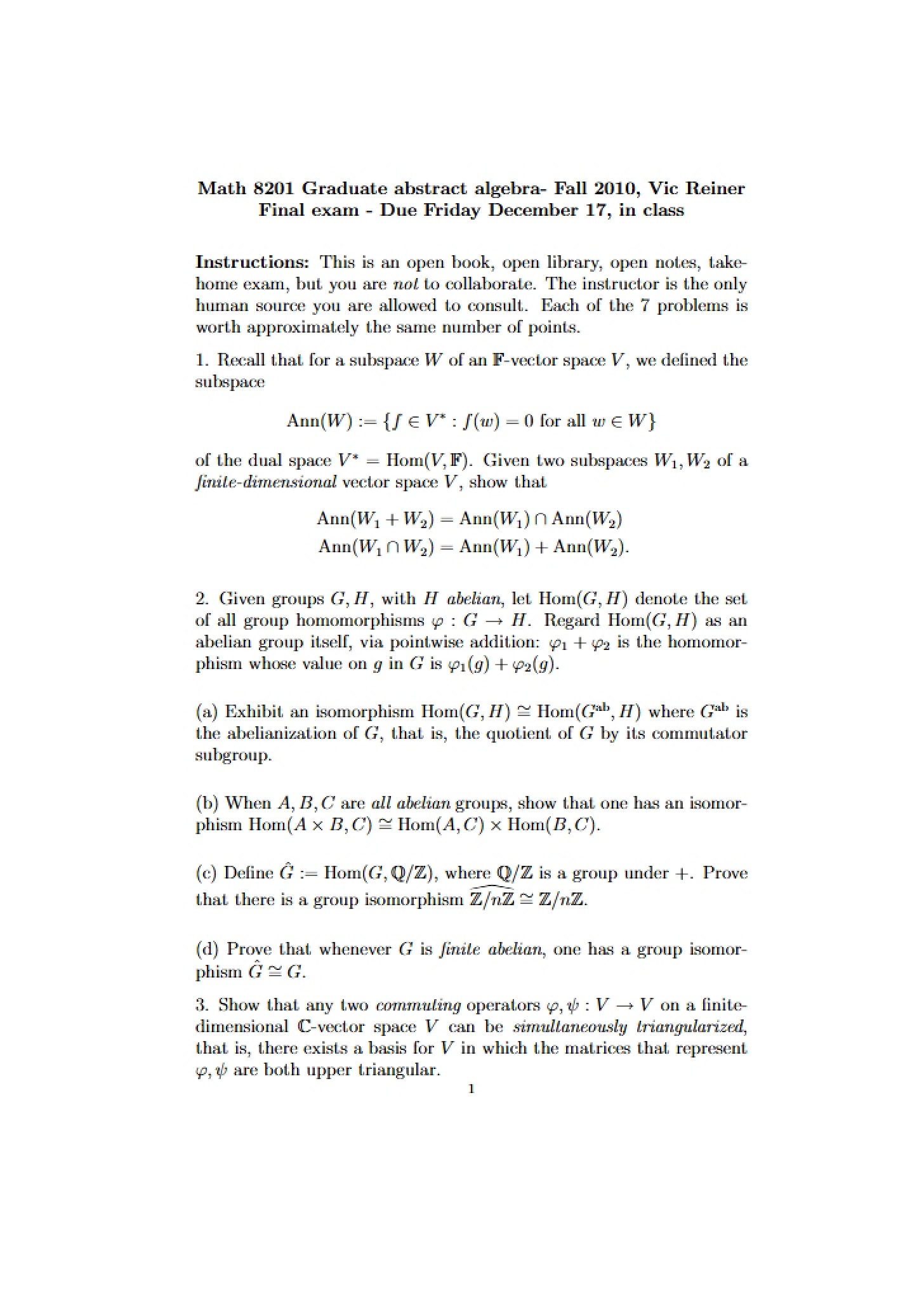
This document is a collection of practice problems designed to test your understanding of core concepts in abstract algebra, specifically focusing on the intersection of Linear Algebra and Group Theory. It originates from past preliminary examinations for a graduate-level course (MATH 8201) at the University of Minnesota Twin Cities. The material is geared towards students preparing for advanced coursework and comprehensive evaluations in these areas.
Why This Document Matters
If you are currently enrolled in, or preparing to take, a graduate-level abstract algebra course, particularly one with a strong emphasis on the relationship between linear transformations and group structures, this resource will be invaluable. It’s ideal for self-testing, identifying knowledge gaps, and building confidence before formal assessments. Students aiming to solidify their understanding of foundational algebraic principles and develop problem-solving skills will find this particularly useful. It’s best utilized *after* initial exposure to the core concepts in a classroom setting.
Common Limitations or Challenges
This document presents a series of problems *without* detailed step-by-step solutions or explanations. It assumes a pre-existing foundation in linear algebra and group theory. It does not function as a textbook or a comprehensive lecture series; rather, it’s a tool for active recall and application of learned material. It also doesn’t cover every possible topic within these broad fields – the selection is based on problems previously used in preliminary exams.
What This Document Provides
* A range of problems exploring diagonalizability and triangularizability of linear transformations.
* Challenges relating to simultaneous eigenvectors and their properties.
* Problems focused on Sylow theorems and classifying groups based on their order.
* Questions concerning the solvability of groups and the existence of normal subgroups.
* Exercises involving group actions and transitive sets.
* Problems requiring the classification of abelian groups of a specific order.
* Tasks involving determining isomorphism between different group structures.