What This Document Is
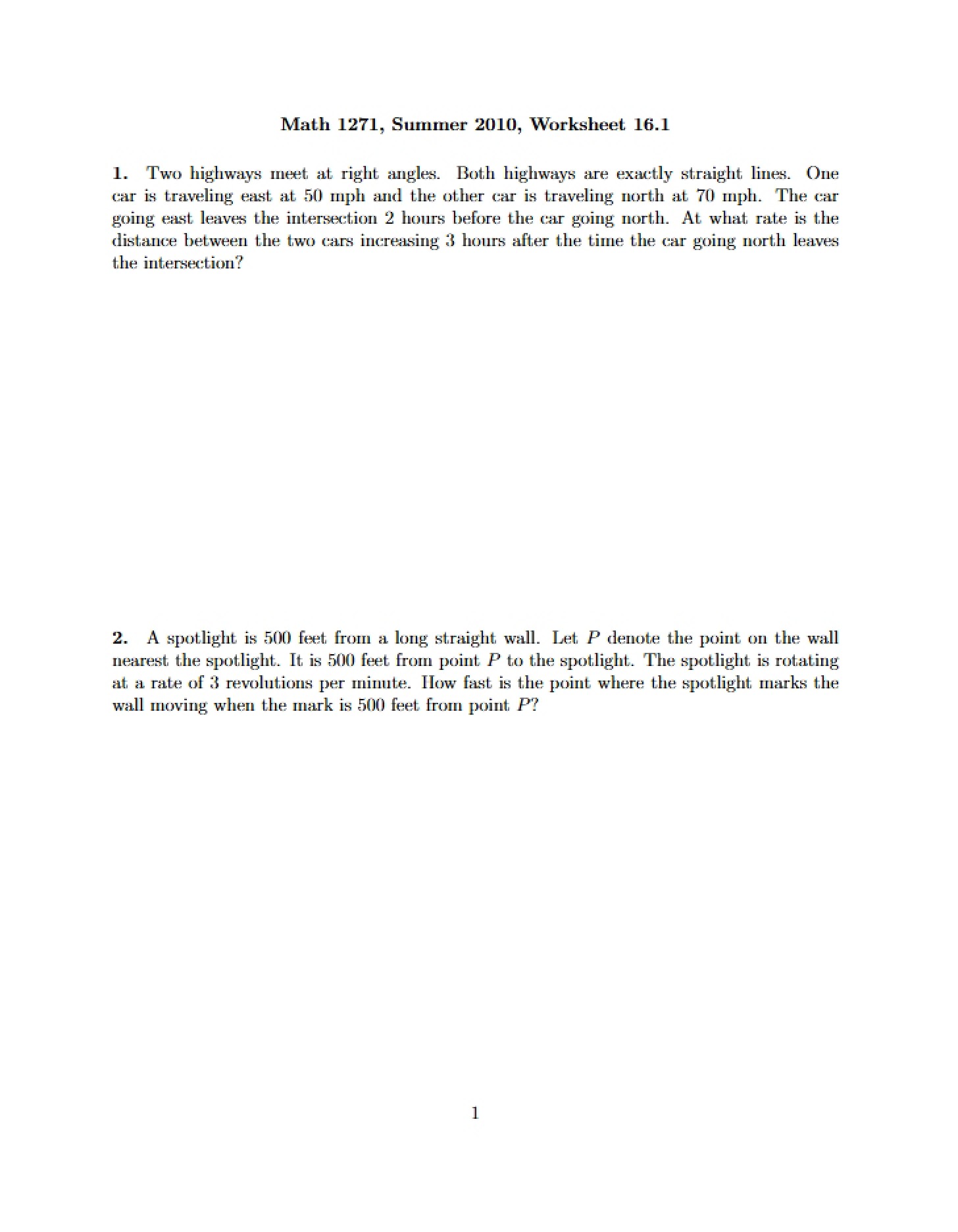
This study guide focuses on applying integral calculus to determine volumes of solids of revolution. Specifically, it delves into techniques for calculating volumes using the method of cylindrical shells, alongside explorations of the disk/washer method. The material is geared towards students in a first-semester calculus course, likely Calculus I, and builds upon foundational knowledge of integration. It presents a series of problems designed to reinforce understanding of these volume calculation techniques.
Why This Document Matters
This resource is invaluable for students tackling volume applications in their calculus coursework. It’s particularly helpful when preparing for quizzes and exams covering solids of revolution. Students who struggle with visualizing 3D shapes and setting up the correct integrals will find this guide beneficial. It’s best used *after* initial lectures on volume methods, as a way to practice and solidify understanding through problem-solving. It’s also a strong resource for students looking to improve their spatial reasoning skills within a mathematical context.
Common Limitations or Challenges
This guide does *not* provide a comprehensive review of basic integration techniques. It assumes a working knowledge of definite integrals and their application. It also doesn’t offer step-by-step solutions; instead, it presents problems for independent practice. While sketches of regions are sometimes referenced, detailed graphical analysis or proofs of theorems are not included. This resource focuses solely on the *application* of volume formulas, not the theoretical derivations behind them.
What This Document Provides
* A collection of problems centered around finding volumes using the cylindrical shell method.
* Practice applying volume formulas to various regions bounded by curves.
* Problems requiring the setup of integrals for volume calculations, without requiring evaluation.
* Scenarios involving rotation around different axes (x-axis, y-axis, and other lines).
* Problems designed to test understanding of how to describe solids generated by given integrals.
* Examples involving regions defined by polynomial, trigonometric, and other functions.