What This Document Is
This resource is a focused exploration of population dynamics, designed for students in an introductory anthropology course. It delves into the complexities of understanding how and why populations grow, shift, and change over time. The material examines various models used to project population trends and the challenges associated with applying these models to real-world scenarios. It moves beyond simple numerical increases to consider the broader implications of population size and composition on societies globally.
Why This Document Matters
This material is essential for any student seeking a deeper understanding of global issues, particularly those related to development, resource allocation, and social change. It’s most beneficial when you’re grappling with concepts of demographic transition, population projections, and the interplay between population and societal factors. Students preparing for discussions or assignments concerning global inequality, migration patterns, or the future of resource management will find this a valuable foundation. It’s particularly relevant when analyzing case studies of specific countries or regions.
Common Limitations or Challenges
This resource provides a theoretical framework for understanding population growth. It does *not* offer specific country-level data or detailed statistical analyses. It also doesn’t present definitive solutions to the challenges posed by population change, but rather equips you with the conceptual tools to analyze these issues critically. It’s important to remember that population dynamics are incredibly complex and influenced by a multitude of factors not fully covered here.
What This Document Provides
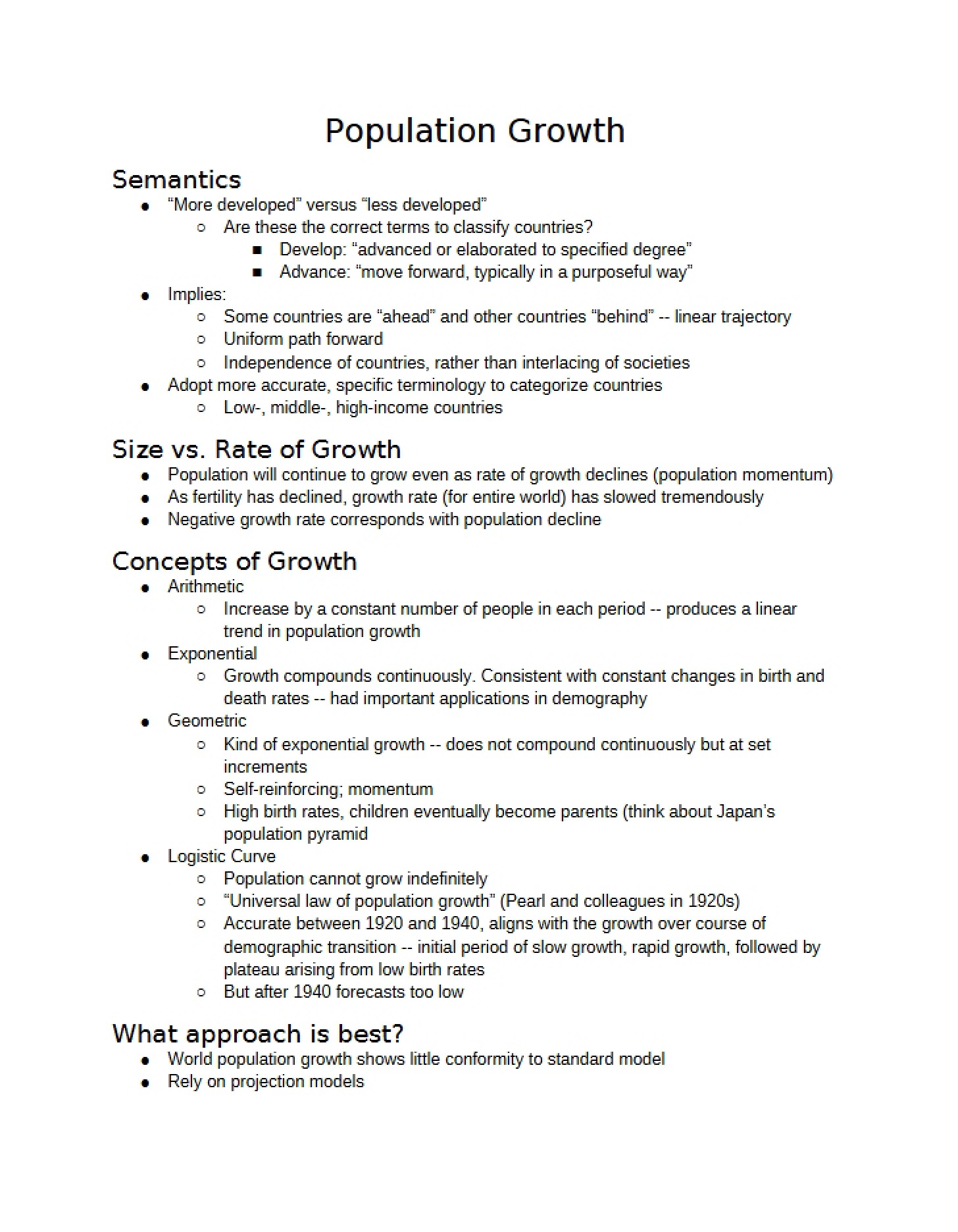
* An examination of different approaches to categorizing countries based on development indicators.
* A discussion of the distinction between population size and the *rate* of population growth.
* An overview of mathematical models used to conceptualize population growth (arithmetic, exponential, geometric, and logistic).
* An explanation of the population balancing equation and its components.
* An introduction to the concept of “doubling time” and its relevance to population projections.
* Considerations of the implications of population growth related to Earth’s capacity and global resource distribution.
* An exploration of how changing population composition impacts societies, both globally and within the United States.