What This Document Is
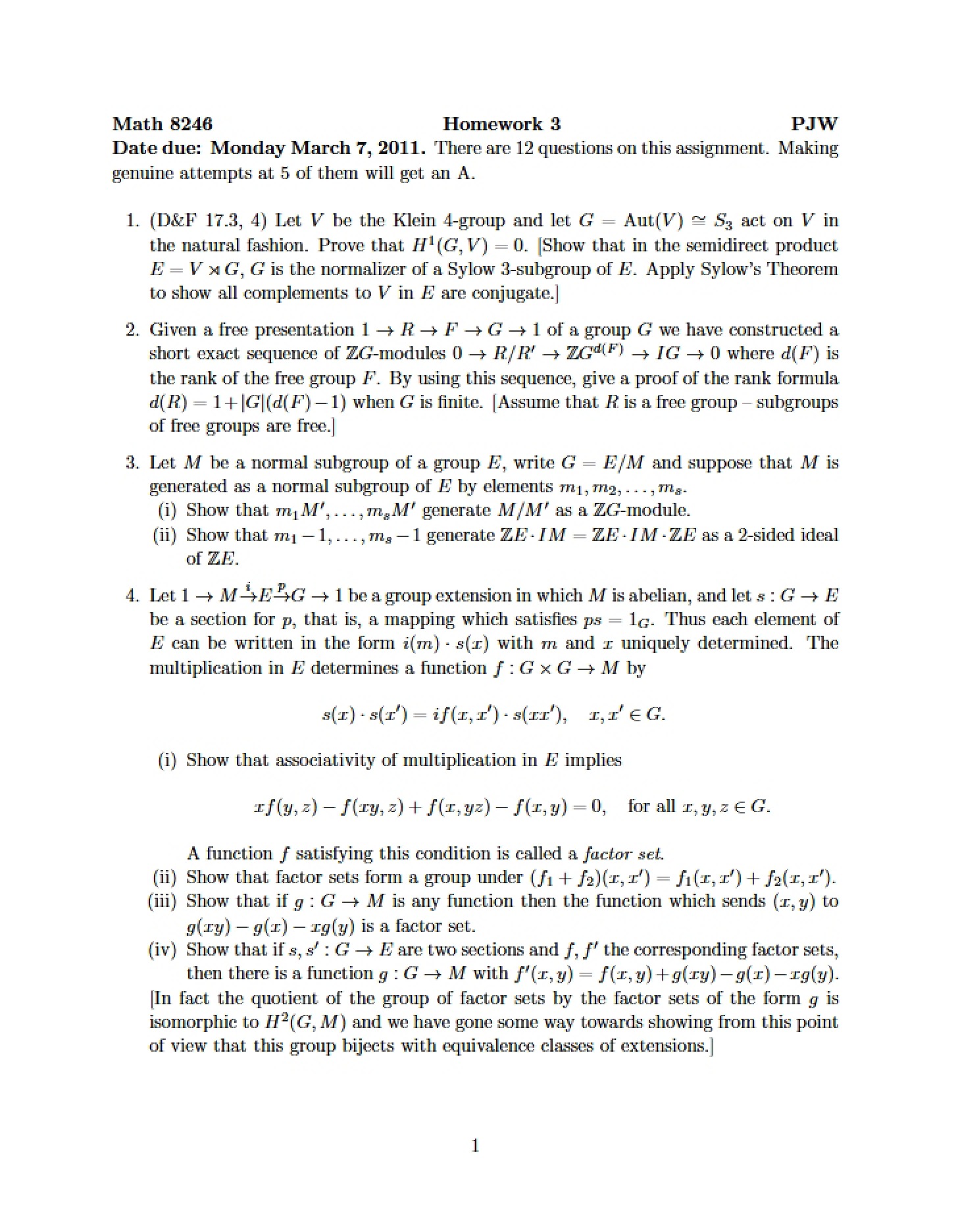
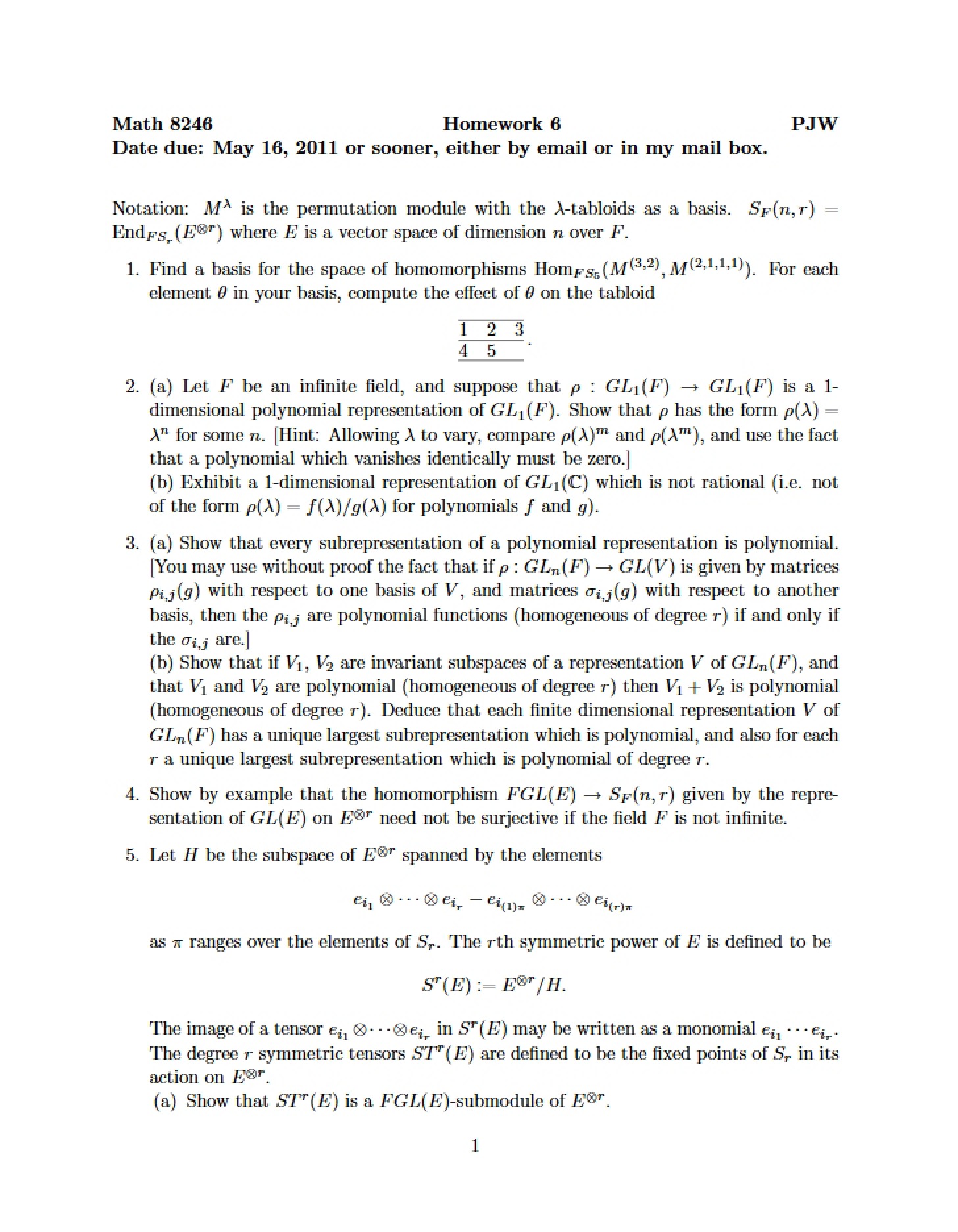
This is a homework assignment for a graduate-level Group Theory course (MATH 8246) at the University of Minnesota Twin Cities. It focuses on advanced concepts within module theory and homological algebra, specifically utilizing the tools of Ext functors and module extensions. The assignment challenges students to apply theoretical knowledge to concrete problems involving vector spaces, modules over rings, and group actions. It builds upon a foundation of abstract algebra and linear algebra.
Why This Document Matters
This assignment is designed for students actively enrolled in an advanced Group Theory course. It’s particularly valuable for those seeking to solidify their understanding of Ext modules, module extensions, and their properties. Successfully completing this assignment demonstrates a strong grasp of abstract algebraic structures and the ability to apply them in problem-solving. It’s best utilized *after* thorough review of lecture notes and relevant textbook material on module theory and homological algebra. It serves as a critical practice component for mastering these complex topics.
Common Limitations or Challenges
This assignment presents a set of challenging problems requiring a deep understanding of abstract algebra. It does *not* provide introductory explanations of the underlying concepts; a solid pre-existing knowledge base is assumed. The problems require independent thought and application of learned techniques – it won’t walk you through step-by-step solutions. Furthermore, it focuses on theoretical exercises and proofs, rather than computational examples. Access to additional resources, such as textbooks and office hours, may be necessary for full comprehension.
What This Document Provides
* A series of problems exploring the computation of Ext dimensions for various module setups.
* Exercises involving the behavior of Ext functors under homomorphisms.
* Tasks requiring the construction and analysis of module extensions.
* Problems relating to cyclic groups and their module representations.
* Questions concerning derivations and automorphisms of modules.
* Exploration of the relationship between Hom and Ext functors.
* Problems involving tensor products of modules and their G-action.