What This Document Is
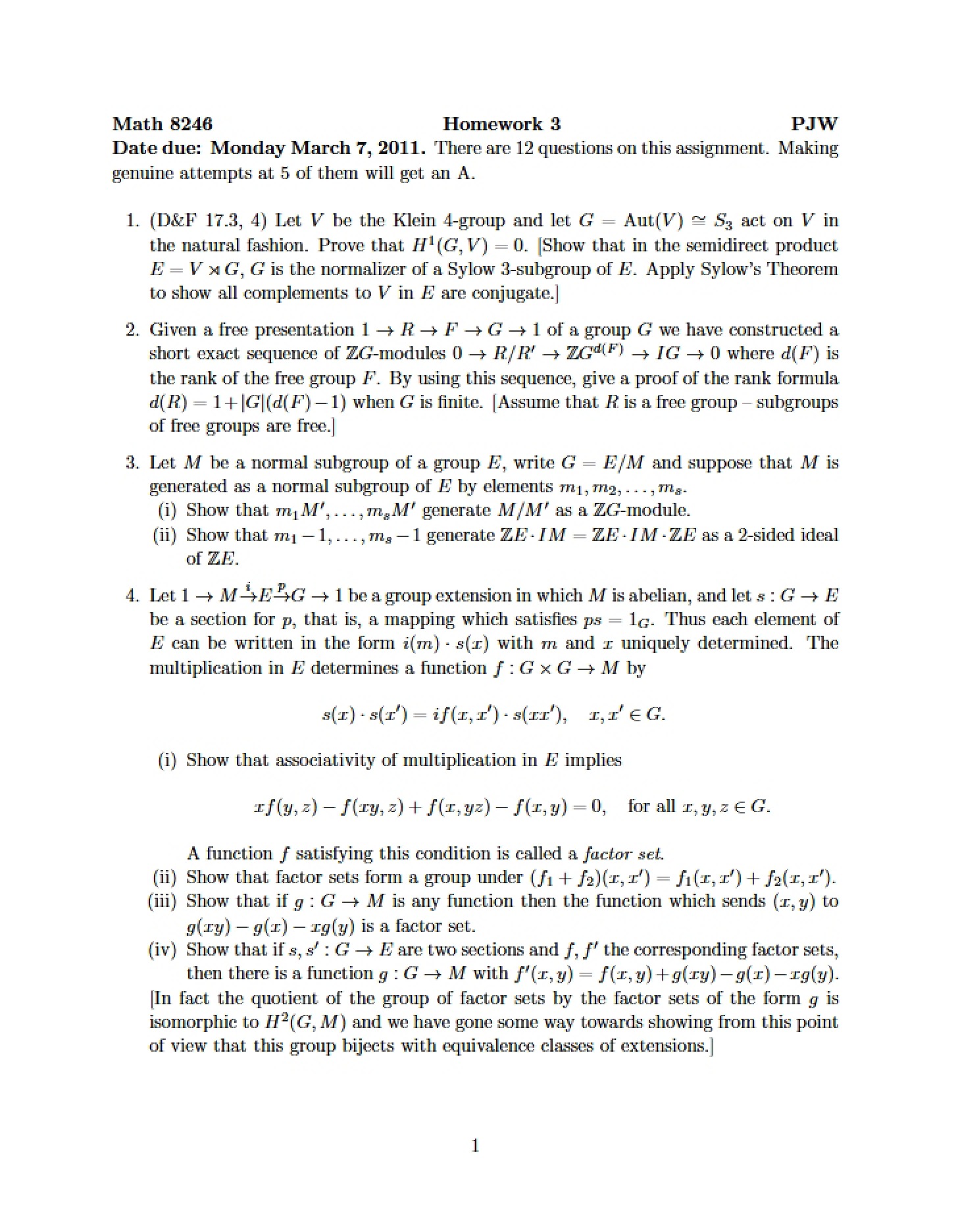
This is a homework assignment for a graduate-level Group Theory course (MATH 8246) at the University of Minnesota Twin Cities. It focuses on advanced topics within representation theory, specifically exploring polynomial representations, permutation modules, and symmetric powers. The assignment delves into the structure and properties of these mathematical objects, requiring students to demonstrate a strong understanding of abstract algebra and linear representations of groups. The problems presented build upon concepts typically covered in an advanced undergraduate or beginning graduate course in abstract algebra.
Why This Document Matters
This assignment is crucial for students enrolled in the specified Group Theory course. Successfully completing it demonstrates mastery of key concepts related to representation theory, which are foundational for further study in areas like Lie groups, algebraic combinatorics, and mathematical physics. It’s designed to solidify understanding through problem-solving and application of theoretical knowledge. Students preparing for qualifying exams or pursuing research in related fields will find working through these types of problems invaluable. This assignment is best utilized *after* a thorough review of lecture notes and relevant textbook material.
Common Limitations or Challenges
This document presents a set of challenging problems requiring a solid foundation in abstract algebra. It does *not* include worked examples or step-by-step solutions. Students will need to rely on their understanding of the course material, independent study, and potentially collaboration with peers to arrive at solutions. The problems require a high degree of mathematical maturity and the ability to translate abstract concepts into concrete calculations. It assumes familiarity with concepts like homomorphisms, tensor products, and polynomial functions.
What This Document Provides
* A series of problems focused on homomorphisms between permutation modules.
* Investigations into the form of 1-dimensional representations of general linear groups.
* Exercises exploring the properties of subrepresentations within polynomial representations.
* Problems concerning the surjectivity of homomorphisms related to representations of GL(E).
* Tasks involving symmetric powers and their relationship to tensors and GL(E)-modules.
* Specific challenges related to representations over fields of characteristic 2.