What This Document Is
This is a homework assignment for EE 557, Computer Systems Architecture, at the University of Southern California. It focuses on applying theoretical concepts learned in the course to practical problem-solving. The assignment centers around advanced pipeline techniques, specifically branch prediction and the Tomasulo algorithm for out-of-order execution. It requires a detailed understanding of how these mechanisms impact performance and correctness in modern processors. The problems build upon material presented in the course textbook and involve analyzing and simulating processor behavior.
Why This Document Matters
This assignment is crucial for students enrolled in EE 557 seeking to solidify their understanding of computer architecture principles. Successfully completing this homework will demonstrate your ability to analyze pipeline hazards, evaluate branch prediction strategies, and trace the execution of instructions through a Tomasulo-based processor. It’s particularly valuable for those preparing for more advanced coursework or careers in processor design, embedded systems, or performance optimization. Working through these problems will enhance your analytical and problem-solving skills, essential for any computer engineering role.
Common Limitations or Challenges
This assignment does not provide a comprehensive review of fundamental computer architecture concepts. It assumes a solid foundation in pipelining, instruction-level parallelism, and cache memory principles. It also doesn’t offer step-by-step solutions or pre-calculated results; the intention is for students to independently apply their knowledge to derive the answers. Furthermore, the assignment focuses on specific scenarios and configurations, and may not cover all possible variations or edge cases within the discussed topics.
What This Document Provides
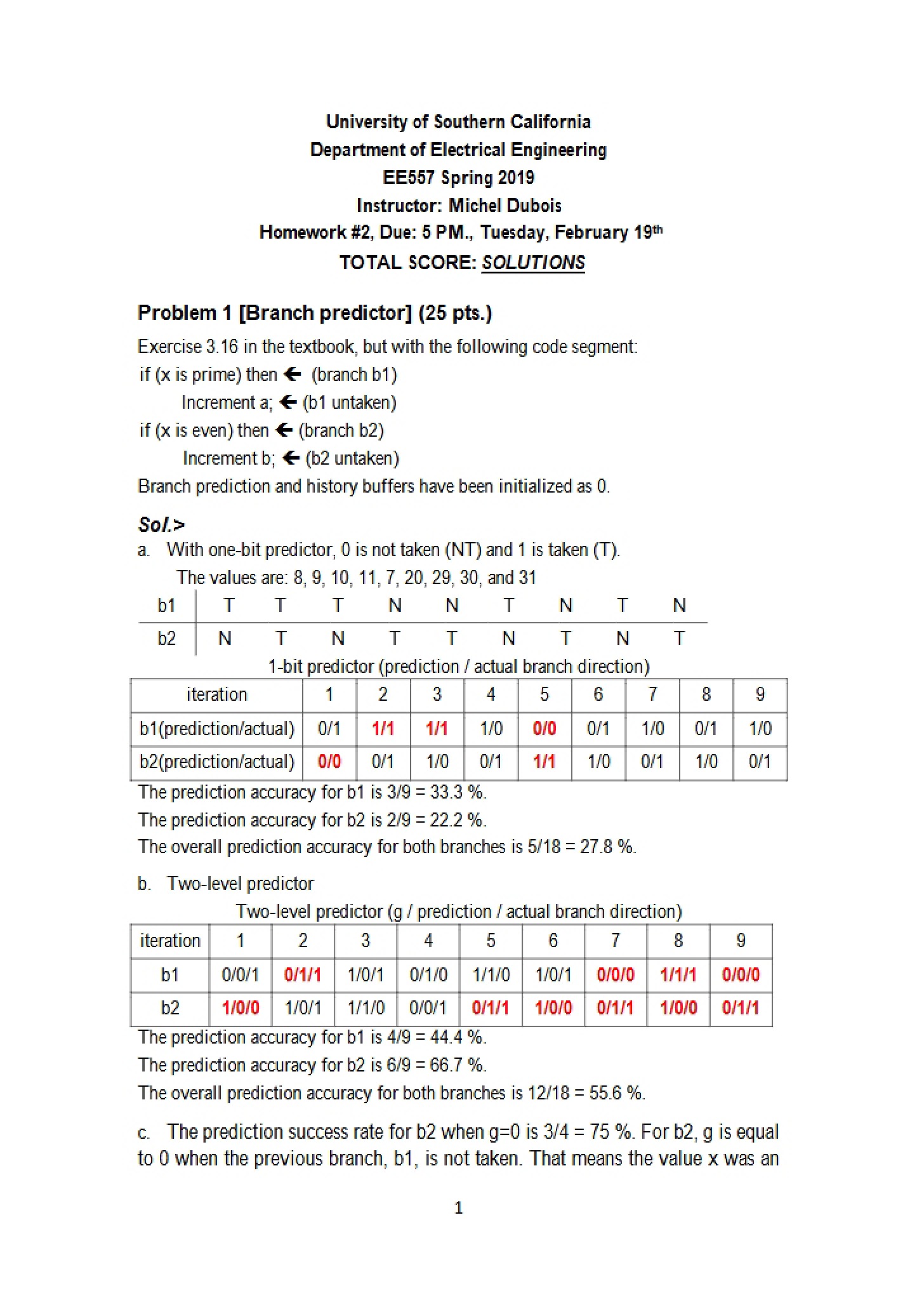
* A series of problems related to branch prediction accuracy and performance.
* Exercises involving the analysis of pipeline behavior with a modified superpipeline structure.
* Detailed scenarios for tracing instruction execution using the Tomasulo algorithm.
* Tasks requiring the completion of tables illustrating processor state and data flow.
* Comparative analyses of speculative scheduling techniques with varying issue queue configurations.
* Problems designed to explore the convergence of execution time in iterative loops.