What This Document Is
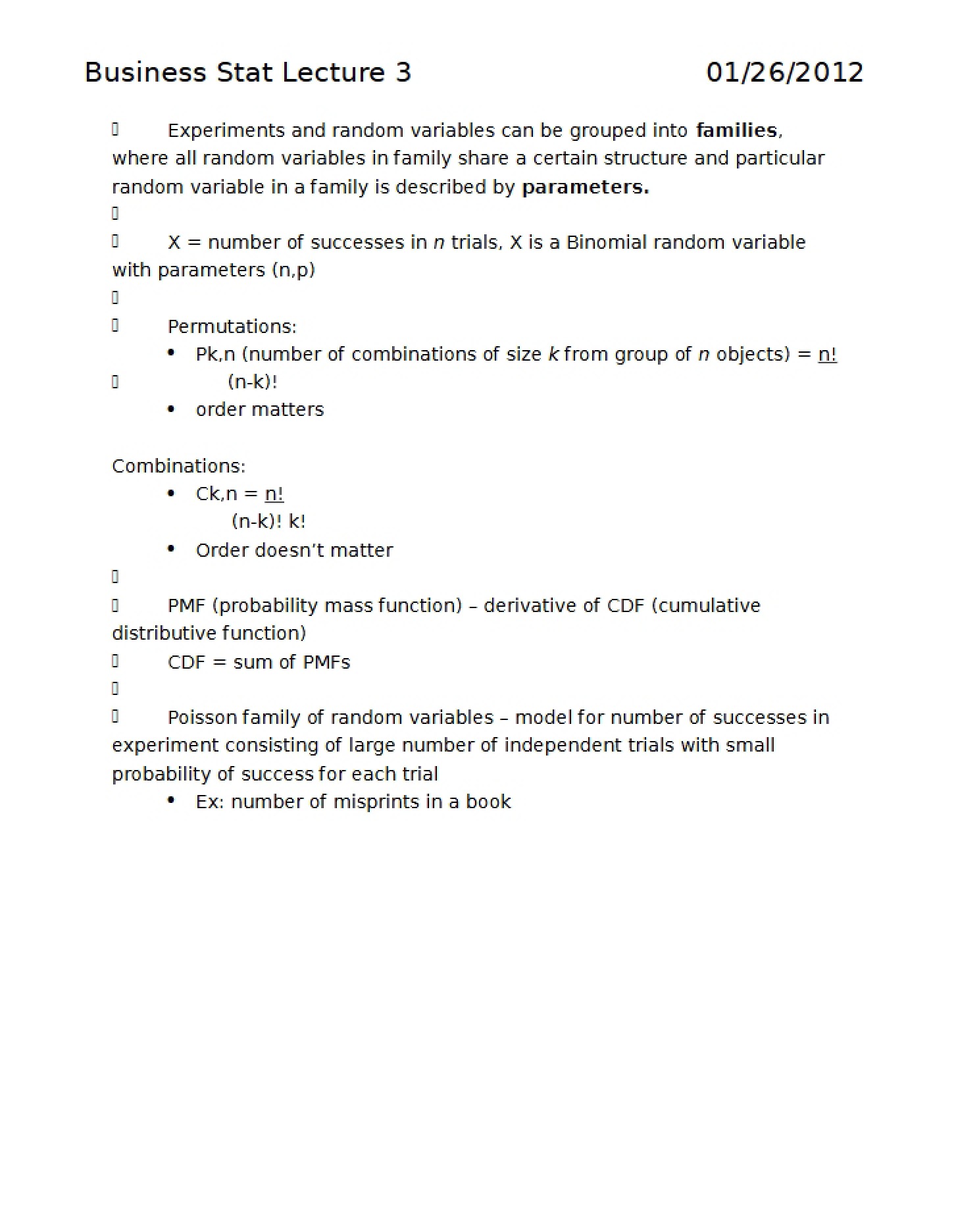
This material represents lecture notes from BUAD 310: Applied Business Statistics at the University of Southern California. It focuses on foundational concepts crucial for understanding probability and statistical analysis within a business context. The lecture appears to lay the groundwork for more complex statistical methods by defining core principles and terminology. It’s structured as a direct record of classroom instruction, likely accompanied by visual aids during the original presentation.
Why This Document Matters
Students enrolled in BUAD 310, or anyone beginning their study of applied statistics, will find this resource valuable. It’s particularly helpful for those seeking to solidify their understanding of the basic language and logic of probability *before* diving into calculations and applications. Reviewing these notes alongside textbook readings and homework assignments can significantly improve comprehension. It’s ideal for use during exam preparation as a refresher on fundamental definitions and relationships. Those with a mathematical background may find it a useful, concise review, while others may benefit from the clear articulation of core ideas.
Common Limitations or Challenges
This lecture does not offer worked examples or practice problems. It presents definitions and conceptual explanations, but doesn’t guide you through the *process* of applying these concepts to real-world business scenarios. It’s also important to note that these are lecture notes, and therefore may not contain the full breadth of material covered in the course – supplementary readings and in-class discussions are likely essential for a complete understanding. Access to this material alone will not guarantee success in the course.
What This Document Provides
* Definitions of fundamental set operations related to probability.
* An introduction to the concept of relative frequency and its connection to probability.
* Discussion of different interpretations of probability, including frequency-based and subjective approaches.
* An explanation of the Law of Large Numbers and its implications.
* A formal representation of probability as a proportion of outcomes within a sample space.
* Key terminology used in probability theory.