What This Document Is
This is part one of Lecture 26 from the ECE 350 Field and Waves course at the University of Illinois at Urbana-Champaign. It delves into the behavior of electromagnetic waves confined within parallel-plate waveguides, specifically focusing on Transverse Magnetic (TM) modes. This lecture builds upon previous discussions of Transverse Electric (TE) modes, expanding the understanding of guided wave propagation. It’s a core component of understanding how signals can be efficiently transmitted in various waveguide structures.
Why This Document Matters
This material is essential for electrical engineering students studying electromagnetics, particularly those interested in high-frequency circuit design, antenna theory, and communication systems. It’s most valuable when studying wave propagation, transmission lines, and the characteristics of guided waves. Understanding these concepts is crucial for analyzing and designing systems where controlling electromagnetic fields is paramount. This lecture will provide a foundational understanding for more advanced topics in the course.
Topics Covered
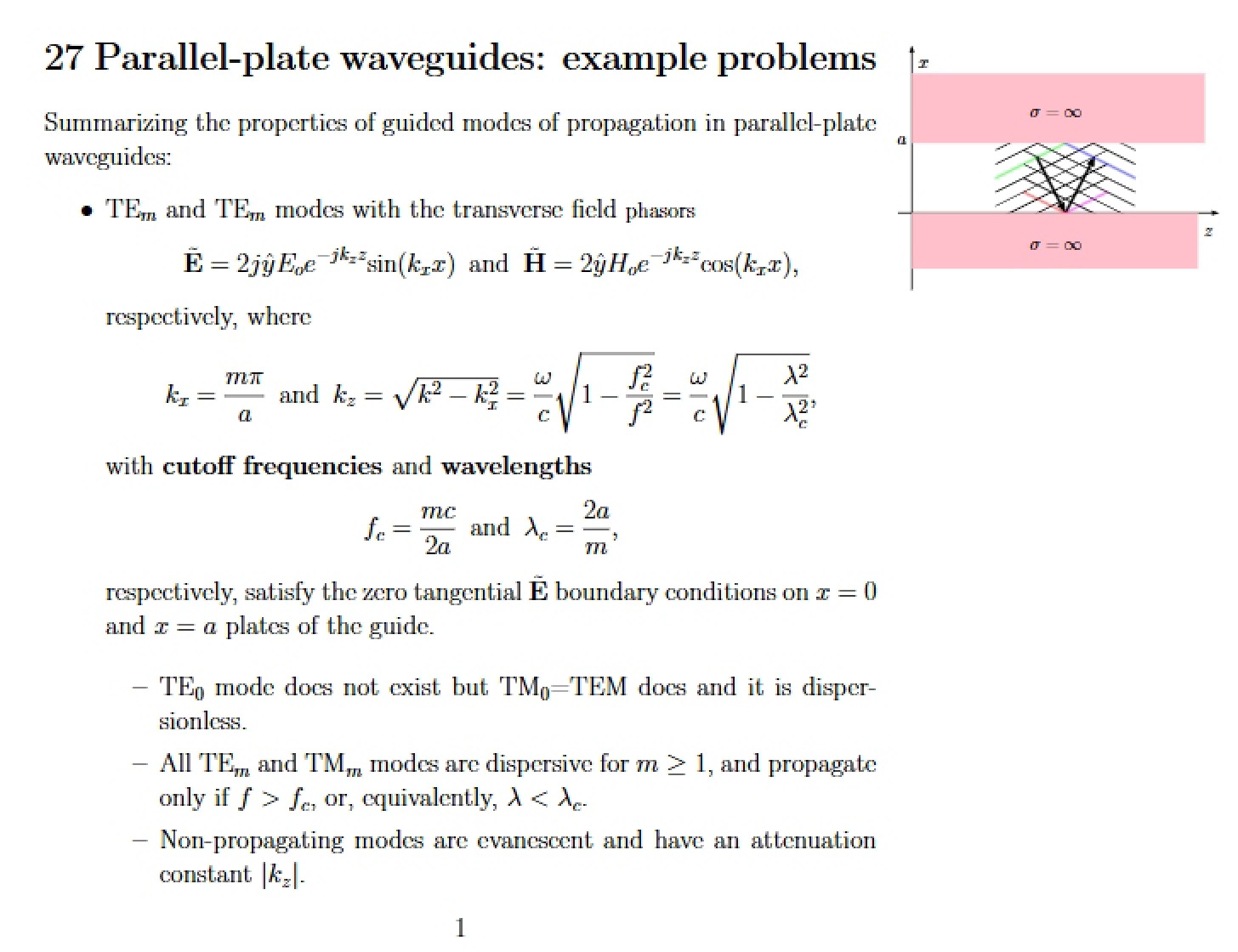
* TM mode propagation characteristics in parallel-plate waveguides
* Comparison of TM and TE mode behavior
* Cutoff frequencies and wavelengths for TM modes
* Relationship between frequency, wavelength, and wavenumber in guided wave scenarios
* Group velocity and its connection to plasma dispersion relations
* Guide impedance for TM modes
* The special case of the TM₀ mode and its relation to TEM waves
What This Document Provides
* A detailed exploration of the mathematical framework describing TM mode fields.
* An examination of the boundary conditions necessary for permissible TM modes.
* A discussion of the unique properties of the TM₀ mode.
* A conceptual link between guided wave propagation and previously studied transmission line theory.
* A problem statement designed to reinforce understanding of the concepts presented.
* Insights into how material properties (dielectric constants) affect wave propagation within the waveguide.