What This Document Is
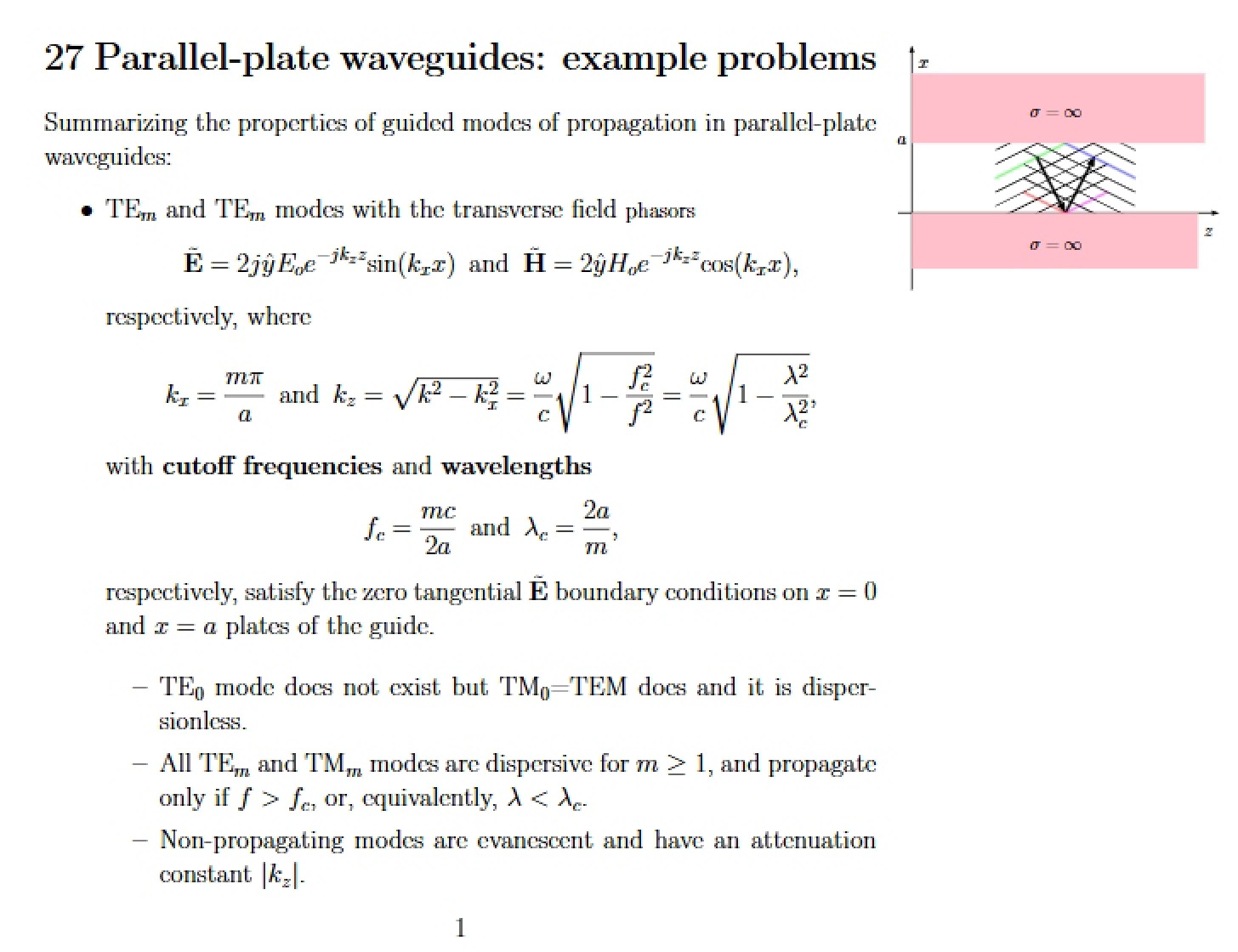
This is part one of a lecture focused on parallel-plate waveguides, a core topic within the study of field and waves. It delves into the theoretical underpinnings of how electromagnetic waves propagate within these structures, building upon foundational concepts from the ECE 350 course at the University of Illinois at Urbana-Champaign. The material presented is designed to enhance understanding of guided modes and their characteristics.
Why This Document Matters
This resource is invaluable for students enrolled in an electromagnetic fields course, particularly those specializing in electrical engineering. It’s most beneficial when studying wave propagation, transmission lines, and waveguide theory. Individuals preparing for exams or working on assignments related to guided wave phenomena will find this a helpful study aid. Understanding these principles is crucial for designing and analyzing various high-frequency circuits and communication systems.
Topics Covered
* Properties of guided modes in parallel-plate waveguides
* Transverse Electric (TE) and Transverse Magnetic (TM) mode behavior
* Cutoff frequencies and wavelengths for different modes
* Waveguide impedance and its relation to field components
* Impact of dielectric materials on waveguide characteristics
* Concepts of propagating and evanescent modes
* Group velocity and its dependence on frequency
What This Document Provides
* A summary of key equations governing guided wave propagation.
* Illustrative examples designed to reinforce theoretical concepts.
* A framework for analyzing wave behavior within parallel-plate structures.
* Discussion of how material properties influence waveguide performance.
* An exploration of the conditions required for signal propagation.
* A foundation for more advanced studies in waveguide theory and applications.