What This Document Is
This document represents Lecture 30 from the ECE 350 Field and Waves course at the University of Illinois at Urbana-Champaign. It delves into the advanced concepts of guide impedance and transmission line (TL) analogies as they relate to waveguide theory. This lecture builds upon previous material concerning electromagnetic wave propagation within waveguides, focusing on how to model and analyze waveguide circuits using principles familiar from transmission line theory. It’s a core component of understanding how signals are efficiently guided and controlled in various electromagnetic systems.
Why This Document Matters
This lecture is crucial for students specializing in electrical and computer engineering, particularly those focusing on microwave engineering, antenna design, and high-frequency circuit analysis. It’s most beneficial when studying after a foundational understanding of transmission lines and waveguide basics has been established. Engineers and researchers working with guided wave structures will find the concepts presented here essential for practical applications and further study. Accessing the full lecture content will provide a deeper understanding needed for successful coursework and future professional endeavors.
Topics Covered
* Guide Impedance and its application to waveguide analysis
* Relationships between waveguide parameters and transmission line characteristics
* Waveguide circuit modeling using transmission line principles
* Quarter-wave matching techniques in waveguide systems
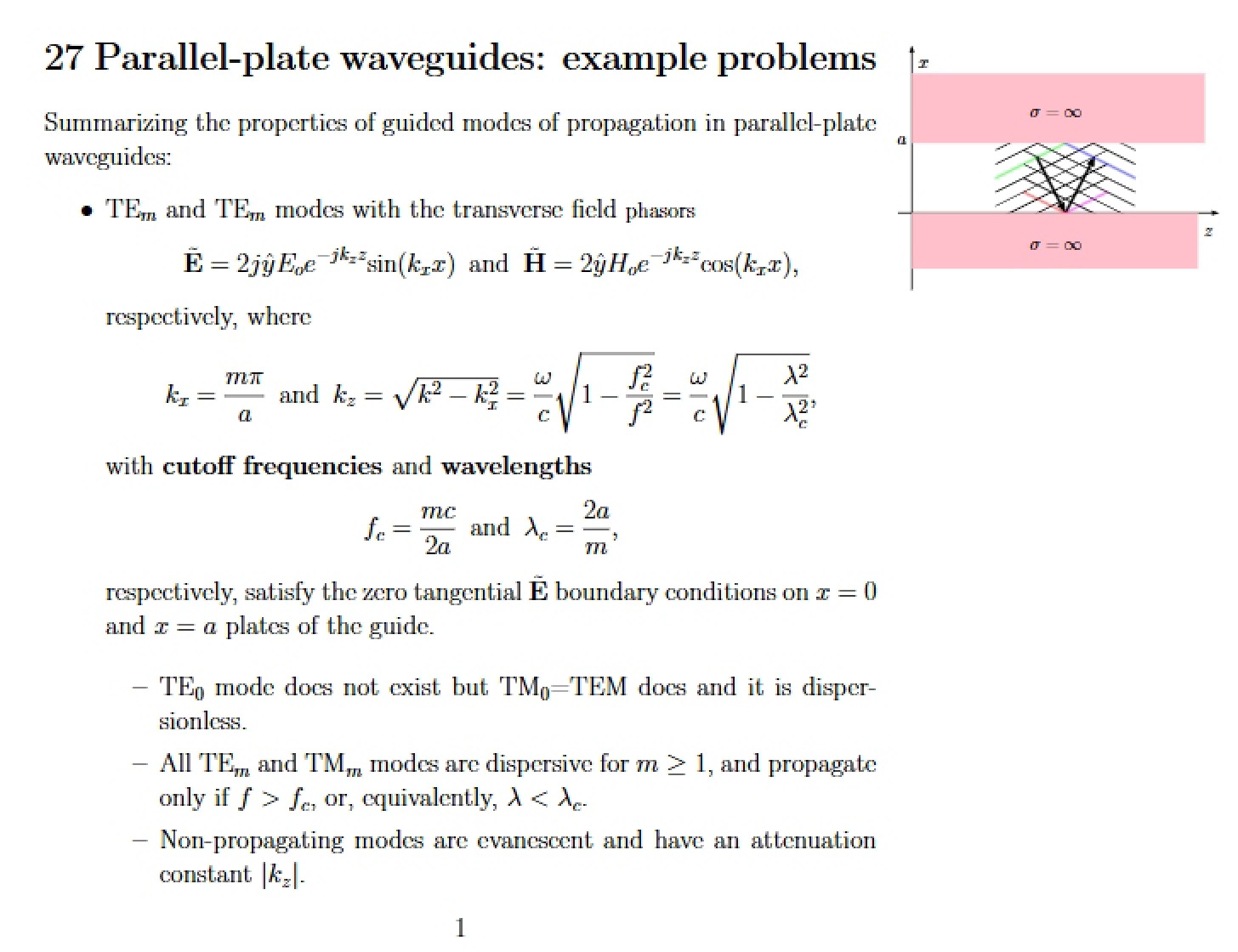
* Analysis of TE mode field distributions within rectangular waveguides
* Cutoff wavelength considerations for different waveguide modes
* Time-averaged power calculations in waveguides
What This Document Provides
* Detailed exploration of how guide impedances facilitate transmission line modeling of waveguides.
* Illustrative examples demonstrating the application of these concepts to practical waveguide scenarios.
* A framework for understanding the behavior of electromagnetic fields within rectangular waveguides.
* Connections between theoretical calculations and the visualization of field patterns.
* A foundation for calculating power transmission characteristics within waveguide structures.
* A stepping stone towards more complex waveguide analysis and design problems.