What This Document Is
This is a lab assignment designed for a Differential Equations and Linear Algebra course (MATH 3280) at the University of Minnesota Twin Cities. It focuses on applying computational tools – specifically Mathematica – to explore fundamental concepts in differential equations. The assignment requires students to combine theoretical understanding with practical implementation, culminating in a formal lab report. It’s a hands-on exercise intended to reinforce learning through active problem-solving.
Why This Document Matters
This assignment is crucial for students enrolled in a rigorous mathematics course seeking to solidify their grasp of differential equations. It’s particularly beneficial for those who learn best by doing and visualizing mathematical concepts. Students preparing for more advanced coursework in engineering, physics, or applied mathematics will find the skills honed through this lab invaluable. It’s best utilized *during* the lab session and as a guide for completing the associated written report, allowing for a deeper understanding of the material covered in lectures.
Common Limitations or Challenges
This assignment does not provide a comprehensive review of the underlying theory of differential equations. It assumes a foundational understanding of concepts like slope fields, initial value problems, and solution verification. It also doesn’t offer step-by-step solutions; rather, it challenges students to independently apply their knowledge and Mathematica skills. Students unfamiliar with Mathematica may require additional resources to effectively complete the tasks. The assignment focuses on *applying* techniques, not necessarily *deriving* them.
What This Document Provides
* A series of tasks centered around visualizing differential equations using slope fields and stream plots.
* Opportunities to utilize Mathematica’s plotting capabilities for qualitative analysis of solutions.
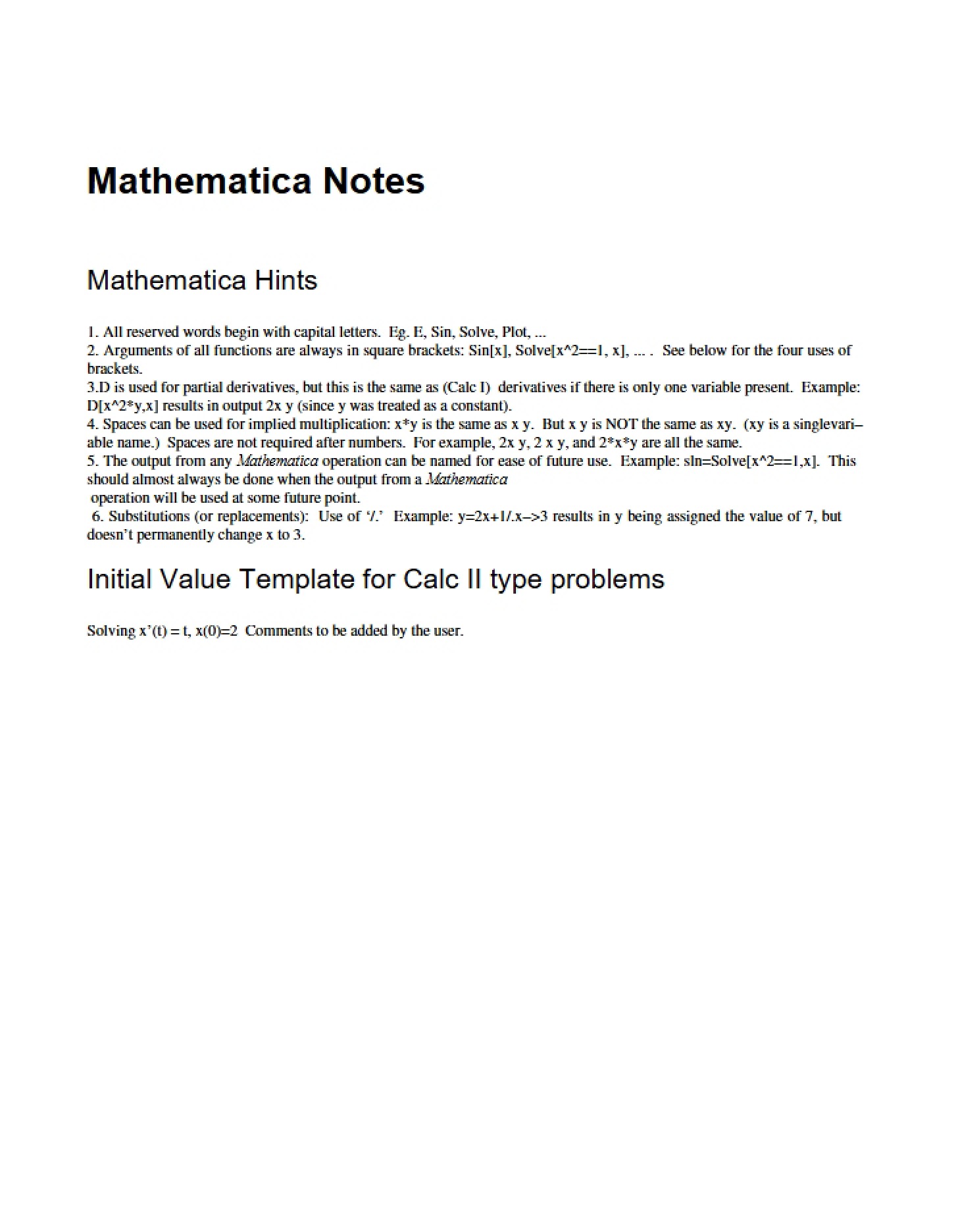
* Exercises in applying a pre-existing Mathematica template to solve initial value problems analytically.
* A challenge to verify whether a given function satisfies a specific differential equation and initial conditions.
* Guidance on report structure, including expectations for goals, procedures, Mathematica output, and conclusions.
* A framework for experimenting with parameters and utilizing Mathematica’s “Manipulate” command for dynamic visualization.