What This Document Is
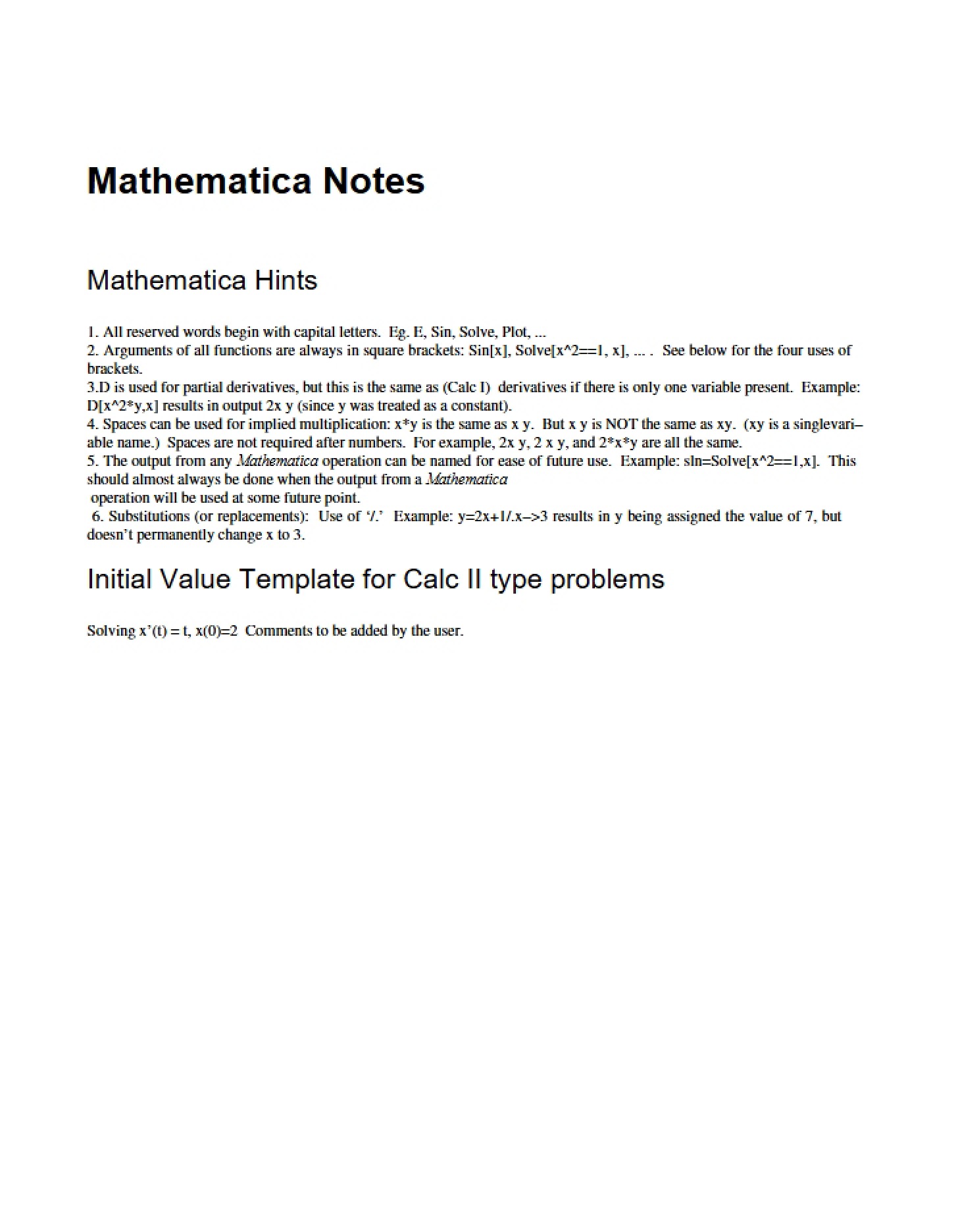
This document is a lab manual designed to accompany the Differential Equations and Linear Algebra (MATH 3280) course at the University of Minnesota Twin Cities. Specifically, it serves as an introductory guide to utilizing Mathematica software within the context of solving problems related to both differential equations and linear algebra. It’s structured as a hands-on laboratory exercise, requiring students to apply computational techniques and document their process.
Why This Document Matters
This resource is invaluable for students enrolled in MATH 3280 who want to build proficiency in using Mathematica as a tool for mathematical exploration and problem-solving. It’s particularly helpful for those who are new to the software or need a refresher on its core functionalities. Mastering these computational skills will not only aid in completing assignments for this course but also provide a foundation applicable to a wide range of STEM disciplines throughout your academic career. Students will benefit from working through the exercises to solidify their understanding of how to translate mathematical concepts into practical computations.
Common Limitations or Challenges
This lab manual focuses specifically on a subset of Mathematica’s capabilities relevant to differential equations and linear algebra. It does *not* provide a comprehensive tutorial on all aspects of the software. Students should be prepared to consult additional resources, such as the Mathematica help documentation and online tutorials, to expand their knowledge. Furthermore, the manual assumes a basic understanding of the mathematical concepts themselves; it’s a tool for *applying* those concepts, not learning them from scratch. It also doesn’t offer pre-solved examples – the intention is for students to actively engage with the software and derive solutions independently.
What This Document Provides
* A structured set of tasks designed to familiarize students with the Mathematica interface and basic commands.
* Guidance on essential Mathematica functions for performing algebraic and calculus-based computations.
* Instructions on how to properly format and document your work within a Mathematica notebook.
* Information on accessing support resources, including online help, instructors, and teaching assistants.
* A grading rubric outlining the expectations for the lab report submission.
* Exercises focused on both symbolic and numerical calculations.