What This Document Is
This document presents a focused exploration of image modeling within the context of computational vision. Specifically, it delves into the mathematical foundations of representing and understanding images as outputs of underlying systems – focusing on linear systems and their application to image formation. It builds upon prior concepts in Bayesian decision theory and perception, extending those ideas into the realm of how images themselves are structured and generated. The material bridges the gap between scene properties and the images we perceive, examining the processes that link the two.
Why This Document Matters
This resource is invaluable for students in computational vision, psychology, or related fields seeking a deeper understanding of how images can be mathematically modeled. It’s particularly useful when tackling problems involving image analysis, psychophysical modeling, or the development of computer vision algorithms. Researchers investigating the mechanisms of visual perception will find the concepts presented here foundational to understanding how the brain might interpret and reconstruct a 3D world from 2D image data. It’s best utilized when you’re ready to move beyond intuitive understandings of images and begin to formalize your thinking with mathematical tools.
Common Limitations or Challenges
This material concentrates on the theoretical underpinnings of image modeling, particularly linear systems. It does *not* provide a comprehensive guide to specific image processing techniques or software implementations. While it touches upon the importance of generative models, it doesn’t offer a step-by-step tutorial on building complex models for specific visual tasks. Furthermore, it assumes a foundational understanding of probability, statistics, and basic linear algebra.
What This Document Provides
* An examination of the rationale behind using generative models for images.
* A discussion of the distinction between image-based and scene-based modeling approaches.
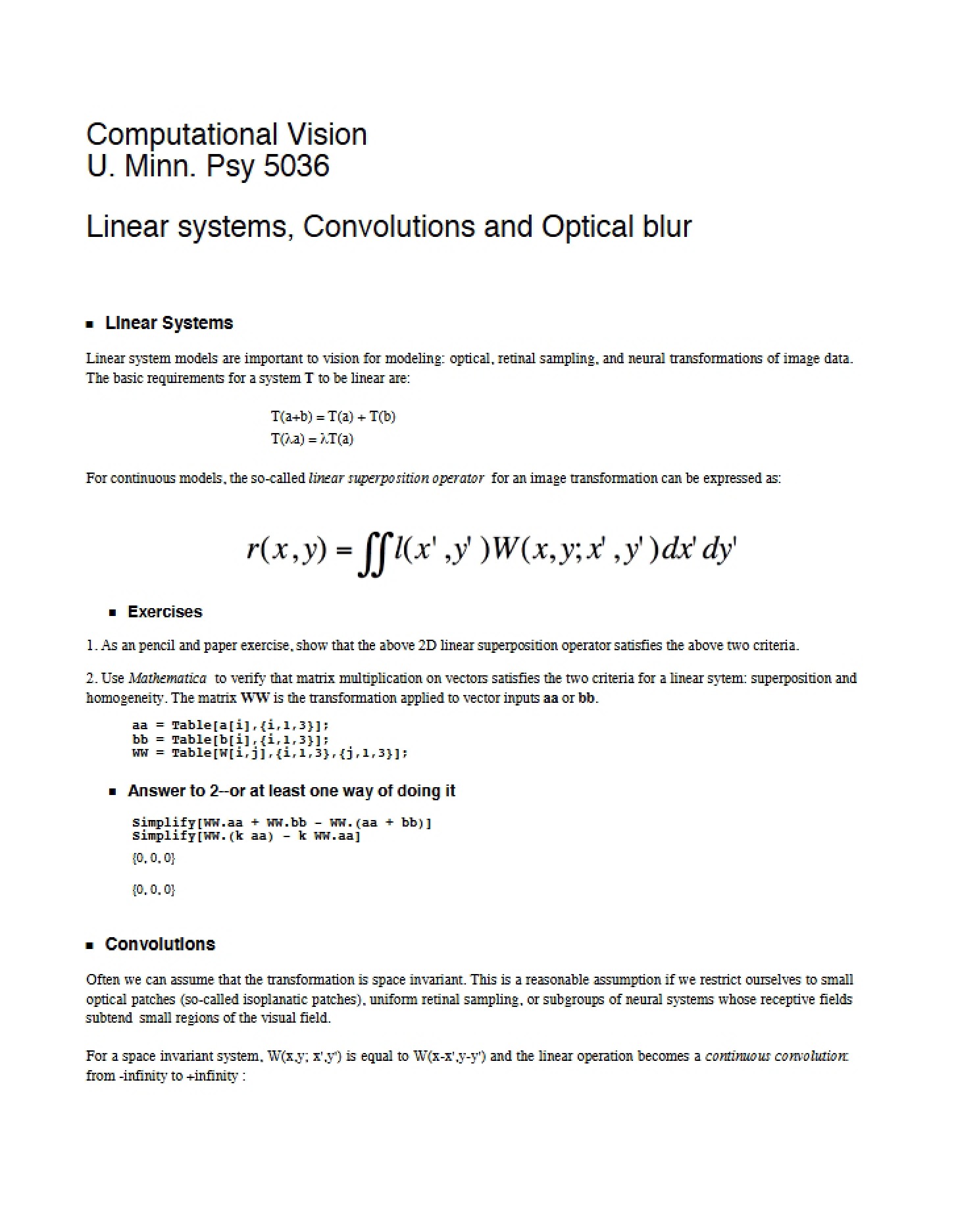
* An introduction to the concept of linear systems in the context of image intensity modeling.
* Exploration of factors limiting spatial resolution in imaging systems.
* An overview of the point spread function and its relationship to image blur.
* Consideration of how prior knowledge and utility influence optimal estimations from image data.