What This Document Is
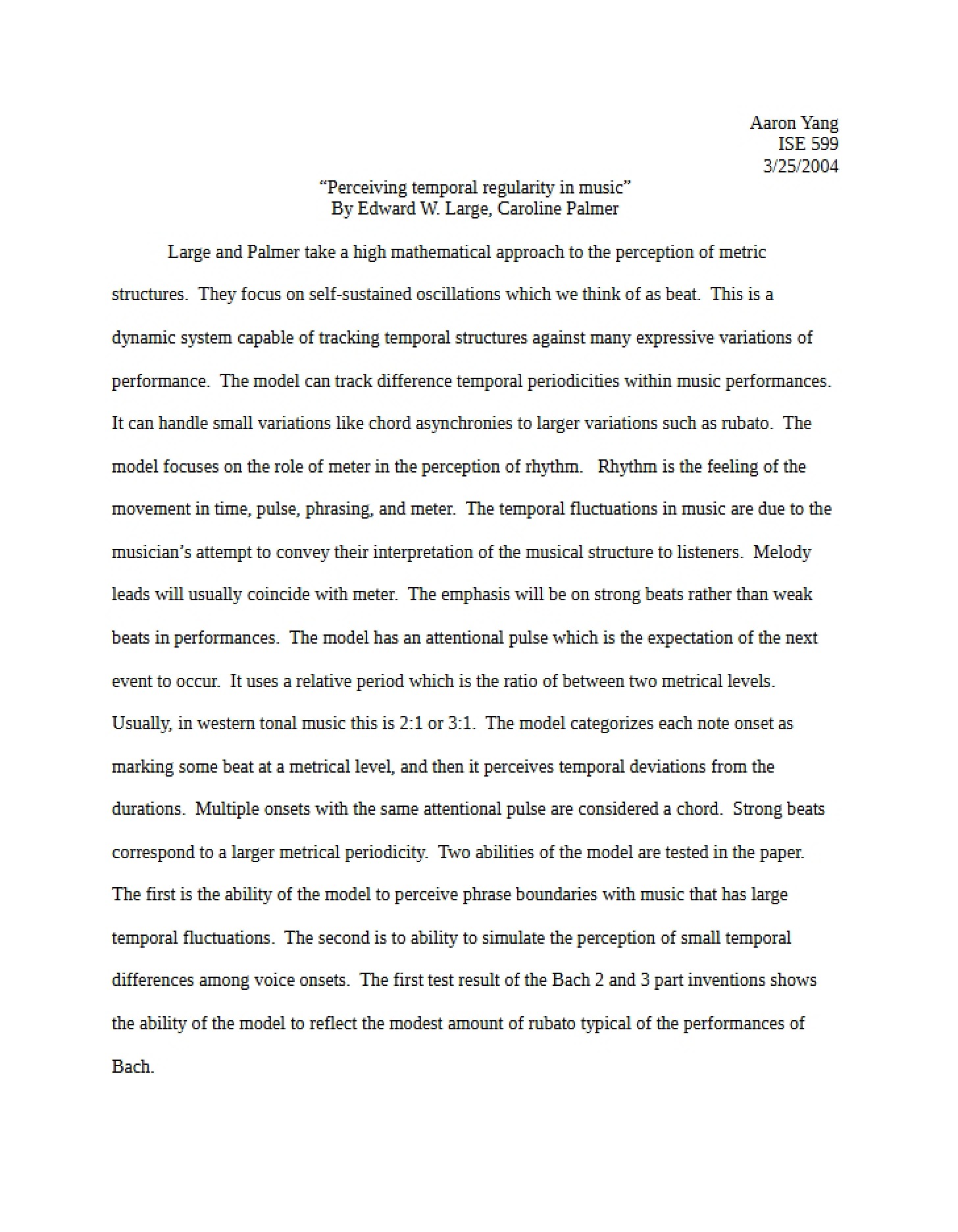
This document represents a detailed presentation of research exploring the cognitive mechanisms behind how humans perceive and process rhythm and timing in music. Specifically, it delves into the complexities of beat and meter perception, examining how we internally model temporal regularities and react to deviations from expected patterns. It appears to be a presentation delivered by a student (Liu, Jie) within a special topics course at the University of Southern California, based on the work of Edward W. Large and Caroline Palmer. The core of the work centers around computational modeling and experimental validation of these perceptual processes.
Why This Document Matters
This material would be highly valuable for students and researchers in fields such as cognitive psychology, music cognition, computational neuroscience, and music theory. It’s particularly relevant for those interested in understanding the underlying principles of rhythmic perception, the neural basis of timing, or the development of computational models of musical cognition. Individuals tackling research projects involving musical timing, or seeking a deeper understanding of how humans interact with and interpret music, will find this a useful resource. It could also be beneficial for musicians seeking to understand the perceptual effects of rhythmic variations in their performance.
Common Limitations or Challenges
This document presents a focused investigation into a specific theoretical framework and set of experiments. It does *not* offer a comprehensive overview of all theories of rhythm and meter perception. It also doesn’t provide a practical guide to musical performance or composition, nor does it cover the broader cultural or historical contexts of rhythm in music. The document focuses on the *modeling* of perception, and doesn’t necessarily detail the experimental setup or statistical analyses in exhaustive detail.
What This Document Provides
* An exploration of fundamental concepts related to rhythm, beat, and metrical structure.
* A description of a computational model utilizing coupled oscillators to simulate beat tracking and entrainment.
* Discussion of how the model accounts for the perception of temporal irregularities.
* An overview of experiments designed to evaluate the model’s performance in tracking different periodicities and detecting deviations.
* Consideration of hierarchical metrical structures and how they are represented within the model.
* Analysis of sensitivity to temporal fluctuations, including phrase-final lengthening.