What This Document Is
This document presents a focused exploration of advanced techniques within Computer-Aided Verification, specifically concerning explicit-state model checking. It delves into the critical concepts of liveness properties and various optimization strategies employed to enhance the efficiency of verification processes. The material originates from EECS 219C at the University of California, Berkeley, and builds upon foundational knowledge in the field. It centers on systems exhibiting asynchronous behavior, a common characteristic in real-world designs.
Why This Document Matters
This resource is invaluable for students and researchers engaged in formal verification, hardware and software design, and related areas of computer engineering. It’s particularly beneficial for those seeking a deeper understanding of how to rigorously prove the correctness of complex systems. Individuals preparing to implement or utilize model checking tools, such as SPIN, will find the insights presented here to be highly relevant. It’s best utilized after gaining a solid grounding in the fundamentals of temporal logic and automata theory.
Topics Covered
* The relationship between temporal logic properties and Buchi automata.
* Techniques for representing system behavior using Kripke structures.
* Methods for constructing product automata through synchronous composition.
* Strategies for identifying error conditions within model checking frameworks.
* Algorithms for detecting cycles and reachability in state spaces.
* Optimizations tailored for asynchronous system verification.
What This Document Provides
* A detailed examination of how to translate system specifications into a format suitable for automated verification.
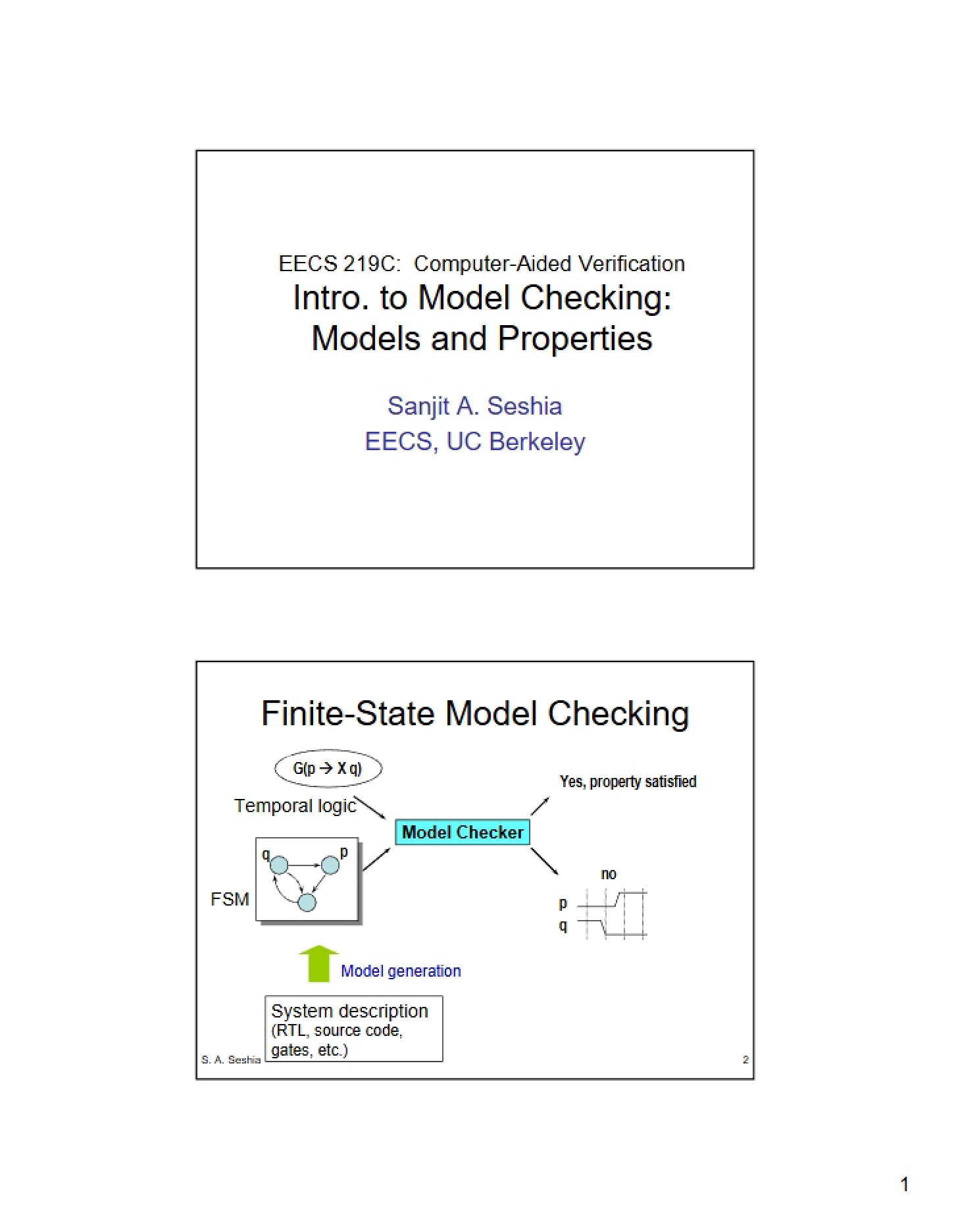
* An overview of the core steps involved in explicit-state model checking.
* Discussions on the practical considerations for applying these techniques to real-world problems.
* Conceptual foundations for understanding advanced algorithms used in industry-standard verification tools.
* A focused perspective on the challenges and solutions related to verifying liveness properties.