What This Document Is
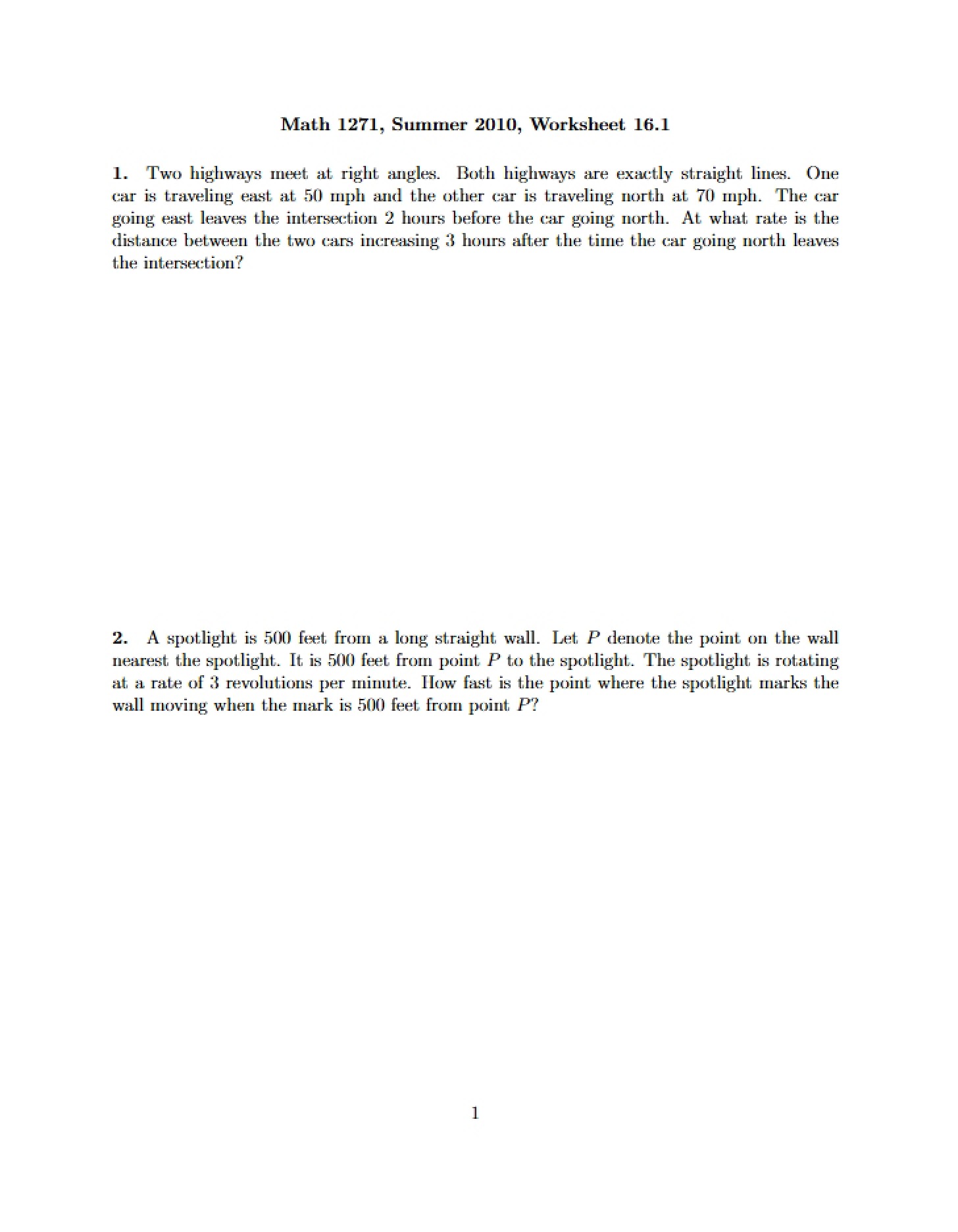
This resource is a collection of worksheets designed to reinforce core concepts from Calculus I (MATH 1271) at the University of Minnesota Twin Cities. Specifically, these worksheets focus on developing proficiency in differentiation and trigonometric identities – foundational skills for success in calculus. The material appears to be geared towards practice and application of rules learned in lecture, rather than introducing entirely new theoretical concepts. It covers a range of problem types, building from basic proofs to more complex function analysis.
Why This Document Matters
Students enrolled in MATH 1271, or a similar introductory calculus course, will find this particularly valuable. It’s ideal for solidifying understanding *after* attending lectures and working through textbook examples. These worksheets are best used for independent practice, homework review, or preparing for quizzes and exams. Working through these types of problems will help build confidence and fluency in applying calculus techniques. Students who struggle with applying theoretical knowledge to specific problems will especially benefit.
Common Limitations or Challenges
This set of worksheets does not provide detailed explanations of the underlying calculus principles. It assumes a base level of understanding from course materials. It also doesn’t offer step-by-step solutions; it’s designed for *you* to work through the problems and test your knowledge. Furthermore, it represents a specific set of practice problems from a Summer 2010 course and may not be fully representative of all topics covered in every iteration of MATH 1271.
What This Document Provides
* Practice problems centered around trigonometric identity manipulation and proofs.
* Exercises focused on applying the chain rule and other differentiation techniques to various function types (including logarithmic and inverse trigonometric functions).
* Problems requiring simplification of complex functions *before* differentiation.
* Opportunities to practice finding first and second derivatives.
* Problems involving function notation and evaluating derivatives at specific points.
* Exercises relating to graphical interpretation of functions and their derivatives.